Why Is No One Buying My Offer? 5 Reasons and How to Fix Them
Short answer: when no one is buying your offer, it's usually one of five things. Your offer doesn't answer the three questions every buyer is silently asking (why is it different, why you, why now). It solves a problem your ideal client isn't focused on right now. The end result is too vague. Your messaging misses the real reasons people buy. Or you simply don't have enough leads seeing it. Most of the time it isn't your price.
If you've built an offer you know is good, put it out there, posted about it, emailed about it, and heard nothing back but crickets, this one's for you.
I've been there. When I launched my business in January 2020, the strategy and offer I used worked brilliantly. If I tried to rinse and repeat that exact same thing now, it wouldn't work in the same way. Not because the offer was bad, but because the market has changed and buyers have changed with it.
So let's work out what's actually going on with yours.
This is part of my ultimate guide to creating an offer that sells, so if you want the whole process from idea to sales page, start there.
Why offers aren't selling like they used to
You've probably heard it everywhere: what used to work isn't working the same way anymore. Here's why.
- People are bored of information. Your ideal client has already bought the courses, the programmes, the mentors. They've been there, done it, and they're probably still not getting the results they want. They're fed up with more content to consume.
- There is more competition than ever. More competition means more choice. Your ideal client has a hundred solutions they could pick, so "good" isn't enough to stand out.
- They want implementation, not another 100 hours of training. How many courses have you started with the best intentions and never finished? Exactly. Buyers want a result faster without having more to get through.
Courses and programmes still sell when they're structured and marketed right. They just don't sell the way they did in 2020. Which brings us to the five reasons your offer isn't converting.
1. Your offer doesn't answer the three questions
Every buyer is asking three questions before they spend a penny with you. If your offer and your messaging don't answer them clearly, they scroll on. I call this Different, You, Now.
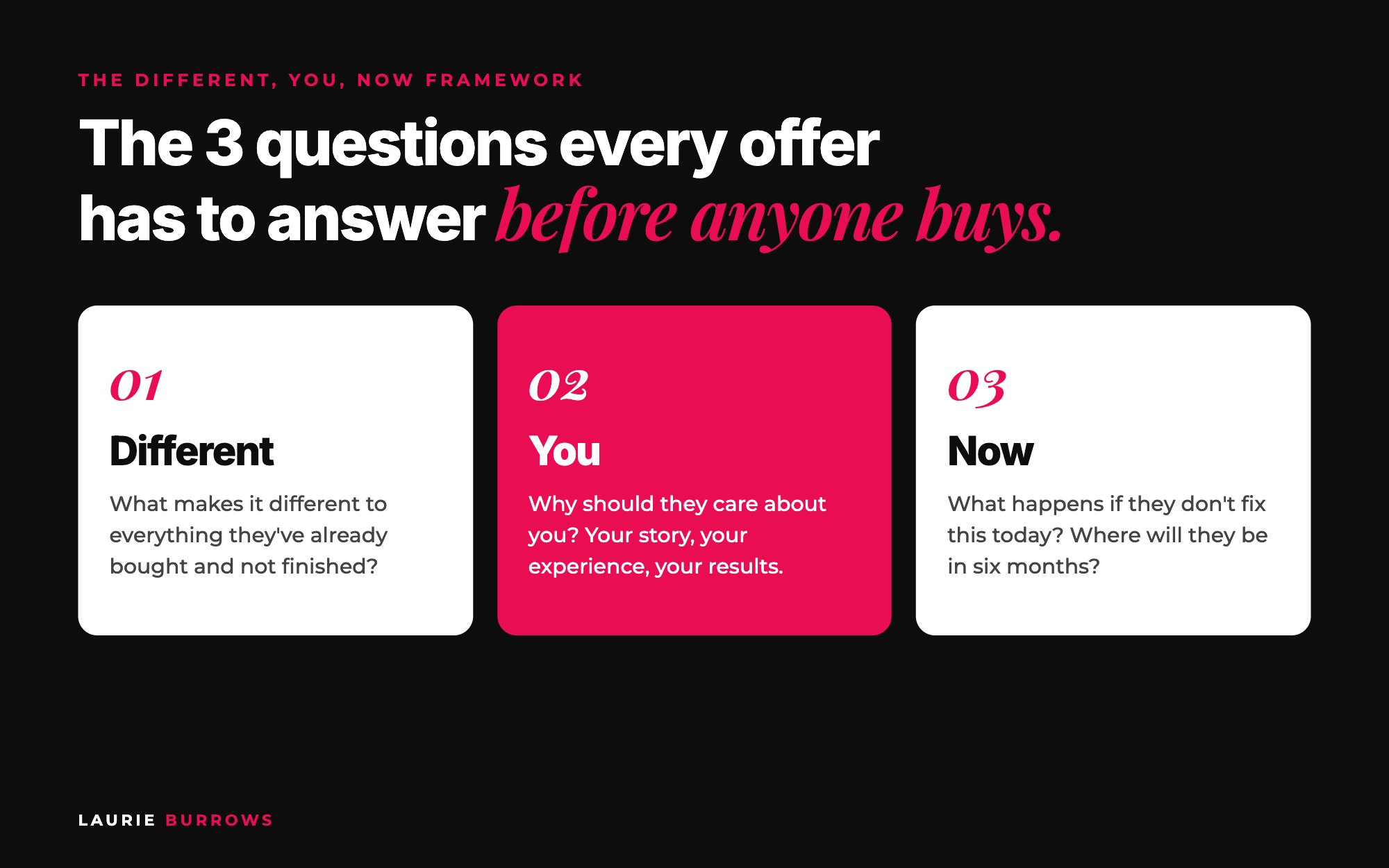
- What makes your offer different? Different to your competitors, and different to everything they've already bought and not finished. If it looks like another course, it gets treated like another course.
- Why you? In all honesty, why should your ideal client give a shit about you? Your experience, your story, your results. You yourself can be the reason someone chooses your offer over someone else's.
- Why now? What happens if they don't solve this problem right now? Where will they be in six months' time? No urgency means "I'll come back to it", and they never do.
When we answered these three questions properly in my own business, we launched a passive AI product at four figures and had over 100 sign-ups, at a time when so many businesses were struggling to sell anything. It worked because it was different to what buyers had tried before: instant answers and implementation in minutes instead of hours of calls and trainings.
Do this now: write down one sentence for each question. If you can't answer one of them in a sentence, that's where your offer is leaking sales.
Free 5 day event · 12th to 16th October
The 6 Figure Game Plan
If you want to see your whole route to 6 figures, not just fix this one offer, join my free 5 day event (12th to 16th October). You'll map your strategy to 6 figures and get the plan, content and pages created for you.
2. There's a mismatch between your ideal client and your offer
This is the one nobody talks about. Most people create offers in one of two ways:
- Option one: you create the offer you want to create, then go out and look for people to buy it.
- Option two: you find and research your ideal client first, then create the offer based on what they actually want.
Option two sells. Option one is guessing, and guessing and hoping isn't a strategy. I go deeper on this in ideal client and offer mismatch.
Even with option two, you can still hit a mismatch: you're solving a problem your ideal client isn't focused on right now. If it isn't their priority today, they won't invest today, however brilliant you are.
The easiest way to see this is Maslow's hierarchy of needs. People sort basic needs first, then safety (like financial security), then belonging, then esteem (confidence, recognition), then growth and purpose.
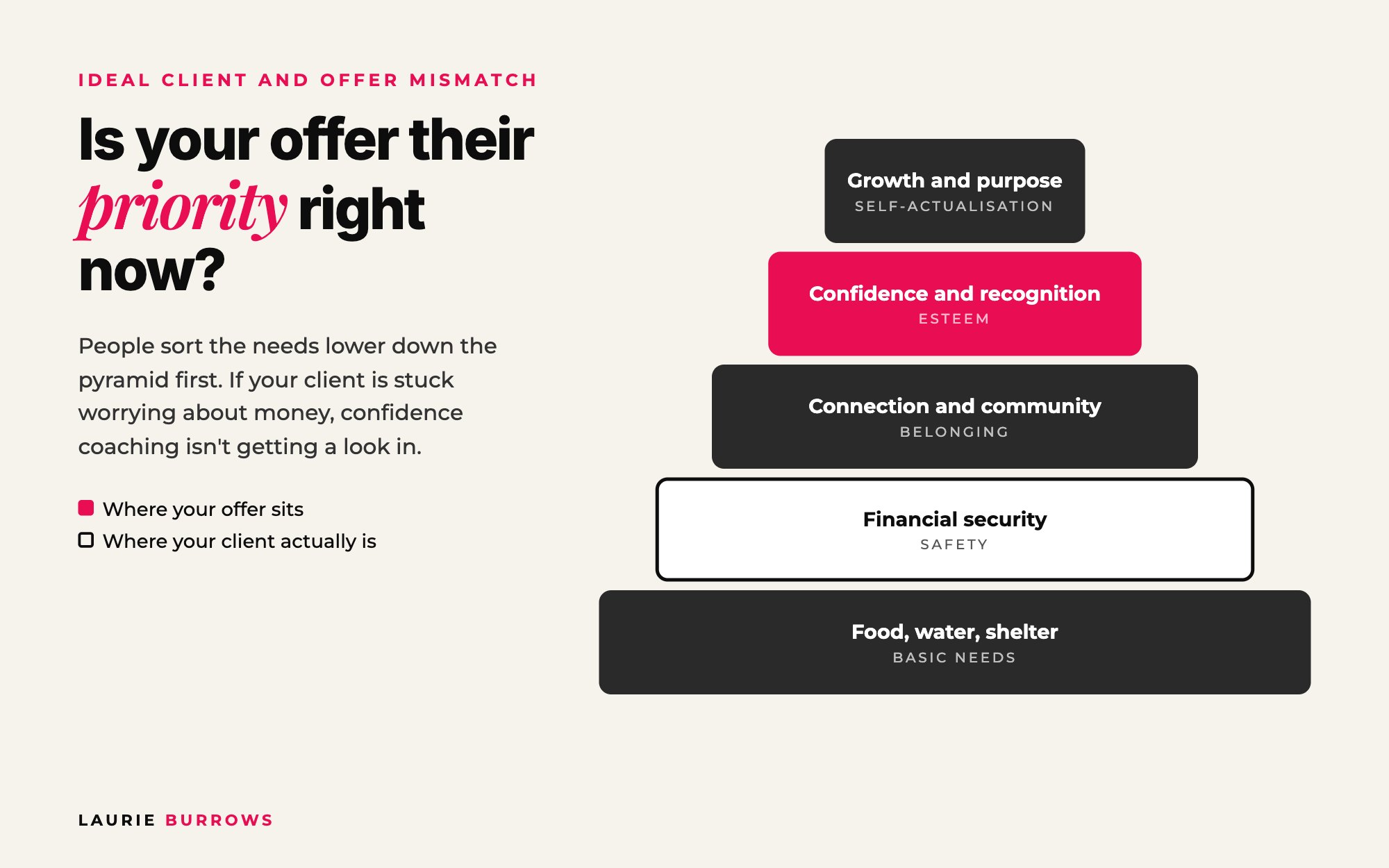
Say you're a confidence coach. Confidence is an esteem need. If your ideal client is lying awake worrying about money, financial security is the priority, and confidence coaching isn't getting a look in. Your offer isn't bad. It's just in the wrong place for where they are.
The fix is one of two things. Either shift the problem and end result you lead with so it meets your client where they are right now, or target a different ideal client who is ready for the transformation you already offer.
3. Your end result is too vague
The end result is the number one reason someone buys. Not your modules. Not your bonuses. The result.
Compare these two:
- "A holistic wellness programme"
- "Heal your gut and stop feeling bloated in 30 days, without restrictive dieting"
One is a nice idea. The other is something someone in pain will pay for today.
This is where my EVP Model comes in. Every offer that sells has three things nailed:
- End Result: a specific, tangible transformation that's worth more to your client than the price.
- Value Stacked: the perceived value clearly outweighs what they pay.
- Point of Difference: the reason it's yours and not the same as everyone else's.
I break the whole model down in the EVP Model explained. The three biggest offer killers I see are being vague, having no clear outcome, and low perceived value. If your sales page lists what's inside but never says exactly where they'll be at the end, that's your problem.
4. Your messaging misses why people actually buy
People don't buy offers. They buy what the offer does for them. When people part with their money, it's almost always for one of these five reasons:
- To escape pain
- To solve a problem
- To get a result faster
- To feel confident
- To become the person they want to be
Now look at your sales page, your posts and your emails. Are you talking about any of those? Or are you talking about calls, modules and how many hours of content they get?
Messaging that doesn't convert tends to be too vague, too surface-level, and not focused on the transformation. Go deeper. Say the thing they're thinking at 2am.
5. It's not your offer, it's your numbers
Sometimes the offer is fine. There just aren't enough people seeing it.
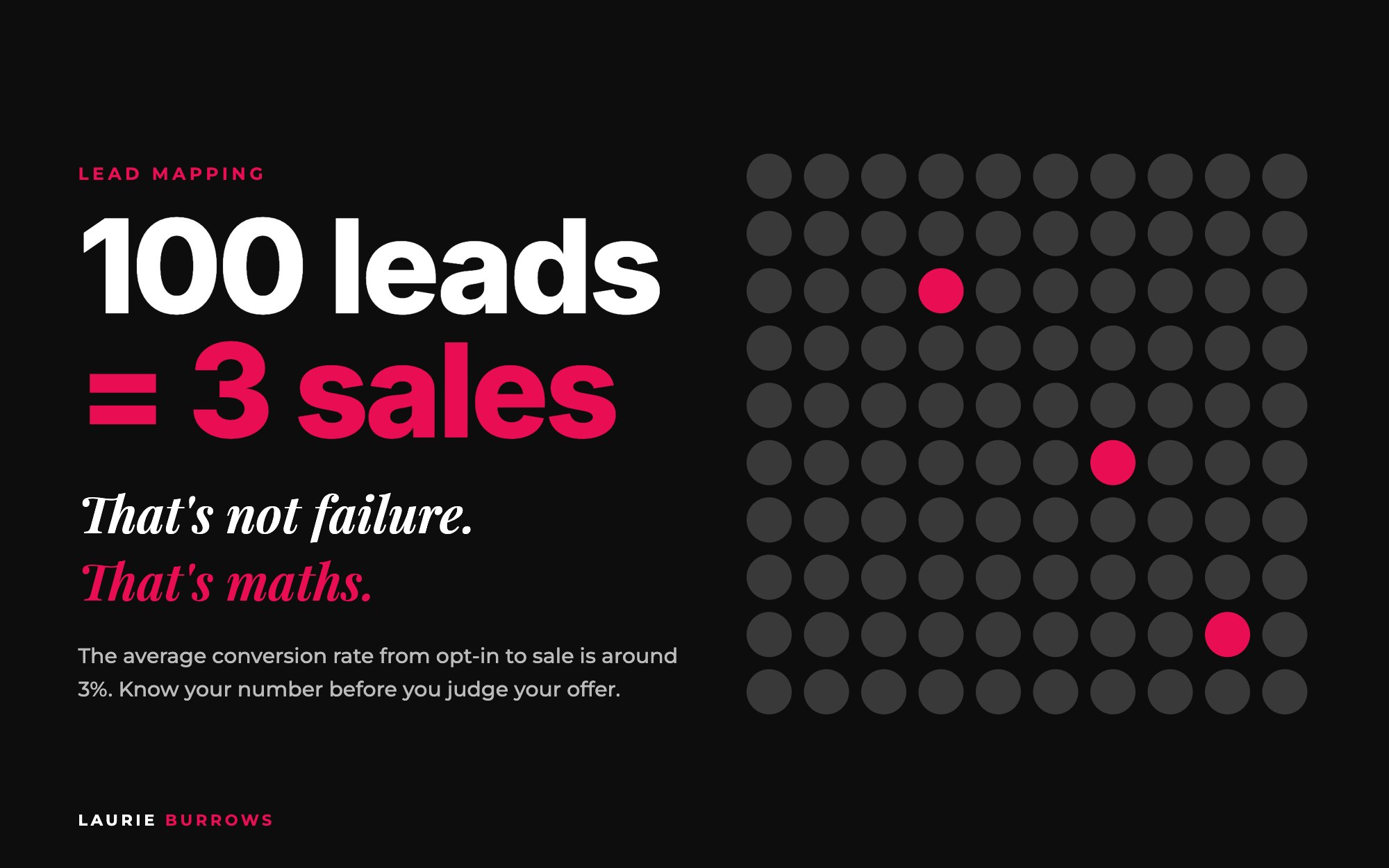
The average conversion rate from people opting in to people buying is around 3%. That means for every 100 leads, roughly 3 buy. If 20 people saw your offer this month and nobody bought, that's not proof it doesn't work. That's maths.
Work backwards with Lead Mapping. If you want 10 sales, you need around 333 leads. If you want $100,000 from a $997 programme, that's about 100 sales and roughly 3,300 leads. Once you know your number, you know whether you have an offer problem or a visibility problem. If you want the full maths, read how many leads do I actually need.
Quick diagnosis: which one is it?
- People engage but never ask about it: you're probably not answering why now, or there's a priority mismatch.
- People ask questions but don't buy: your end result or value stack isn't clear enough.
- Hardly anyone sees it: you don't have an offer problem, you have a leads problem.
- It used to sell and now it doesn't: the market has moved. Revisit what makes it different and how fast it gets people a result.
How to fix an offer that isn't selling, step by step
Knowing the five reasons is useful. Fixing yours is better. This is the exact process I take my own offers through when sales slow down. Do it in order, so you don't fix things that aren't broken.
Step 1: Check your numbers before you touch the offer
Pull three numbers from the last 30 days: how many new leads you got (opt-ins, enquiries, people who joined your free event), how many people actually saw the offer (sales page visits, people on the pitch, people you sent the link to) and how many bought.
Divide sales by leads. If you're anywhere near 3%, your offer is doing its job and you need more leads. If you had fewer than 100 leads, you don't have enough data to judge the offer yet. Only when plenty of the right people have seen it and almost nobody bought do you move on to step 2.
Time: 30 minutes. Done when: you've written down leads, views, sales and your conversion rate.
Step 2: Write your Different, You, Now in three sentences
Take a blank page and write one sentence for each question: what makes this different, why you, and why now.
If any sentence comes out woolly ("I'm really passionate about helping people"), that's a leak. Keep rewriting until each sentence has something specific in it: a number, a timeframe, a story or a result.
Time: 20 minutes. Done when: you have three sentences you could read out loud on a live without cringing.
Step 3: Test whether it's a priority right now
Look at the last ten conversations you had with ideal clients: DMs, comments, calls, emails. Write down the problems they mentioned in their own words. Then ask yourself honestly: is the problem my offer solves on that list?
If it isn't, you have a priority mismatch. Either reframe the end result so it solves the thing they're already talking about, or go and find the people who are ready for what you sell.
Time: 45 minutes. Done when: you can point to at least three real conversations where someone described the problem your offer solves.
Step 4: Rewrite your end result so it passes the 2am test
Use the offer statement formula below. A good end result says who it's for, the specific result, the timeframe and what they won't have to do to get it. Then check it against the five reasons people buy: escape pain, solve a problem, get a result faster, feel confident, become who they want to be. At least one of those should jump off the page.
Time: 30 minutes. Done when: someone who doesn't know you could read it and tell you exactly what they'd get.
Copy and paste: offer statement formula
I help [who, specifically] to [specific end result] in [timeframe], without [the thing they hate or have already tried].
Different: unlike [what they have tried before], this [how it works differently].
You: I [your proof, story or result] so I know exactly where you are stuck.
Now: every month you leave this, [what it is costing them in money, time or how they feel].
Step 5: Put it back in front of people and measure again
Update your sales page headline, your bio and your next three posts with the new end result. Then put it in front of the people most likely to buy: your email list, the people who've engaged in the last 30 days and anyone who has asked about working with you. Give it 14 days and run the step 1 numbers again.
If rewriting the sales page, the bio and the posts feels like a week of work, this is the bit to hand off. The Copywriter inside Ascendia OS writes your sales page, emails and posts in your voice from your new end result, so the fix goes out everywhere at once instead of dribbling out over a month.
Time: 2 hours to update, then 14 days to test. Done when: you have a before and after conversion rate to compare.
Example: a business coach with a $997 programme
This is an illustrative example, not a client. Imagine a business coach selling a $997 group programme. In the last 30 days she had 40 new leads and one sale. Her first thought is to drop the price to $497.
Step 1 tells her something else. One sale from 40 leads is a 2.5% conversion rate, which is right around average. Her offer isn't broken. She just doesn't have enough people seeing it. Using Lead Mapping, ten sales a month at 3% needs around 333 leads, so her real job is getting from 40 leads to 300 plus, not halving her price.
She still runs steps 2 to 4, because her sales page said "a group programme to help you grow your business". It now says "Sign your first 5 clients in 90 days, without spending hours a day on social media". Same offer, same price. One version is a nice idea and the other is something a coach with no clients will pay for this week.
Benchmarks to aim for
| What you measure | Benchmark | What it tells you |
|---|---|---|
| Leads to sales | Around 3% on average. My own launches convert at 10 to 12%. | Below 1% with plenty of leads: look at the offer and messaging. |
| Leads needed per 10 sales | Around 333 at 3% | If you are far below this, fix visibility first. |
| Live attendees vs everyone registered | Around 25% of live attendees buy vs 2.5% overall | Get people live and the offer has a much better chance. |
Common mistakes (and the fix)
- Dropping the price first. Fix: run the numbers in step 1. Price is rarely the reason, and a cheaper vague offer is still vague.
- Creating a brand new offer every time one goes quiet. Fix: fix the packaging, the end result and the priority match before you build anything new.
- Judging an offer on 20 people. Fix: get it in front of at least 100 leads before you decide it does not work.
- Listing modules instead of results. Fix: lead with where they will be and by when, then show what is inside.
If you want help spotting where else money is slipping out of your business, grab my free Revenue Leak Audit. It walks you through the 12 places businesses quietly lose sales, and the offer is only one of them.
Your action plan
Today
- Pull your leads, views and sales for the last 30 days and work out your conversion rate.
- Write your Different, You, Now in three sentences.
This week
- Review your last ten ideal client conversations and list the problems they mentioned.
- Rewrite your end result using the offer statement formula.
- Update your sales page headline, your bio and your next three posts.
Next 30 days
- Put the offer in front of your list and your warm audience every week.
- Work out your lead target with Lead Mapping and plan where those leads will come from.
- Measure again after 14 and 30 days and compare your conversion rate.
- Read the ultimate guide to creating an offer that sells if the offer itself needs rebuilding.
Want help getting your offer selling?
The 90 Day Revenue Growth Accelerator is my group programme where I help you fix your offer, your messaging and your numbers, then build the plan to hit your revenue goal.
Rather have it done for you?
Let Ascendia OS work out your numbers and rewrite your offer for you
The Strategist learns your business, maps what to sell and how many sales you need, and the Copywriter turns your new end result into a sales page, emails and posts that sound like you. 14 days free, no tech skills needed.
Frequently asked questions
How do I know if it's my offer or my marketing?
Look at your numbers. If plenty of the right people are seeing it and still not buying, it's the offer or the messaging. If very few people are seeing it, it's visibility. On average around 3% of leads buy, so you need enough leads before you judge the offer.
Why did my offer stop selling when it used to sell well?
Buyers have changed. There's more competition, people are tired of information, and they want implementation and faster results. An offer that worked in 2020 or 2021 often needs a clearer point of difference and a faster route to the result to sell now.
Do I need to create a brand new offer?
Not always. Start by answering Different, You, Now, tightening your end result and checking it's a priority for your ideal client right now. Many offers start selling again with better packaging and messaging, not a rebuild.
How many leads do I need to sell my offer?
Divide your sales target by your conversion rate. At an average of 3%, you need roughly 33 leads for every sale. So 10 sales means around 333 leads.
How long should I test an offer before changing it?
Give it at least 14 days and at least 100 leads before you make a big call. Anything less and you're reacting to noise, not data.
What makes an offer a no brainer?
A specific end result that's worth more to the client than the price, a clear value stack, a real point of difference, and a reason to buy now. That's the EVP Model plus Different, You, Now.
Laurie Burrows is a UK-based marketing and sales strategist who has built a business that's generated multi-seven figures in sales through social media and digital marketing. Today, Laurie helps business owners use social media, content and digital marketing to get seen, attract more clients and make more sales. She's also the founder of Ascendia OS.
Do you want to scale your business to 10K months in the next 90 days? I am looking for 10 people for my new case study program. DM me the word CASE STUDY on Instagram (@_laurieburrows) to learn more.