How Many Leads Do I Actually Need?
Short answer: divide your revenue goal by your offer price to get the number of sales you need, then divide that by your conversion rate. At the industry average of 3%, you need around 33 leads for every sale, so 333 leads for 10 sales. If you want $10,000 a month from a $2,000 offer, that's 5 sales and about 167 leads a month. Then map exactly where each of those leads will come from, and break it down into a weekly number you can act on.
When founders tell me their launch flopped or their month was quiet, the first thing I ask is how many leads they generated. Most of the time they don't know. And when we work it out, the answer is almost always the same: not enough.
Everyone sets a sales goal. $10k, $50k, $100k. They work out how many spots they need to sell at what price. But then they stop. They never work out how many people actually need to opt in to make those sales happen, or where those people are coming from. So they post a bit of content, send an email, and hope for the best. Guessing and hoping isn't a strategy. Here's how to work out your number in 20 minutes, step by step.
This is part of my ultimate guide to lead generation for coaches. Start with this number, then the guide shows you where to find every one of those leads.
What counts as a lead?
A lead is anyone who shows interest in something you have to offer. In practice, that means anyone who opts in: signs up to your challenge, downloads your free guide, registers for your masterclass or joins your free 5 day experience. Comments on an audit post and poll votes count too.
Important: leads are the people who opt in, not the people who show up. When you calculate your numbers, you work from sign-ups.
The formula
- Revenue goal divided by price = sales needed.
- Sales needed divided by conversion rate = leads needed.
The average conversion rate for a launch is around 3% (most businesses see somewhere between 1 and 3%). That means for every 100 leads, about three buy:
| Goal | Offer price | Sales needed | Leads at 3% | Leads at 6% | Leads at 10% |
|---|---|---|---|---|---|
| $10,000 | $2,000 | 5 | 167 | 84 | 50 |
| $10,000 | $1,000 | 10 | 333 | 167 | 100 |
| $30,000 | $1,500 | 20 | 667 | 334 | 200 |
| $100,000 | $997 | about 100 | about 3,340 | about 1,670 | about 1,000 |
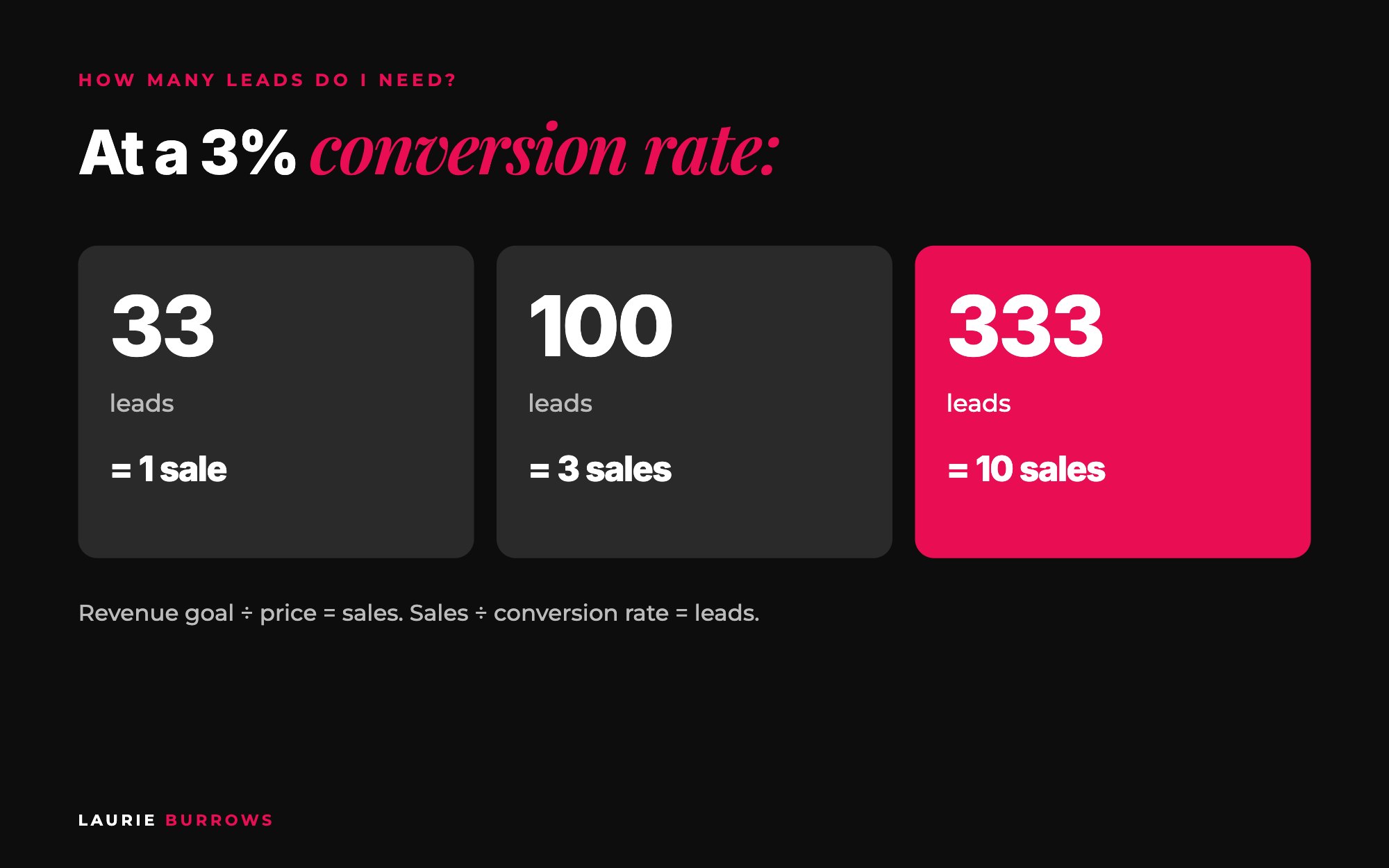
Seeing 3,300 might make your stomach drop. Don't let the number scare you. Once you know it, you can do two things about it: map where those leads will come from, and work on your conversion rate so you need fewer of them.
Free 5 day event · 12th to 16th October
The 6 Figure Game Plan
Want help turning your goal into a leads number and a plan to hit it? Join my free 5 day event. You'll map your strategy to 6 figures and get the plan, content and pages created for you.
How to work out your leads number, step by step
Step 1: Work out how many sales you need
Take your monthly goal. Subtract any recurring revenue already coming in. Divide what's left by the price of the offer you're selling. Round up.
Time: 5 minutes. Done when: you have one number: sales needed this month.
Step 2: Find your conversion rate
Look at your last launch or the last 90 days: how many people opted in, and how many bought? Divide buyers by leads. If you don't have the data, use 3%. My own launches convert at 10 to 12%, but I still put a slightly lower number into my calculator than I expect. I like the wiggle room.
Time: 10 minutes. Done when: you have a conversion rate written as a percentage.
Step 3: Divide sales by conversion rate
That's your leads target for the month. Divide by four for a weekly target. In one of my quarterly plans, around 101 sales at a 5% conversion rate meant roughly 2,000 leads for the quarter: about 674 a month, or 156 a week. That weekly number is what I plan my visibility around.
Time: 2 minutes. Done when: you have a monthly and a weekly leads target.
If you'd rather not do this maths every month, the Strategist inside Ascendia OS does it for you. It sets the goal, maps what to sell and when, and tells you how many sales you need, so your leads target is always up to date.
Step 4: Find your lead gap
Now compare it to reality. How many people opted in to anything of yours last month? The difference is your lead gap, and it shows you exactly what not generating enough leads costs.
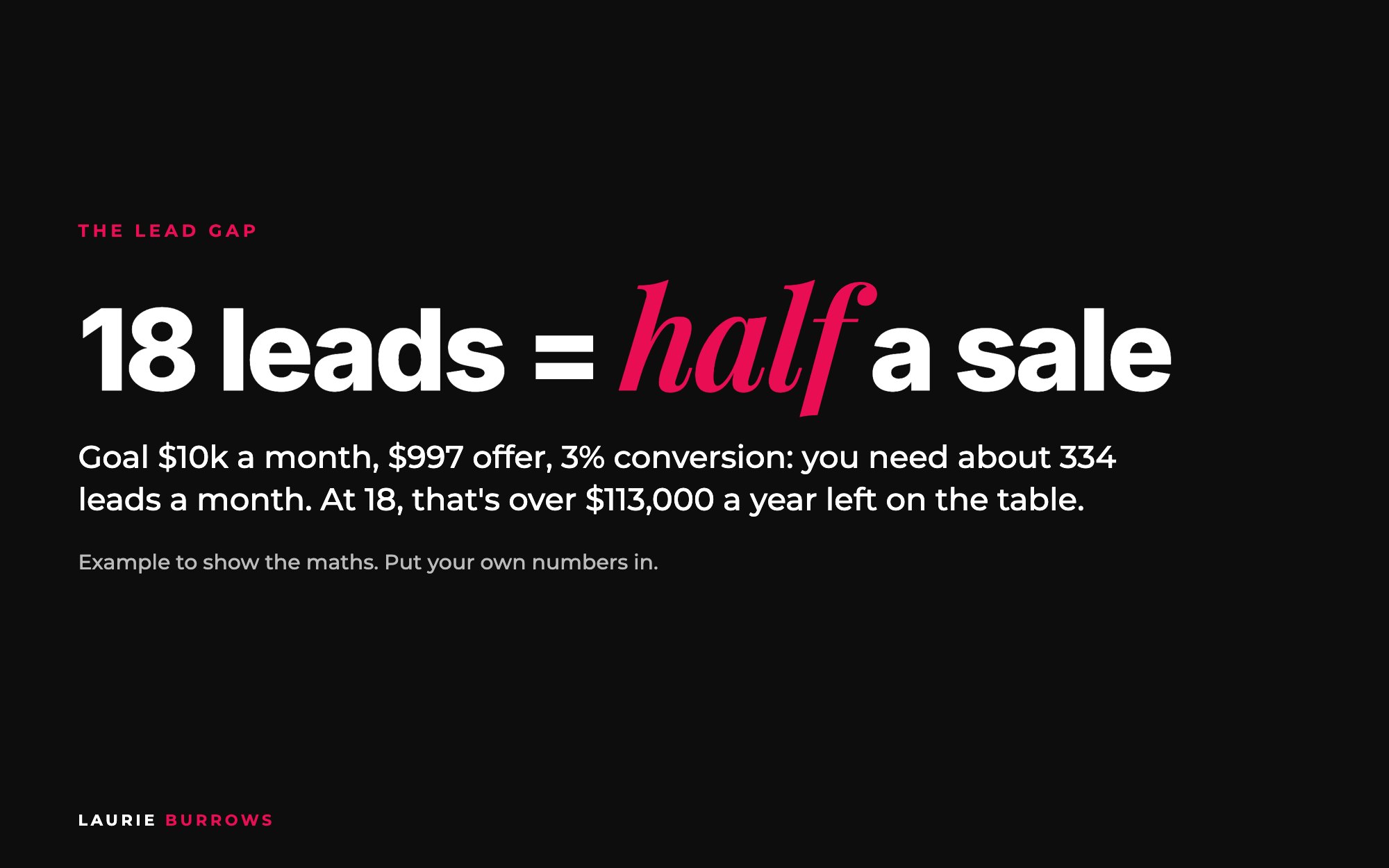
Say your goal is $10,000 a month, your offer is $997, and you convert 3% of leads. You need about 334 leads a month. If you're only generating 18, you're making about half a sale a month instead of 10. Over a year, that gap is worth over $113,000. Not because your offer is wrong or because you're not good enough, but because not enough people are coming into your world.
Time: 5 minutes. Done when: you know your lead gap as a number of leads and as dollars a month.
Step 5: Build your Lead Map
Knowing your number is step one. Lead Mapping is step two: write down every place your leads will come from, with a realistic number next to each one, until it adds up to your target. Here's a lead map for a launch where I needed 3,000 sign-ups:
- My email list: 1,000
- My social media (Facebook and Instagram posts, ladder posts and lead generation stories): 500
- Guest speaking: 10 spots in other people's memberships, groups and podcasts, 50 sign-ups each = 500
- Exchanges: someone promotes my free event to their audience, I promote something of theirs to mine = 500
- Ads: 500
- Affiliates: 10 people promoting the free event, bringing 50 each = 500
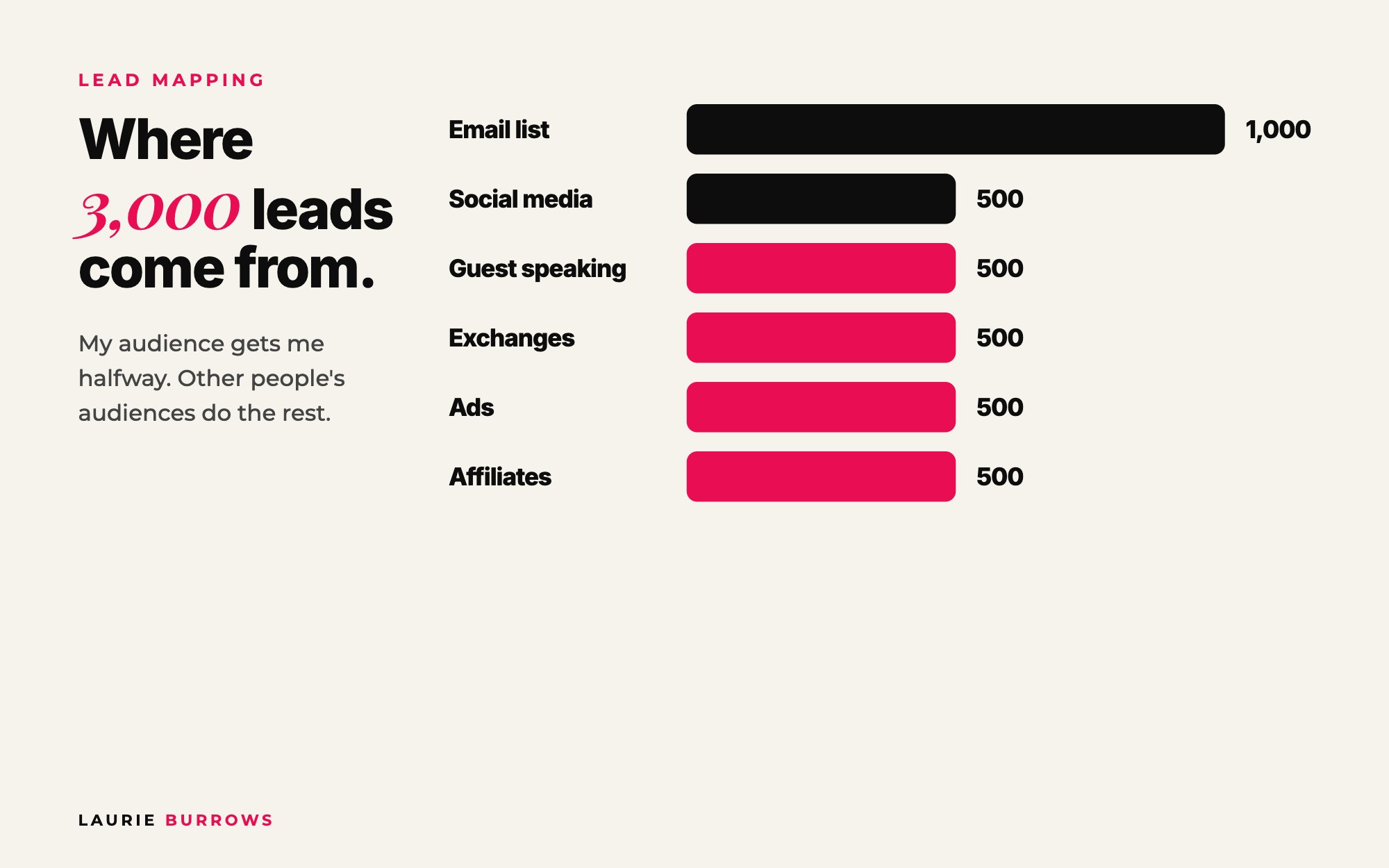
My own audience only got me to 1,500. Most people's lead map stops after email and social media, which is why so many launches fall short. Your own audience is rarely enough when you want to sell in bulk, so you need other people's audiences too. I break down how to fill a launch in how to have a 6 figure launch.
Time: 30 minutes. Done when: your map adds up to your leads target, with a number and a named action next to every source.
Step 6: Track leads weekly, not sales
During a launch, my head isn't on the $100k. It's on the leads. Every Monday, check last week's sign-ups against your weekly target. Hit the leads target and the sales target becomes far more realistic. Miss it, and you know on day seven, not day thirty.
Time: 10 minutes a week. Done when: you have a running total of leads by source.
Copy and paste: the leads calculator and Lead Map
Copy and paste: leads calculator
Monthly goal: $[ ]. Recurring already coming in: $[ ]. New sales needed: $[ ]
Offer price: $[ ]. Sales needed: [new sales needed divided by price] = [ ]
Conversion rate: [ ]% (use 3% if unsure). Leads needed: [sales divided by conversion rate] = [ ]
Weekly leads target: [leads needed divided by 4] = [ ]
Leads last month: [ ]. Lead gap: [ ]
LEAD MAP: email [ ] + social [ ] + guest spots [x spots x 50 = ] + exchanges [ ] + ads [ ] + affiliates [ ] = [ ]
Why does conversion rate change how many leads you need?
Because the better you convert, the fewer people you need. Double your conversion rate from 3% to 6% and you halve the leads you need. Conversion rates aren't fixed. They depend on:
- Your price. More people can afford less. A $50 offer usually converts better than a $10,000 one, but you need to sell far more of them.
- Your strategy. A 3 to 5 day challenge full of new, cold leads might convert around 3%. A masterclass to a warm audience who already know you could convert at 25%.
- What happens after someone opts in. Personal follow up, DMs and conversations push conversion rates up. Sending everyone to a sales page and hoping does not.
If you're converting fewer than 5 out of every 100 leads, look at your sales process as well as your lead generation. I explain why live attendees buy so much more in why live attendees buy 10 times more.
What if you don't hit your leads number?
Do not panic. If you get 1,500 sign-ups instead of 3,000, that's not a failed launch. You have two options:
- Raise your conversion rate. At 6% instead of 3%, 1,500 leads does the same job as 3,000. Add personal DMs to everyone who engages and a follow up email sequence.
- Run another event. Host another masterclass a week or two later. You don't have to hit the whole goal from one event.
And you don't have to rely on events at all. A free guide with a strong follow up, free audits, lead generation stories and an evergreen funnel can all generate leads every week. That's how you go from feast and famine to steady.
If building the opt-in page is the bit that stops you, the Funnel Builder inside Ascendia OS builds your opt-in page, thank you page and checkout for you, and the Email Marketer writes the follow up.
Benchmarks
- 3%: average launch conversion. 10 to 12%: my own launches.
- 333 leads for 10 sales at 3%.
- About 50 sign-ups per guest speaking spot is a realistic planning figure.
- 25% vs 2.5%: live attendees convert far better than the overall list, so show up rates matter.
Common mistakes
- Mistake: Counting attendees instead of sign-ups. Fix: calculate from opt-ins. Show up rate is a separate number to improve.
- Mistake: A lead map that stops at email and social. Fix: add guest spots, exchanges, affiliates and ads until it adds up.
- Mistake: Planning with your best ever conversion rate. Fix: use a slightly lower number than you expect.
- Mistake: Checking numbers at the end of the month. Fix: check leads every Monday so you can fix it this week.
- Mistake: Generating leads with no sales process behind them. Fix: every opt-in gets a follow up: an email sequence, a DM, a low priced offer on the thank you page.
Your action plan
Today
- Fill in the leads calculator above.
- Count how many people opted in to anything of yours last month.
- Write your lead gap at the top of your plan.
This week
- Build your Lead Map until it adds up to your target.
- Pitch yourself for two guest spots or one exchange.
- Set up a simple weekly leads tracker by source.
Next 30 days
- Review leads against target every Monday.
- Add one new source to your map if you're behind.
- Work on conversion: add a personal DM to every engaged lead.
Want the full system for turning leads into sales?
Content To Clients® is my complete system for turning content and leads into repeat sales: the free resources, the follow up, the offers and every template I use. If you'd rather start free, grab the Revenue Leak Audit.
Prefer to start free? The Revenue Leak Audit shows you 12 places your business is quietly losing money, and an under-filled lead pipeline is usually the first. For a steady flow of leads every week, read the ultimate guide to lead generation for coaches.
Rather have it done for you?
Let Ascendia OS work out your numbers and fill your pipeline
The Strategist works out how many sales and leads you need. The Funnel Builder builds your opt-in pages, and the Content Creator writes and schedules the posts that send people to them. 14 days free, no tech skills needed.
Frequently asked questions
How many leads do I need to make one sale?
At the industry average 3% conversion rate, around 33 leads per sale. If you convert at 10%, it's 10 leads per sale. Use your own data once you have it.
What is a good conversion rate for coaches?
For a launch to a mix of new and warm leads, 1 to 3% is average. Personal follow up, live events and a warm audience can push it much higher. My own launches convert at 10 to 12%.
Do people who sign up but don't attend count as leads?
Yes. They opted in, so they're leads. Always calculate from sign-ups, then work on show up rates separately.
How do I generate more leads quickly?
Get in front of other people's audiences: guest speaking, exchanges, collaborations and affiliates. Free audits and lead generation stories also bring in leads within days.
Should I focus on more leads or a better conversion rate?
Both, but start with whichever is further off. If very few people are opting in, it's a leads problem. If plenty opt in and nobody buys, work on conversion first.
Laurie Burrows is a UK-based marketing and sales strategist who has built a business that's generated multi-seven figures in sales through social media and digital marketing. Today, Laurie helps business owners use social media, content and digital marketing to get seen, attract more clients and make more sales. She's also the founder of Ascendia OS.
Do you want to scale your business to 10K months in the next 90 days? I am looking for 10 people for my new case study program. DM me the word CASE STUDY on Instagram (@_laurieburrows) to learn more.