The EVP Model Explained
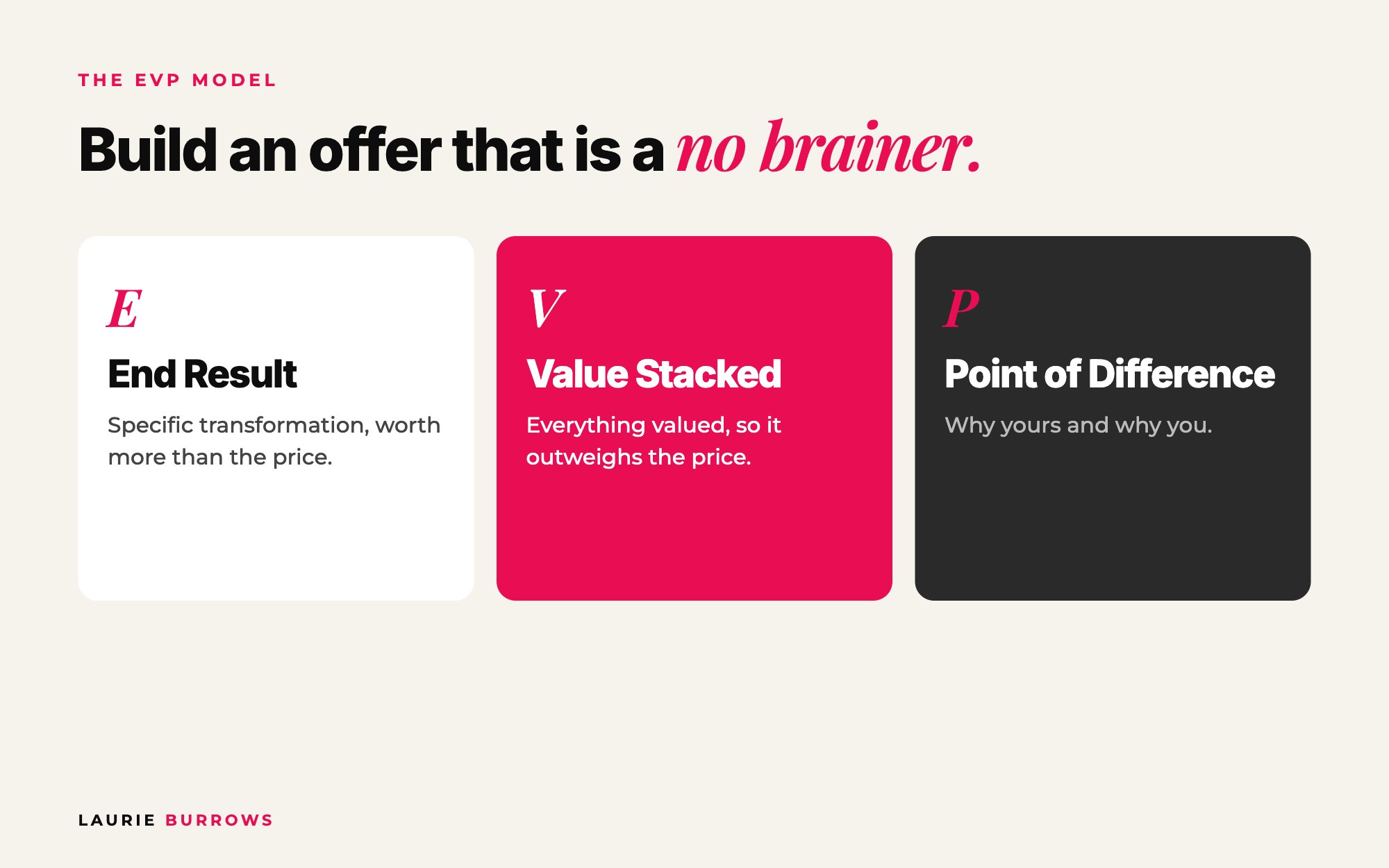
Short answer: the EVP Model is my framework for building an irresistible offer. E is the End Result: the specific transformation your client gets, which has to be worth more to them than the price. V is Value Stacked: everything included, valued so it clearly outweighs what they pay. P is Point of Difference: why your offer, and you, rather than everything else they could buy. Nail all three and your offer becomes a no brainer.
I created the EVP Model because I kept seeing the same thing. Brilliant coaches with brilliant offers, and no sales. When I pulled their offers apart, one of three things was always missing. Either the result wasn't clear, the value wasn't obvious, or nothing made it stand out.
Here's how to use the model on your own offer, step by step, with the questions I ask my clients.
This is part of my ultimate guide to creating an offer that sells, where the EVP Model sits at the heart of the whole build.
Before you start: why did you say yes?
Before you touch the model, list three things you've invested in (a course, a programme, a mentor). For each one, write down what made it a hell yes. You'll almost always find an end result you wanted, a feeling that you were getting more than you paid for, and something about that person or offer that made it different. That's the EVP Model in your own buying behaviour. Keep that list next to you as you work.
E: End Result
The end result is the number one reason anyone buys. It's their return on investment, and that return doesn't have to be money. It's the transformation. The rule: it has to be worth more to them than your price.
Questions to answer
- Where is my ideal client now, and where do they want to be when they finish?
- How long will it take to get there?
- What do they want to avoid doing or giving up along the way?
- Is this a priority for them right now, or a "one day"?
- Is it tangible? If not, what's the why behind the why?
Example
Not: "An eight module video programme on gut health." Instead: "Heal your gut and stop feeling bloated in 30 days, without restrictive dieting." Result, timeframe, and the thing they don't want to do.
Then check the priority. If your ideal client is focused on something more urgent, they won't invest however good your end result is. You either change the end result to meet them where they are, or find an ideal client for whom it's the priority.
V: Value Stacked
After the end result, a buyer looks at the value versus the price. When the value outweighs the price, it becomes a no brainer. This is about packaging, and the format matters far less than the perceived value and the convenience.
Questions to answer
- What is every single thing included?
- What would each piece be worth if I sold it on its own?
- Does each piece get them a better or faster result?
- Can I deliver it without needing more of my time?
- What bonus would make it easier to say yes now?
Example
In our academy, one of the most valuable additions is an AI trained on the method. People ask it questions and get instant help with their action steps instead of waiting for the next call. It gets them faster results, and it doesn't matter whether 100 or 1,000 people use it, it doesn't take more of my time. That's the kind of thing you want in your stack. One to one calls for everyone is the opposite: it caps how many clients you can take.
For the full process of laying it out, see how to build a value stack.
P: Point of Difference
You're not the only person helping your clients get this result. So why should they choose you and this offer?
Questions to answer
- What's missing from the other solutions out there?
- Why haven't my clients got results before, and how does my offer overcome that?
- What friction do I remove?
- What do I make faster, easier and more effective?
- Why me? Why this? Why now?
Example
When we researched our audience, the reason people hadn't got results before was that they'd joined courses and never got through the training or implemented. So we built a three day implementation into the academy, where people leave with a full sales system actually in place. Our ideal clients are business owners who are time poor, so removing time as a barrier became part of our point of difference too.
Score your offer
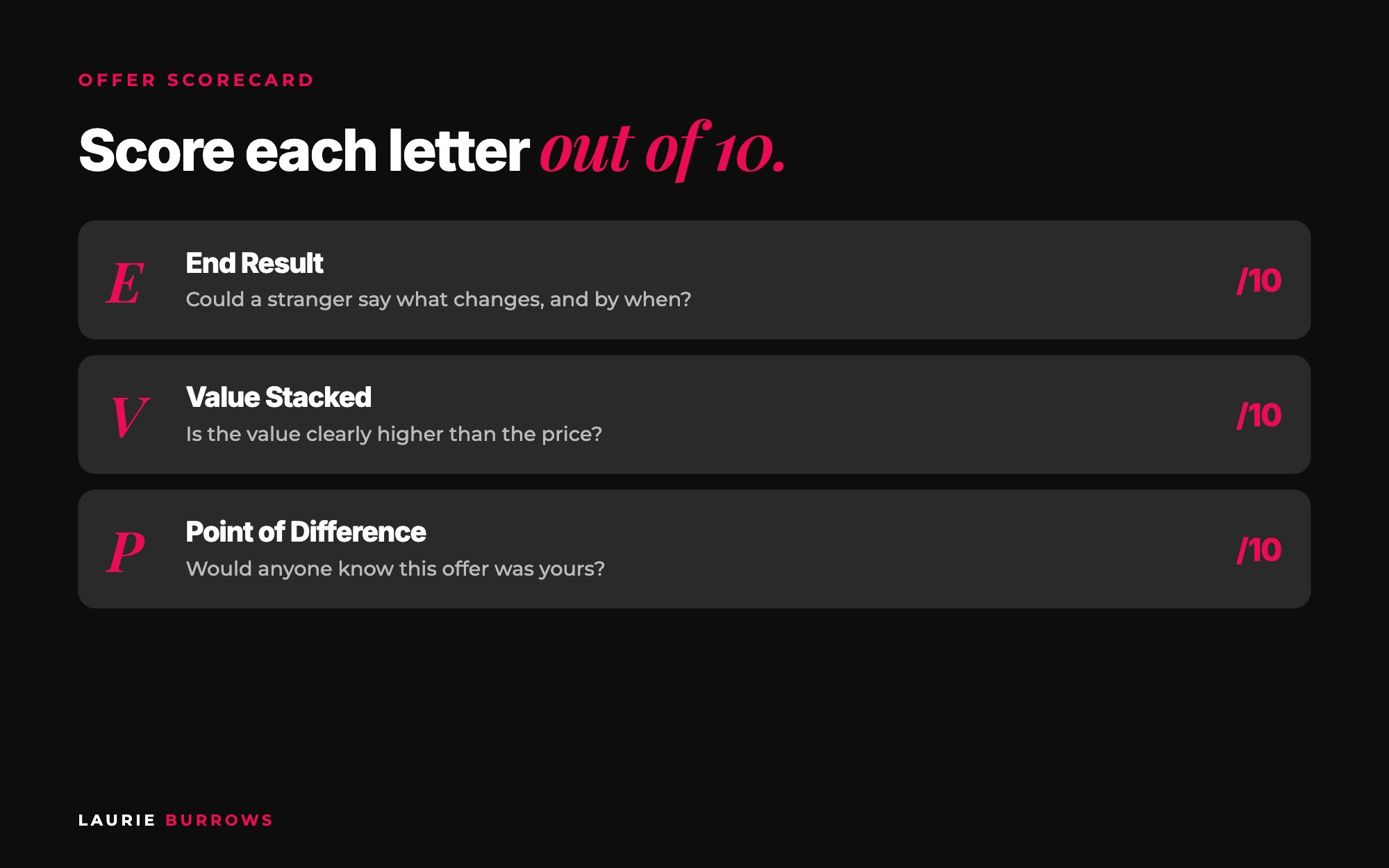
Once you've answered the questions, give each letter a score out of 10:
- E: could a stranger read your end result and know exactly what changes, by when?
- V: is the total value clearly higher than the price, and have you actually shown it?
- P: if you covered up your name, would anyone know this offer was yours?
Anything under seven is where your offer is leaking sales. Fix the lowest score first, and always fix E before V and P, because if the end result isn't clear, nothing else gets read.
Do this now: on one page, write your end result in one sentence, list your value stack with a value next to each item, and answer the four point of difference questions. Score each letter out of 10, then rewrite the lowest scoring section before you post about your offer again.
Where to use your EVP
- Your sales page: end result in the headline, value stack before the price, point of difference throughout.
- Your pitch: lead with the end result, show the stack, then the price.
- Your content: rotate posts about the result, the value and why you.
- Sales conversations: use it to handle objections, especially "I've tried things before".
If you want the bigger picture of how the EVP Model fits into building an offer from scratch, read the ultimate guide to creating an offer that sells. And for why these three things matter so much to buyers, see the 3 reasons people buy. More help is in my free resources.
How to build your EVP offer, step by step
Here's how to run your own offer through the EVP Model in one sitting. Grab the worksheet below, set a timer and work through it in order.
Step 1: Write your End Result sentence
Answer the E questions above, then squeeze them into one sentence: who, result, timeframe, without what. Check it's a priority for your ideal client this month, not "one day".
Time: 20 minutes. Done when: a stranger could read the sentence and tell you what changes for them, and by when.
Step 2: List and price your Value Stack
Write every piece of the offer in a list. Next to each one, write what it would sell for on its own. Add them up. Then mark anything that needs more of your time with a star, and see if you can swap at least one starred item for a template, a community or a group session.
Time: 30 minutes. Done when: you have a total value that is clearly higher than your price.
Step 3: Write your Point of Difference
Answer: why haven't my clients got this result before, and what does my offer do that fixes that? Then write one line each for why you, why this and why now.
Time: 20 minutes. Done when: your answer would not make sense on a competitor's sales page.
Step 4: Score it and fix the lowest letter
Give E, V and P a score out of 10 using the scorecard above. Anything under 7 gets reworked before you sell. Always fix E first, because nobody looks at the value stack if they don't want the result.
Time: 10 minutes, plus rewrites. Done when: every letter scores 7 or more.
Step 5: Put your EVP everywhere
End result in your sales page headline and bio. Value stack shown before the price on your sales page and in your pitch. Point of difference woven through your content every week.
Time: 1 to 2 hours. Done when: your sales page, pitch and bio all say the same EVP.
If updating every page is the part you keep putting off, the Copywriter inside Ascendia OS writes sales pages, launch emails and DMs that sound like you. Give it your EVP worksheet and it drafts each one around your end result, value stack and point of difference.
Copy and paste: EVP offer worksheet
E (End Result): I help [who] to [specific result] in [timeframe], without [what they want to avoid]. Priority check: would they pay for this THIS month? [yes / no]
V (Value Stacked): [item 1] worth $[x] | [item 2] worth $[x] | [item 3] worth $[x] | [bonus] worth $[x] | Total value: $[total] | Price: $[price]
P (Point of Difference): They haven't got this result before because [reason]. My offer fixes that by [how]. Why me: [proof]. Why now: [cost of waiting].
Scores out of 10: E [ ] V [ ] P [ ]. Fix first: [lowest letter].
Example: a business coach's $2,000 group programme
This is an illustrative example.
- E: "Sign your first 5 clients in 90 days, without posting every day." Score 8.
- V: 12 week curriculum ($2,500), weekly group coaching ($3,600), DM and post templates ($297), private community ($500), 3 day implementation sprint ($1,000). Total $7,897 for $2,000. Score 8.
- P: "Most coaches haven't signed clients because they post and hope. This programme gives you a daily 20 minute client plan and builds it with you live." First draft score 5, because "why me" was missing. Adding her own story of signing her first clients from scratch took it to 8.
Benchmarks to aim for
| Check | Aim for |
|---|---|
| Score for each letter | 7 out of 10 or higher |
| Total value vs price | Clearly higher, ideally several times the price |
| End result sentence | Under 30 words with a timeframe |
| Leads to sales once your EVP is clear | Around 3% on average. My own launches convert at 10 to 12%. |
Common mistakes (and the fix)
- Starting with the value stack. Fix: nobody cares about the stack until they want the result. E first.
- Stacking value with more one to one time. Fix: add things that get faster results without more of your hours.
- A point of difference that is just "I care more". Fix: name what is missing from what they have tried and how you fix it.
- Doing the worksheet and never updating the sales page. Fix: put your EVP into your headline, pitch and bio the same week.
Your action plan
Today
- Copy the EVP worksheet and fill in E.
- List and price every part of your value stack.
This week
- Write your point of difference and why you, why this, why now.
- Score each letter and rework anything under 7.
- Update your sales page headline and bio.
Next 30 days
- Pitch using the EVP order: result, stack, price.
- Rotate your content between result, value and difference posts.
- Rescore your offer after 30 days of feedback.
- Take your EVP through the rest of the build in the ultimate guide to creating an offer that sells.
Free 5 day event · 12th to 16th October
The 6 Figure Game Plan
Once your EVP scores 7 or more on every letter, it's time for the plan to sell it. In my free 5 day event you'll map your strategy to 6 figures and get the plan, content and pages created for you.
Want help building an offer that scores 10 out of 10?
In the 90 Day Revenue Growth Accelerator I help you shape your end result, stack the value and sharpen your point of difference, then build the plan to sell it.
Rather have it done for you?
Put your EVP everywhere, without writing it all yourself
The Copywriter turns your EVP into a sales page, launch emails and DMs in your voice, and the Content Creator rotates result, value and difference posts across your month and schedules them. 14 days free, no tech skills needed.
Frequently asked questions
What does EVP stand for?
End Result, Value Stacked and Point of Difference. Together they cover the three biggest reasons people decide to invest in an offer.
Which part of the EVP Model matters most?
The end result. It's the main reason anyone buys and their return on investment. If it isn't clear and worth more than the price, the value stack and point of difference won't save the offer.
Can I use the EVP Model for a service, not a course?
Yes. It works for courses, programmes, memberships, masterminds and done for you services. Any offer needs a clear result, value that outweighs the price and a reason to choose you.
How is the EVP Model different from a value proposition?
A value proposition is usually one statement. The EVP Model breaks the decision into three parts so you can see exactly which one is weak and fix it, rather than rewording a tagline.
How often should I review my offer with the EVP Model?
Before every launch, and whenever sales dip. Buyers and markets change, so an end result or point of difference that worked a year ago may need sharpening.
Laurie Burrows is a UK-based marketing and sales strategist who has built a business that's generated multi-seven figures in sales through social media and digital marketing. Today, Laurie helps business owners use social media, content and digital marketing to get seen, attract more clients and make more sales. She's also the founder of Ascendia OS.
Do you want to scale your business to 10K months in the next 90 days? I am looking for 10 people for my new case study program. DM me the word CASE STUDY on Instagram (@_laurieburrows) to learn more.