Ideal Client and Offer Mismatch: Why the Right Offer Still Won't Sell
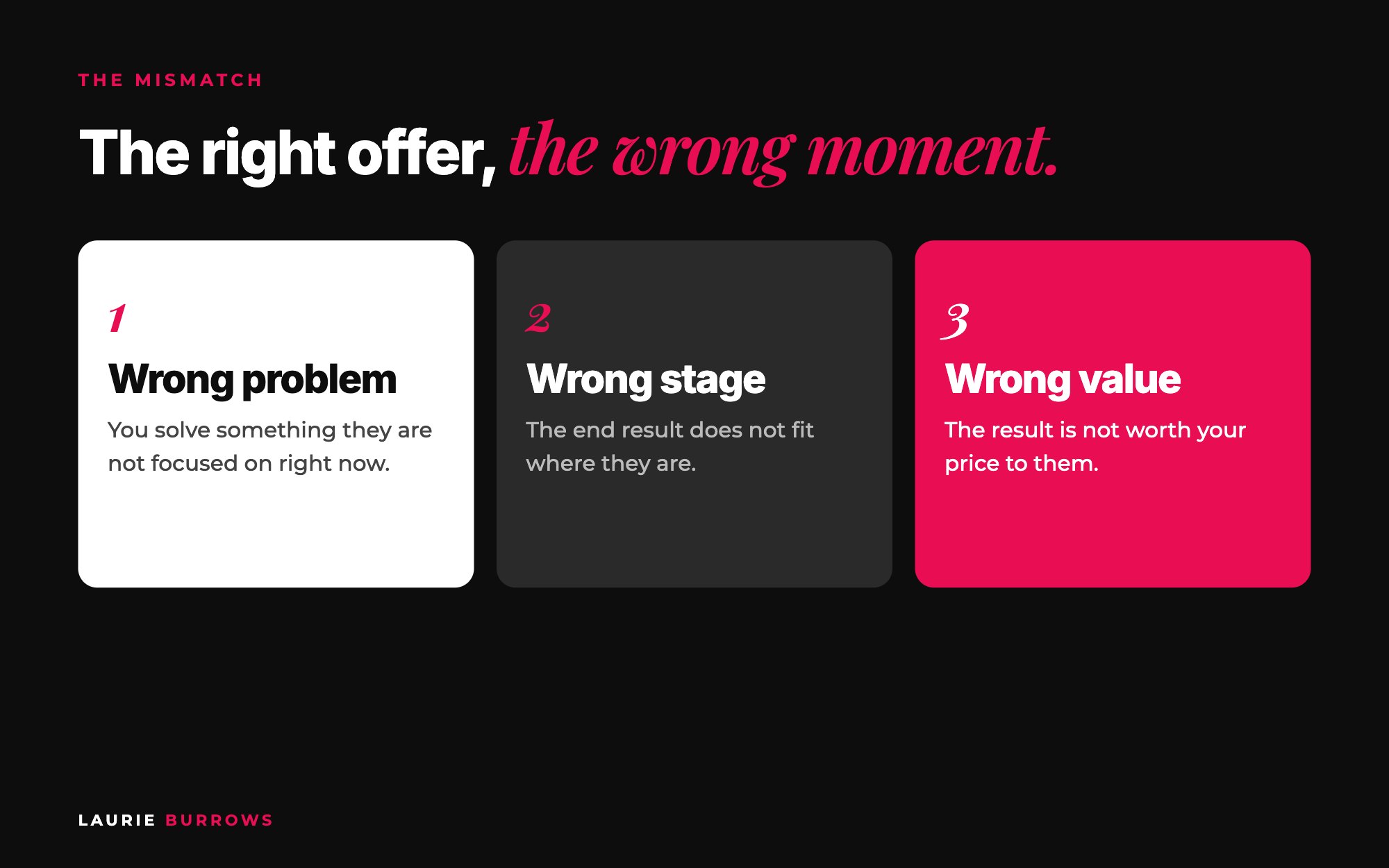
Short answer: an offer can be brilliant and still not sell if there's a mismatch between it and your ideal client. The three most common mismatches are: you're solving a problem they aren't focused on right now, the end result doesn't fit where they are in their journey, or the end result isn't worth your price to them. The fix is to either change the end result so it meets them where they are, change the ideal client to someone ready for what you offer, or change the model and price.
This is the one nobody talks about, and it's the one I see most often when I review offers. The coach is genuinely brilliant. The offer would change lives. The sales page is decent. And still, nothing.
When we dig into it, the offer isn't the problem and the marketing isn't the problem. The problem is the gap between what the offer delivers and what the ideal client is prioritising right now. You can't market your way out of that. You have to fix the match.
This is part of my ultimate guide to creating an offer that sells, where matching the offer to the right person is one of the first phases.
How do mismatches happen?
Mostly through assumptions. There are two ways people create offers. Option one: you create what you want to create, then go and find people to buy it, or you assume the audience you already have wants it. Option two: you research your ideal client first, then build the offer around what they want and will pay for.
Option one is where mismatches are born. Not because you're doing anything wrong, but because you're passionate about a particular problem and you want your ideal client to have that problem. Sometimes they do. Often they have a bigger one sitting in front of it.
Free 5 day event · 12th to 16th October
The 6 Figure Game Plan
Want to check your offer, your ideal client and your numbers line up before your next launch? In my free 5 day event you'll map your strategy to 6 figures and get the plan, content and pages created for you.
The 3 types of ideal client and offer mismatch
1. You're solving a problem they aren't focused on right now
Write down the problem you solve and the end result you help people achieve. Now ask honestly: is that what your ideal client is focused on this month? If they have bigger fires to put out, your offer sits on the "one day" list, and one day rarely comes.
Here's an example. Say you're a fitness coach who helps mums working nine to five lose weight and feel confident. Lovely offer. But if your ideal client's real focus right now is making extra money so she can leave her job and be at home more, a confidence and weight loss programme isn't her priority. She might love your content. She won't buy.
2. The end result doesn't fit where they are in their journey
Even when the topic is right, the end result can be pitched at the wrong stage. If you promise "scale to multiple six figures with a team" to someone who hasn't made their first $1,000 online, they can't see themselves in it. If you promise "your first client" to someone already making $20,000 a month, they've moved past it. Same topic, wrong rung of the ladder.
3. The end result isn't worth your price to them
The end result has to be worth more to your ideal client than the price you're charging. If you're trying to sell a high ticket coaching programme to someone who would never pay that much for that result, it won't sell, however well you pitch it. That doesn't mean your price is wrong. It means the price, the result and the person don't line up.
Using Maslow's hierarchy to spot a priority mismatch
I touched on this in why is no one buying my offer, but it's worth going further, because it's the clearest way to see whether you're pitching at the right level.
Maslow's hierarchy of needs has five levels, and people generally sort the lower levels before they spend on the higher ones:
- Basic needs: food, water, shelter.
- Safety needs: financial security and stability. Offers here: making money, paying the bills, job security, a reliable income.
- Belonging needs: connection, community, relationships. Offers here: dating and relationship coaching, community memberships, networking.
- Esteem needs: confidence, recognition, achievement. Offers here: confidence coaching, personal branding, speaking, leadership.
- Self actualisation: growth, purpose, creativity. Offers here: purpose work, creative projects, legacy.
Plot your offer on one level and your ideal client's current focus on another. If your offer sits above where they are right now, that's your mismatch. A confidence offer (esteem) sold to someone worried about money (safety) will struggle every time.
How to tell if you have a mismatch
Ask yourself these four questions:
- Do people love my content and say "I need this one day" but not buy?
- When I ask my audience what they're struggling with, do they describe a different problem to the one I solve?
- Do sales conversations stall on "it's not the right time" rather than "it's too expensive"?
- Have I actually asked my ideal clients what they want, or have I assumed?
If you're nodding along to two or more, you're probably looking at a mismatch rather than an offer or marketing problem.
How to fix an ideal client and offer mismatch
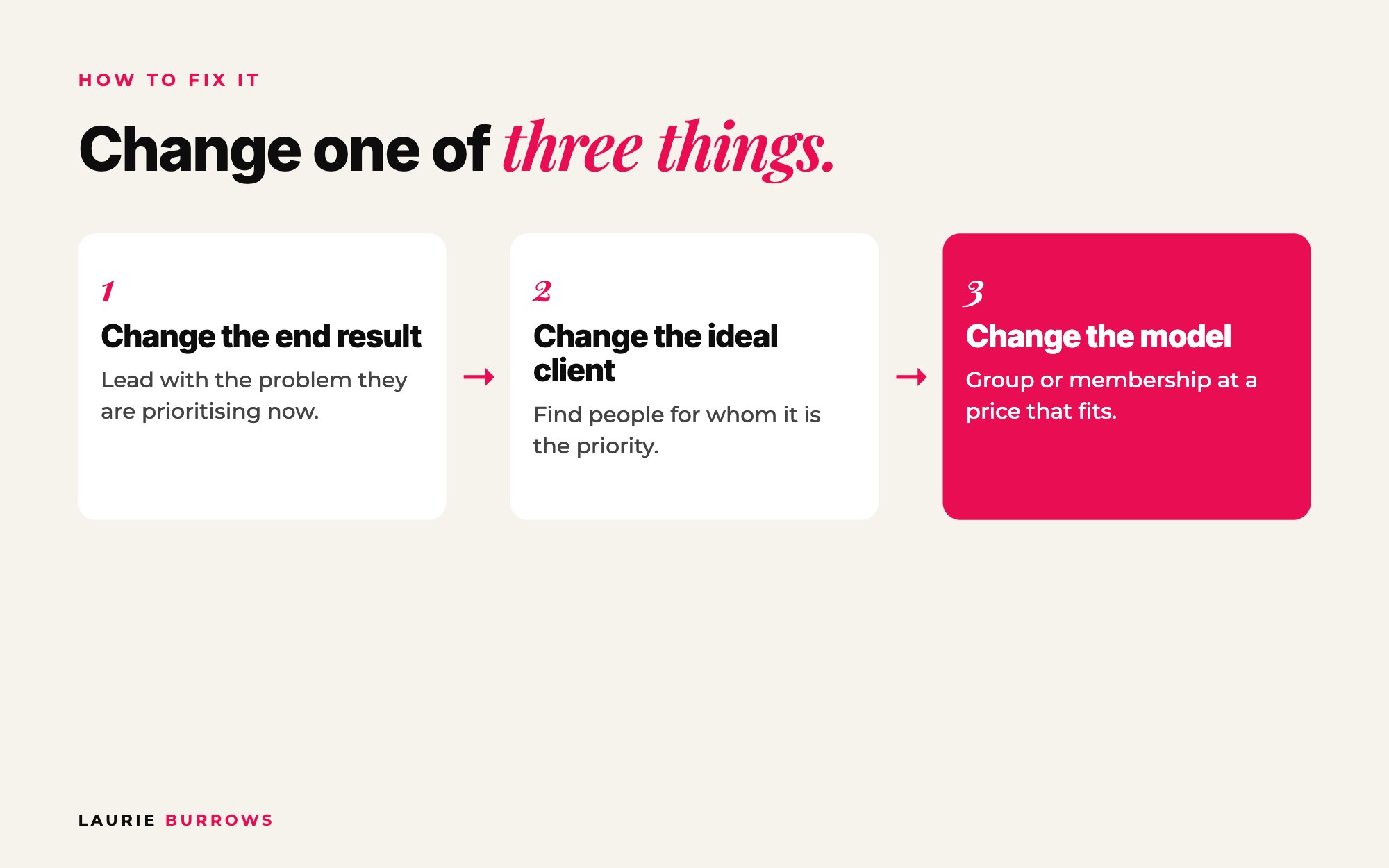
You have three options. Pick the one that fits what you want your business to look like.
Option 1: Change the end result to meet them where they are
If you love working with this ideal client, change what you lead with so it solves the problem they're prioritising right now. Often you don't need a new offer, just a new angle. The confidence coach whose ideal clients are focused on money can lead with "the confidence to raise your prices and win clients". The fitness coach can lead with the energy and focus that helps busy mums get more done. Same expertise, end result moved down to where the client is.
Use the why behind the why. Why do they want confidence? To speak on stage. Why? To build a reputation. Why? To get clients. Keep asking until you reach the level your ideal client is actually focused on.
Option 2: Change the ideal client
If you want to keep the offer exactly as it is, go and find the people for whom it is the priority right now. The confidence offer might be a perfect fit for established business owners who already have the money sorted and now want recognition and visibility. Same offer, different person.
Option 3: Change the model or price
If the end result simply isn't worth your current price to the people you want to help, you can change the model. Instead of a high ticket one to one programme, a group programme or membership might put the result at a price that makes sense to them. You'll need to sell more of them, which means your focus shifts to audience growth, but it can work brilliantly. I explain how to make that decision in how to price a coaching programme.
Do this now: message five people who match your ideal client and ask one question: "What's the one thing you most want to fix in the next 90 days?" Compare their answers to the end result your offer promises. If they don't match, you've found your mismatch.
Use AI as a soundboard
If you're not sure who your ideal client should be, AI is a brilliant thinking partner. Try a prompt like: "This is the end result I help with. Help me find the ideal client who is most ready and willing to invest in this right now, and explain why it's a priority for them." Then go back and forth with it. When I started my business, AI didn't exist. Now you can test ten versions of your ideal client in an afternoon.
Just remember AI gives you hypotheses, not answers. You still need to check them with real people. That's what market research before you build is for.
A mismatch isn't a failure
If you've just realised your offer and ideal client are mismatched, don't panic. It's one of the most common things I see, and it's one of the quickest to fix because you don't need to start again. You keep your expertise and your content, and you either move the end result, move the ideal client or move the model.
And remember, what you choose now doesn't have to be forever. Your business can look however you want it to look, and it can change as you do.
Want the full process for building an offer around the right person? Start with the ultimate guide to creating an offer that sells and my free resources.
How to find and fix your mismatch, step by step
Here's the process I'd follow if I suspected a mismatch in my own business. It takes about a week, most of it is listening, and at the end you'll know exactly which of the three fixes to use.
Step 1: Write down your current offer in one line
Who it's for, the end result and the price. For example: "Confidence coaching for new business owners, so they feel confident showing up online, $2,000." Don't polish it. You need to see what you're actually selling, not what you wish it said.
Time: 10 minutes. Done when: you have one line with a who, a result and a price.
Step 2: Collect your ideal client's priorities in their words
Go through your last 20 comments, DMs, emails, enquiries and sales calls. Copy and paste every problem someone mentions, word for word, into one document. If you don't have 20, ask your audience with the poll and question box below. Count how often each problem comes up.
Time: 1 to 3 days (mostly waiting for answers). Done when: you have a list of at least 20 real answers and the top three problems are obvious.
Copy and paste: priority poll and question box
Story poll: "What is the one thing you most want to fix in your business in the next 90 days?" Options: [your offer's problem] / [the problem you suspect they care about more] / [a third likely problem] / Something else.
Question box: "What is the biggest thing stopping you from [end result] right now? Be honest, I read every one."
Follow-up DM to anyone who answers: "Thank you for answering! Can I ask, if that was sorted in the next 90 days, what would it change for you?"
Step 3: Place your offer and their priority on Maslow's hierarchy
Put your offer's end result on the level it belongs to: security (money, stability), belonging (community, connection), esteem (confidence, recognition) or growth (purpose, impact). Then do the same for the top problem from step 2. If your offer sits above their priority, you've found a priority mismatch.
Time: 15 minutes. Done when: you can say "my offer is on level X and they are on level Y".
Step 4: Check the stage and the price
Ask two more questions. Does the end result match where they are in their journey (first client versus scaling a team)? And would the end result be worth more than your price to them, not to you? If either answer is no, note it. That's mismatch type 2 or 3.
Time: 15 minutes. Done when: you know which of the three mismatch types you have, or that you have none.
Step 5: Pick one fix and test it for 30 days
Choose option 1 (change the end result), option 2 (change the ideal client) or option 3 (change the model or price). Only one. Rewrite your offer line, your bio and your sales page headline, then post about the new angle at least three times a week for 30 days and track enquiries.
Time: 2 hours to rewrite, 30 days to test. Done when: you can compare enquiries and sales from the 30 days before with the 30 days after.
A test only works if it actually runs for the full 30 days. If rewriting your bio, headline and sales page is what usually stalls you, the Copywriter inside Ascendia OS redrafts them around the new end result in your voice, and the Content Creator writes and schedules your posts on the new angle, so you can spend the month watching the numbers instead of writing.
Example: a confidence coach selling a $2,000 programme
This is an illustrative example. A confidence coach sells "Show Up Confident", a $2,000 programme for new business owners. People love her content. Nobody buys.
Her step 2 list of 24 answers says: "I need clients" (11), "I don't know what to post" (7), "I'm scared of being visible" (4), other (2). Most of her audience is on the security level: they need money coming in. Her offer is on the esteem level. That's a priority mismatch.
She keeps the same ideal client and picks option 1. The new line: "Show up online with confidence and book your first 5 clients in 60 days, without feeling salesy. $2,000." The confidence work is still the heart of the programme. It's now attached to the thing they're already lying awake about.
Benchmarks to aim for
| Signal | What good looks like |
|---|---|
| Your offer's problem in their top three | It should be number one or two on your list |
| Leads to sales | Around 3% on average. If you have 100 plus leads and are well below that, suspect a mismatch. |
| Sales conversations | More "how do I start?" than "it's not the right time" |
| Testing period | At least 30 days and enough leads before you judge the fix |
Common mistakes (and the fix)
- Assuming your audience wants what you want to teach. Fix: ask them first, in their words, then build or reposition the offer.
- Changing the offer, the client and the price all at once. Fix: change one thing, test it for 30 days, then decide.
- Treating "I need this one day" as a yes. Fix: it usually means your offer is not their priority today.
- Pitching a scaling result to beginners. Fix: match the end result to the stage your ideal client is at right now.
Your action plan
Today
- Write your offer in one line: who, result, price.
- Post the priority poll and question box.
This week
- Collect 20 answers in their words and count the top three problems.
- Place your offer and their priority on Maslow's hierarchy.
- Choose one fix and rewrite your offer line, bio and headline.
Next 30 days
- Post about the new angle three times a week.
- Track enquiries and sales against the previous 30 days.
- Decide whether to keep the fix or test the next option.
- Work through the rest of the offer build in the ultimate guide to creating an offer that sells.
Want a second pair of eyes on your offer?
Inside the 90 Day Revenue Growth Accelerator I help you match your offer to the right ideal client, sharpen the end result and build the plan to sell it.
Rather have it done for you?
Test your new angle without rewriting everything yourself
The Copywriter rewrites your sales page, emails and DMs around the new end result in your voice, and the Content Creator plans, writes and schedules a month of posts on the new angle. 14 days free, no tech skills needed.
Frequently asked questions
What is an ideal client and offer mismatch?
It's when your offer solves a problem, or promises an end result, that your ideal client isn't prioritising right now or doesn't value at your price. The offer may be excellent, but it's aimed at the wrong person or the wrong moment.
How do I know if my ideal client is wrong or my offer is wrong?
Ask real ideal clients what they most want to fix in the next 90 days. If the answer is a different problem to the one you solve, decide whether you'd rather change the end result you lead with or find a different ideal client who is focused on your problem.
Can I keep my offer and just change my messaging?
Often, yes. If your expertise can help with the problem they're focused on, leading with a different end result can be enough. If it genuinely can't, you'll need to target a different ideal client instead.
Why do people say they love my offer but never buy?
Usually because it isn't a priority for them right now. They believe it would help one day, but something else is more urgent, so that's where their money goes first.
Does Maslow's hierarchy really apply to coaching offers?
It's a useful lens rather than a rule. It shows that people tend to spend on security before confidence or purpose, which helps you check whether your offer matches what your ideal client is focused on right now.
Laurie Burrows is a UK-based marketing and sales strategist who has built a business that's generated multi-seven figures in sales through social media and digital marketing. Today, Laurie helps business owners use social media, content and digital marketing to get seen, attract more clients and make more sales. She's also the founder of Ascendia OS.
Do you want to scale your business to 10K months in the next 90 days? I am looking for 10 people for my new case study program. DM me the word CASE STUDY on Instagram (@_laurieburrows) to learn more.