How to Set a Revenue Goal (Not an Income Goal)
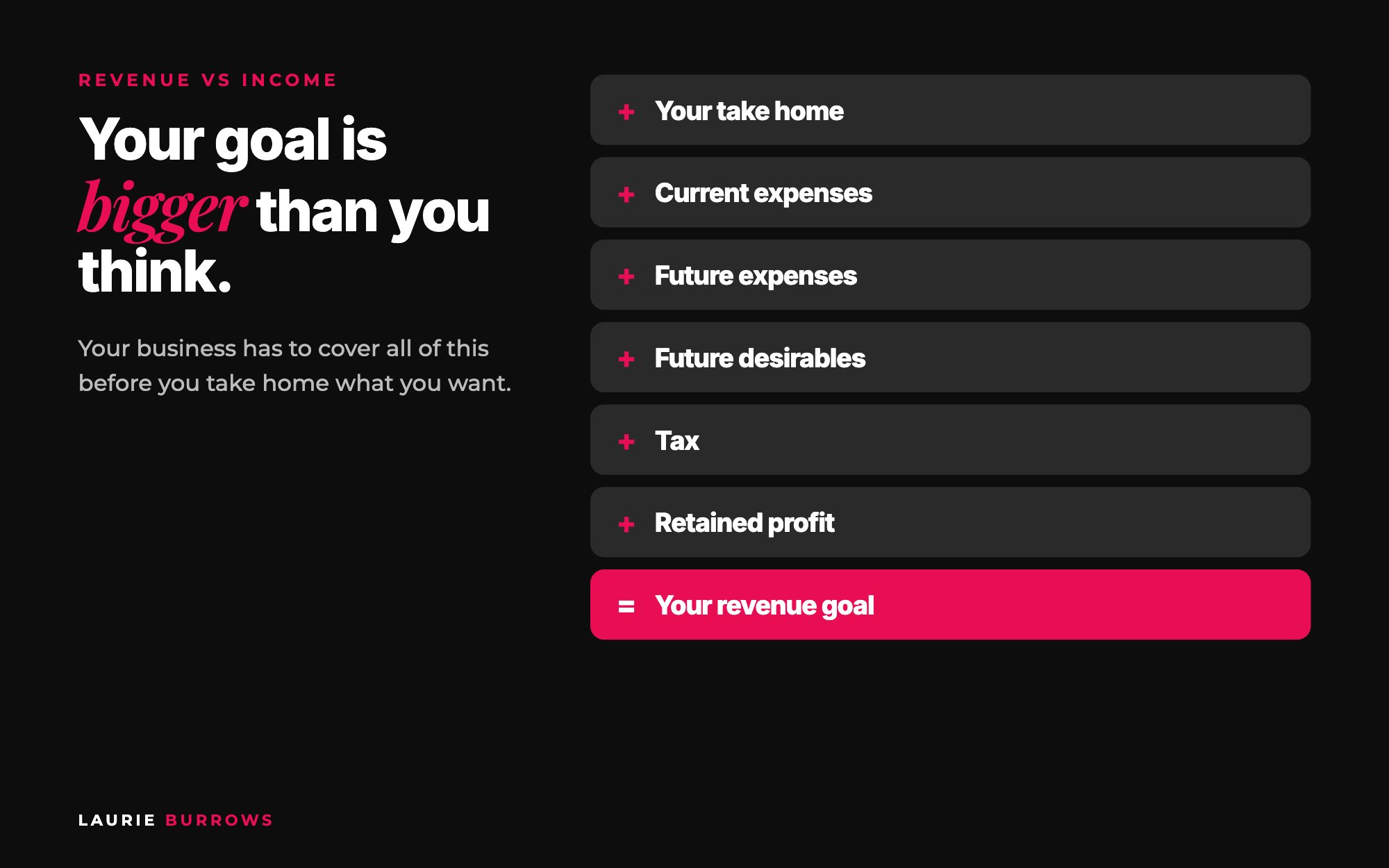
Short answer: a revenue goal is what your business needs to bring in. An income goal is what you want to pay yourself. To set a revenue goal, start with what you want to take home, then add your current expenses, future expenses, anything big you're saving for, tax and the profit you want to keep in the business. That total, not your take home figure, is the number you plan your sales around. It takes about an hour with your bank statements open.
When I ask a room full of founders to put their goal for the year in the chat, I get brilliant answers. $100k. $200k. $500k. Then I ask one question: is that what you want your business to bring in, or what you want to pay yourself?
Most of the time, it's what they want to pay themselves. And that's one of the biggest mistakes I see in yearly planning. You aim your business at your take home number, you hit it, and then you realise you're not paying yourself anywhere near what you wanted. Because the business had expenses. And tax. And nothing left over. Here's how to set the right number, step by step, with a worked example and a worksheet you can copy.
This is part of my ultimate guide to a 6 figure year. Start here, because every other part of the plan (your offers, your launches, your leads) is built on this one number.
What's the difference between a revenue goal and an income goal?
- Revenue (sales): everything your business sells, whether people pay in full or on a payment plan.
- Cash: the money that actually lands in your bank account.
- Profit: cash coming in minus all your expenses.
- Income (take home): what you pay yourself after expenses, tax and retained profit.
If you bring $100,000 into your business this year, I can tell you now that's not what you'll take home. Your revenue goal always has to be bigger than your income goal.
Free 5 day event · 12th to 16th October
The 6 Figure Game Plan
Got your number but not sure how to turn it into sales? Join my free 5 day event. You'll map your strategy to 6 figures and get the plan, content and pages created for you.
How to set a revenue goal, step by step
Step 1: Write down what you want to pay yourself
Write down what you want to hit your personal bank account every month. If your goal was $100k a year take home, that's roughly $8,333 a month. Use a real number based on your life, not a number that sounds good on Instagram.
Time: 10 minutes. Done when: you have one monthly take home figure and the yearly total next to it.
Step 2: List your current expenses
Open your bank statements for the last three months and list every subscription, tool, team member and service. Your website platform, your VA, Zoom, your accountant, your ads. If they add up to $5,000 a month, that's $60,000 a year your business needs to cover before you're paid a penny.
Time: 20 minutes. Done when: every recurring cost is on one list with a monthly total.
Step 3: Add your future expenses
What will you need to hit your goal that you don't have yet? More team members, a new CRM, a coach, a bigger ads budget for your launches. I know my expenses go up every year because I need more support to grow, so I plan for it upfront rather than being surprised by it.
Time: 10 minutes. Done when: you have a monthly figure for new costs and the month each one starts.
Step 4: Add any future desirables
Is there something big you're saving for? When I bought my house, I needed a deposit, so that had to be built into my goal on top of what I wanted to pay myself. A car, a renovation, a sabbatical: if it's coming, plan for it now.
Time: 5 minutes. Done when: each big purchase has a number and a date, or you've written none this year.
Step 5: Add tax
This varies country to country and depends on whether you're self employed or a limited company. In the UK, for example, there's corporation tax on profits, dividend tax on what you pay yourself, and VAT once you go over the threshold, which instantly takes 20% off your sales. I'm not an accountant, so get proper advice. Send your accountant your numbers from steps 1 to 4 and ask: roughly how much tax will this create?
Time: one email to your accountant. Done when: you have an estimated yearly tax figure from someone qualified.
Step 6: Add retained profit
This is money you keep in the business after everything else. It covers you if something unexpected happens, and it gives you cash to invest when an opportunity comes up. Pick a figure that would let you sleep at night if you had a quiet month.
Time: 5 minutes. Done when: you have a retained profit number for the year.
Step 7: Add it all up and split it by month
Add all six together. That's your real revenue goal. When I walk a room through this, almost everyone's number goes up. That's the point. Better to know now than in December.
Then break the annual number into months. There are three ways to do it:
- The same every month. Simple. $360k a year is $30k a month.
- Lower in quarter one, building each quarter. At the start of the year your audience, reputation and team are smallest, so selling should get easier as the year goes on. I used to plan mine this way.
- Launches first. Put your big launches into the months they work best, give those months bigger targets, then work out what the months in between need to bring in. This is how I plan now.
Time: 15 minutes. Done when: all 12 months have a revenue target that adds up to your yearly goal.
Worked example: $7,000 a month take home
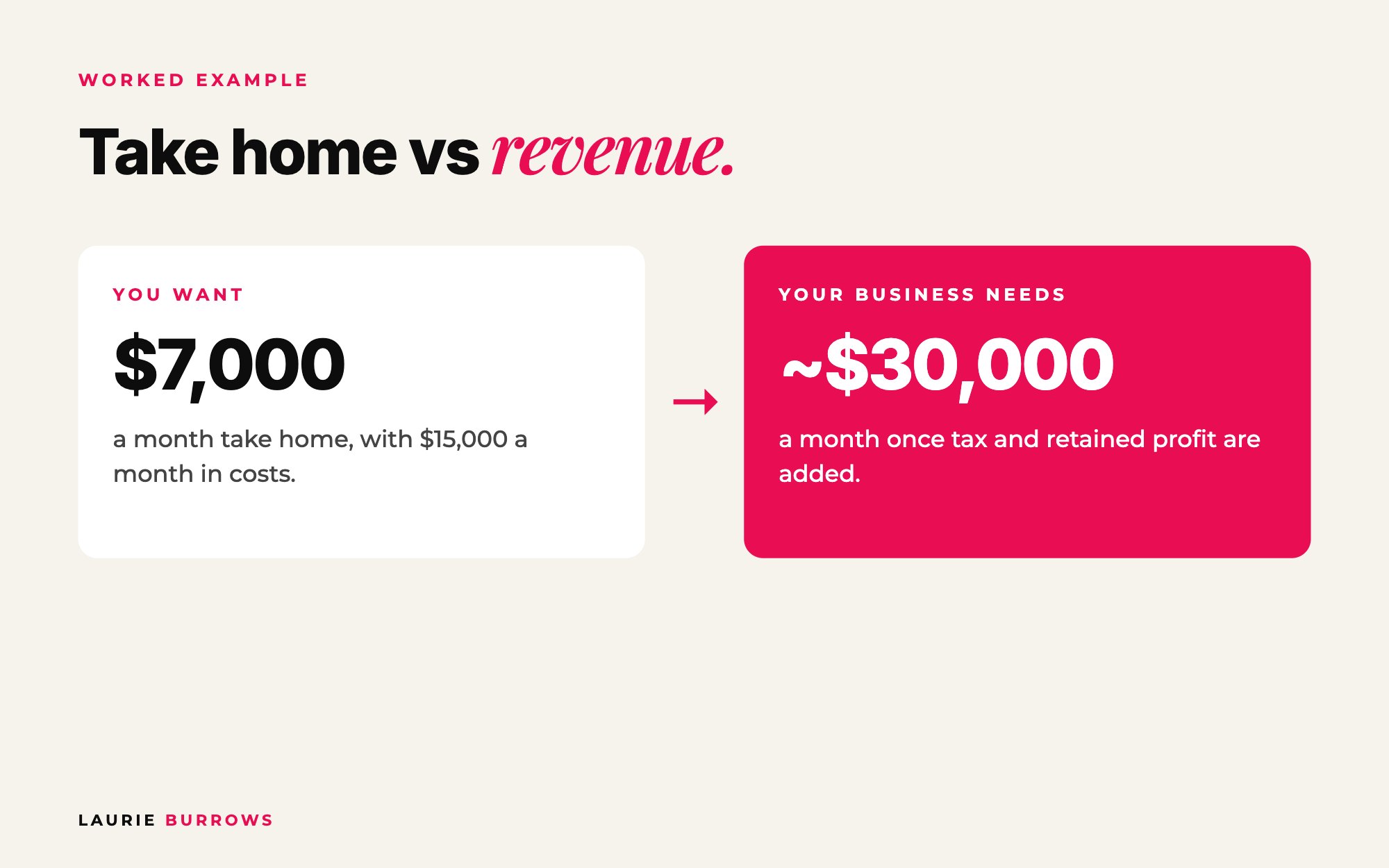
Example only, to show the maths. Your tax figure must come from your own accountant. A consultant wants to pay herself $7,000 a month. Her costs are $15,000 a month, including a VA, an ads budget and a coach.
| Line | Per year | Notes |
|---|---|---|
| Take home | $84,000 | $7,000 x 12 |
| Current expenses | $180,000 | $15,000 x 12 |
| Future expenses | $12,000 | a new tool and extra VA hours, $1,000 a month |
| Desirables | $0 | nothing big this year |
| Tax (estimate) | $54,000 | from her accountant |
| Retained profit | $30,000 | about three months of take home as a buffer |
| Revenue goal | $360,000 | $30,000 a month |
Now turn it into a plan. She already has $10,000 a month coming in from payment plans, so she needs $20,000 a month in new sales. Her main offer is $1,500, so that's about 14 sales a month. At a 3% conversion rate, that's around 467 leads a month, or roughly 108 a week. That's a completely different plan to "I want a 6 figure year", and it tells her exactly what her visibility has to deliver. If you want the leads maths in detail, read how many leads do I actually need?
If you don't fancy redoing this maths every quarter, this is exactly the job of the Strategist inside Ascendia OS. You tell it your goal, it learns your business, then maps what to sell, when, and how many sales you need each month. You still bring the tax figure from your accountant. It does the rest of the planning.
Copy and paste: the revenue goal worksheet
Copy and paste: revenue goal worksheet
1. Take home: $[ ] a month x 12 = $[ ]
2. Current expenses: $[ ] a month x 12 = $[ ]
3. Future expenses: [what] from [month] = $[ ]
4. Desirables: [what] by [date] = $[ ]
5. Tax estimate from my accountant: $[ ]
6. Retained profit: $[ ]
REVENUE GOAL (1 to 6 added together): $[ ] = $[ ] a month
Recurring already coming in: $[ ] a month. New sales needed: $[ ] a month
Main offer price: $[ ]. Sales needed a month: [ ]. Leads needed a month at 3%: [ ]
Daily check: am I on track? If not, what can I do about it today?
Don't forget recurring revenue
Recurring revenue from payment plans, memberships and masterminds makes your monthly goal easier, because you're not starting from zero. If you need $30k a month and $20k is already coming in, you only need $10k in new sales. Just keep an eye on when it ends. I learned that the hard way, which I share in the recurring revenue mistake that hurt my cash flow.
Benchmarks to plan with
- 3% of leads buying is the launch average if you don't know your own conversion rate.
- 333 leads for every 10 sales at 3%.
- 20% off your sales instantly if you're VAT registered in the UK and haven't priced for it.
- Revenue goal always higher than income goal. If yours isn't, a line is missing.
Common mistakes
- Mistake: Setting your goal as what you want to take home. Fix: start there, then add steps 2 to 6 on top.
- Mistake: Treating sales as cash. Fix: if people pay on a payment plan, only the first payment lands this month. Label your goal sales, cash or profit.
- Mistake: Leaving tax until the bill arrives. Fix: get an estimate from your accountant now and build it in.
- Mistake: No buffer. Fix: add retained profit so one quiet month doesn't become a crisis.
- Mistake: A yearly number with no monthly plan. Fix: split it by month, then work out sales and leads for each one.
Your action plan
Today
- Write your monthly take home figure.
- Export three months of bank statements and list every expense.
This week
- Complete the worksheet above, steps 1 to 6.
- Email your accountant for a tax estimate.
- Choose how to split the year: even, building, or launches first.
Next 30 days
- Work out sales and leads needed for each of the next three months.
- Build your 90 day plan around those numbers.
- Check every morning: am I on track, and if not, what can I do today?
Once you have your number, the next step is turning it into a quarter you can actually execute. I walk through that in how to plan your next 90 days, and the full year in the ultimate guide to a 6 figure year.
Want help turning your revenue goal into a plan?
In the 90 Day Revenue Growth Accelerator we set your real number together, then build the offers, the leads plan and the weekly actions to hit it, with me helping you make it happen. Not ready yet? Start with the free Revenue Leak Audit.
Prefer a free first step? The Revenue Leak Audit shows you 12 places your business is quietly losing money, so your new goal doesn't leak away before it reaches your bank.
Rather have it done for you?
Let Ascendia OS turn your revenue goal into a plan
The Strategist maps what to sell, when and how many sales you need each month. Then the Launch Manager, Content Creator and Funnel Builder create the launches, posts and pages that get you there. 14 days free, no tech skills needed.
Frequently asked questions
Is a revenue goal the same as a sales goal?
Yes, broadly. Your revenue or sales goal is the total value of everything your business sells. It's different from your cash goal, because payment plans mean not all of it lands in your bank account straight away.
How much more than my income goal should my revenue goal be?
It depends on your expenses, your tax and how much profit you want to keep, so there's no single percentage. Add each one up properly. For most founders the revenue goal ends up a lot higher than they expected.
Should I include tax in my business goal?
Yes. Tax comes out of what your business makes, so if you leave it out you won't pay yourself what you planned. Speak to an accountant about the rules where you are.
What is retained profit?
Retained profit is money you deliberately keep in the business after expenses, tax and your own pay. It's your safety net and your fund for future investment.
Should every month have the same revenue target?
It can, but it doesn't have to. You can start lower and build each quarter, or plan your big launch months first and set the other months around them.
Laurie Burrows is a UK-based marketing and sales strategist who has built a business that's generated multi-seven figures in sales through social media and digital marketing. Today, Laurie helps business owners use social media, content and digital marketing to get seen, attract more clients and make more sales. She's also the founder of Ascendia OS.
Do you want to scale your business to 10K months in the next 90 days? I am looking for 10 people for my new case study program. DM me the word CASE STUDY on Instagram (@_laurieburrows) to learn more.