The Recurring Revenue Mistake That Hurt My Cash Flow
Short answer: the recurring revenue mistake is not tracking when it ends. Payment plans, memberships and masterminds all finish at some point, and if several end in the same month without anything new coming in, your cash flow drops overnight. Fix it with a simple month by month spreadsheet of every recurring payment, spot the drop offs months in advance, and plan a relaunch, renewal or bigger launch one to two months before each one hits. Setting it up takes about an hour.
I love recurring revenue. It's the reason I don't start every month from zero. But I'm going to be honest about a mistake I made with it, because I see so many founders heading for exactly the same thing.
A few years into my business, I wasn't really watching my recurring revenue. It was just there, coming in every month, and I'd stopped paying attention to when each person's commitment ended. Then one month, around 10 people finished one of my programmes at the same time. Overnight, we lost about $20,000 in recurring revenue.
Nothing had gone wrong with the programme. People had simply come to the end of it, exactly as planned. The problem was that I hadn't planned for it. And that hit our cash flow hard that month. Here's what I do now, step by step, so it never happens to you.
This is part of my ultimate guide to a 6 figure year, where recurring revenue is one of the first numbers we plan around.
What is recurring revenue?
Recurring revenue is money that comes into your business every month without you having to sell anything new that month. It usually comes from:
- Payment plans on your courses and programmes.
- Masterminds paid monthly.
- Memberships and subscriptions.
- Retainers for done for you services.
If you have a 12 month mastermind at $1,000 a month with 20 people in it, that's $20,000 coming in every month for the next 12 months, even if you don't launch a single thing.
Why recurring revenue is so powerful
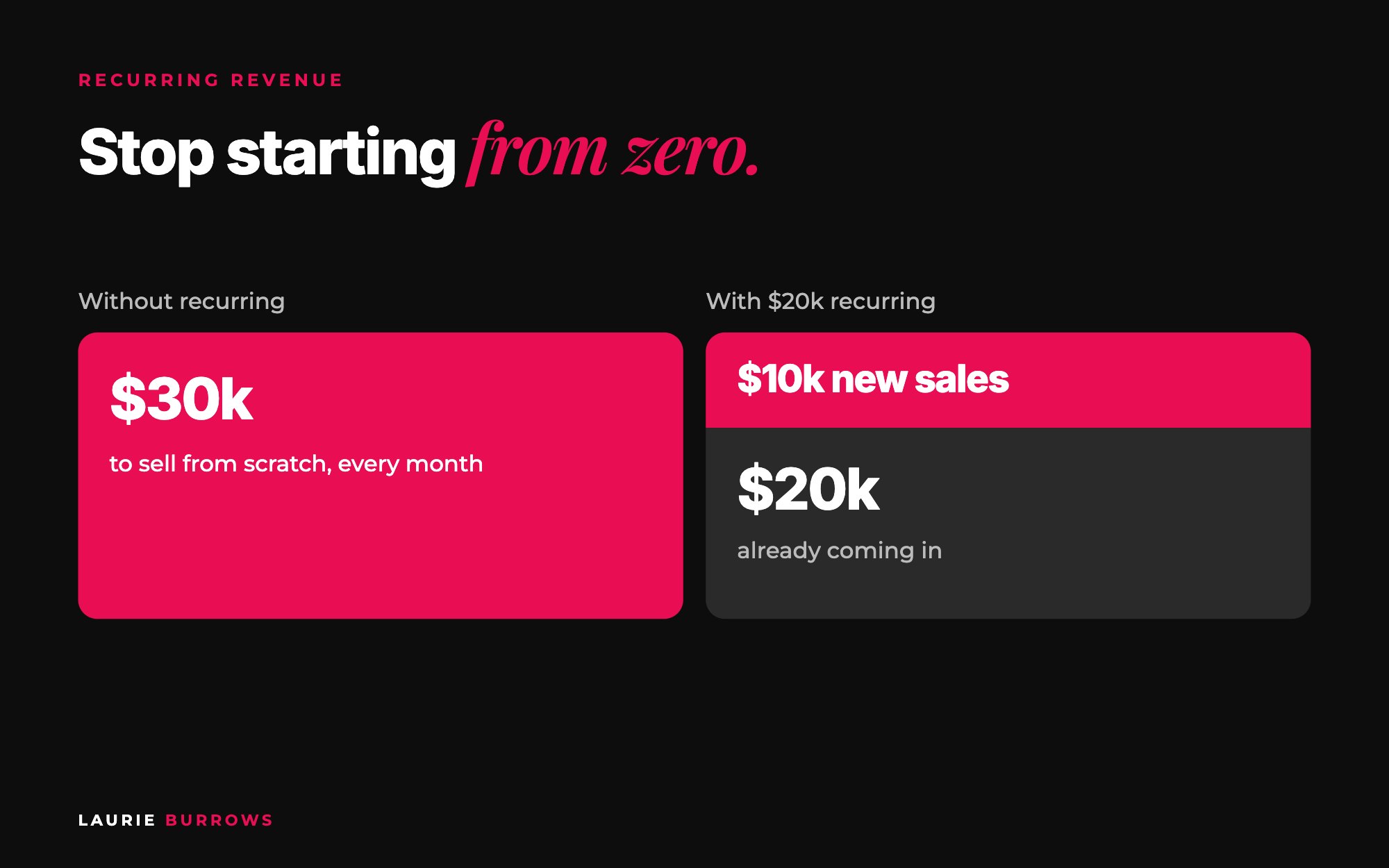
The more recurring revenue you build, the less you need to sell each month. Want $100k months and already have $50k recurring? You only need $50k in new sales. On a smaller scale: if your goal is $20k a month and $10k is already recurring, you only need another $10k.
Every new sale stacks on top of what's already there. That's how people build the businesses you see hitting multiple six figure months. It's also why, for my mastermind, I actually like people going on payment plans. Ten people paying $2,000 a month is $20,000 a month for the year, and anything I launch builds on top of it.
Free 5 day event · 12th to 16th October
The 6 Figure Game Plan
Want to plan your next 6 figures around the money that's already coming in? Join my free 5 day event. You'll map your strategy to 6 figures and get the plan, content and pages created for you.
So what's the mistake?
Recurring revenue feels permanent. It isn't. Every payment plan has a last payment. Every mastermind has an end date. And if you've had a big launch where lots of people joined at the same time, they'll all finish at the same time too. One big intake, one end date, one month where a big chunk of income disappears at once.
There's a second version of this mistake, and it's even more common: confusing sales with cash. Sell nine spots on a $12,000 mastermind and that's a six figure launch. But if all nine choose a $1,000 a month payment plan, only $9,000 lands in your account this month. The rest arrives over the next 12 months. Plan your spending around the $108,000 and you're in trouble.
How to fix it, step by step
Step 1: List every recurring payment
Go through your payment platform and write down every active payment plan, membership, monthly mastermind and retainer. For each one, note who is paying (or which programme), the monthly amount, the month payments started and the month of the last payment.
Time: 30 minutes. Done when: every active recurring payment is on one list with an end month.
Step 2: Build the 12 month view
Create a spreadsheet with one row per payment and one column for each of the next 12 months. Put the monthly amount in every month it's due, then add a total row at the bottom. That total row is your recurring revenue for every month of the year ahead.
Time: 20 minutes. Done when: you can see one total for each of the next 12 months.
Step 3: Circle the drop offs
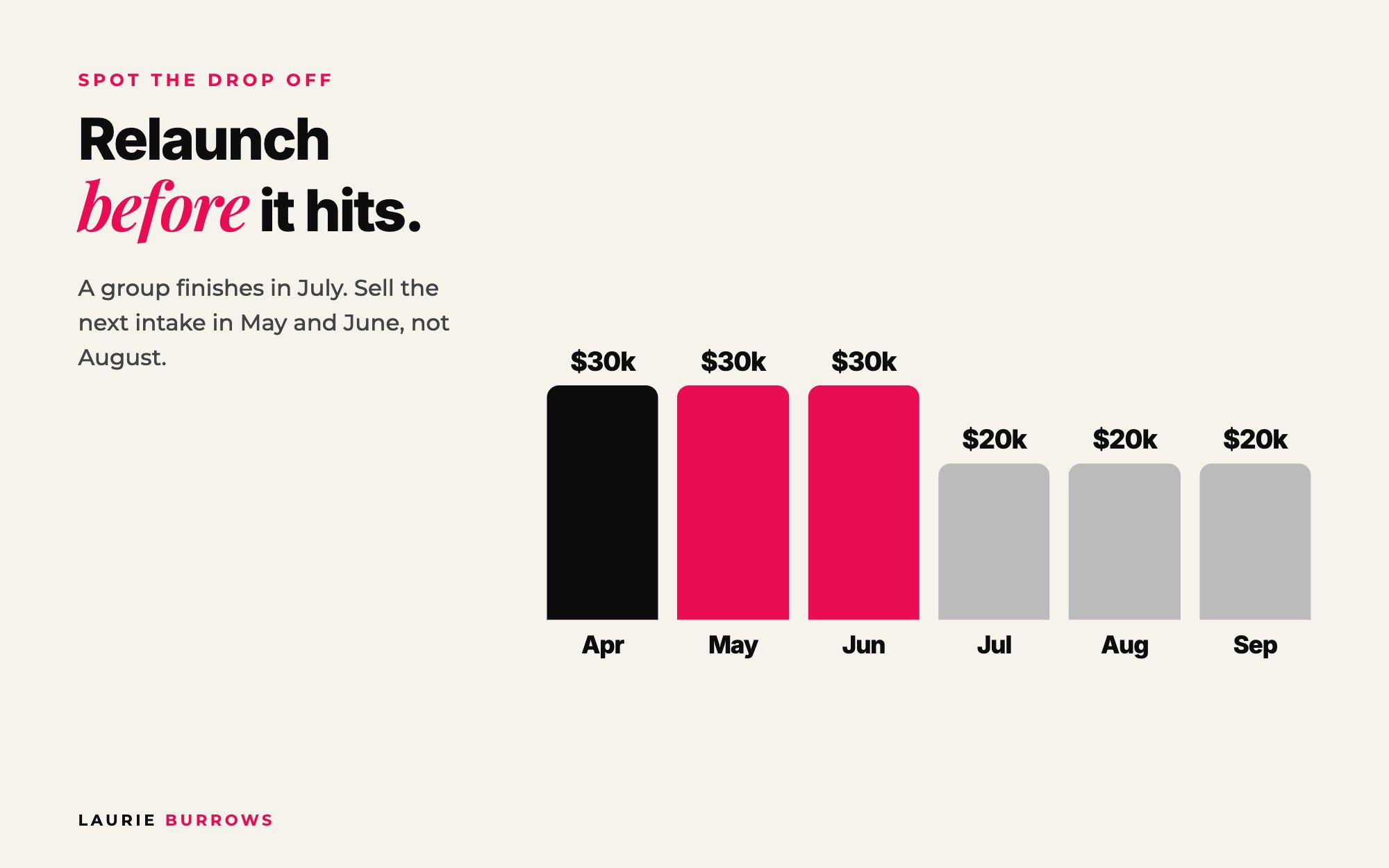
Look along the total row. Any month where it falls is a drop off. You might see that in July your recurring revenue falls by $10k because a group finishes their mastermind. Now you know you need to do something in May or June, not in August when the money has already gone.
Time: 5 minutes. Done when: every drop off month is circled with the amount it falls by.
Step 4: Plan your response one to two months before each drop
For every circled month, choose one of these and put it in your calendar one to two months earlier:
- Relaunch the offer that's ending. If a mastermind group finishes in July, promote the next intake in May or June so new members start as others leave.
- Offer a renewal or next step to current clients. The people finishing already know what it's like to work with you. Give them a reason to continue.
- Plan a bigger launch for that month. If a dip is coming, that's the month for your big challenge or masterclass, not a quiet one.
- Push pay in full. If you need cash to cover the gap, add a pay in full bonus, like a one to one, a VIP day or access to another course.
If setting up a relaunch every time feels like a lot, this is the job of the Launch Manager inside Ascendia OS. It plans the launch from first email to cart close, then sets it up to run again on repeat, so the next intake is ready before the drop off arrives.
Time: 15 minutes. Done when: each drop off has a named action and a start date in your 90 day plan.
Step 5: Have the next step conversation before the last payment
Your current clients are the easiest people in the world to sell to, because they already know what it's like to work with you. About six weeks before someone's final payment, start the conversation. Use the script below.
Time: 10 minutes per client. Done when: every client finishing in the next two months has had a personal message from you.
Step 6: Update it every month
Add every new payment plan as it comes in and check the total row on the first working day of each month. When I do my 90 day planning, the very first thing I mark on the calendar, alongside my best launch months, is where recurring revenue drops off. I go through the whole process in how to plan your next 90 days.
Time: 15 minutes a month. Done when: the sheet matches your payment platform and the next drop off is already planned for.
Worked example: spotting a $6,000 drop in month five
Example only, to show how it works. A coach has three sources of recurring revenue:
| Source | Monthly | Ends after | Months 1 to 4 | Month 5 | Month 6 |
|---|---|---|---|---|---|
| Mastermind (6 people) | $1,000 each | month 4 | $6,000 | $0 | $0 |
| Programme payment plans (10 people) | $250 each | month 6 | $2,500 | $2,500 | $2,500 |
| Retainer client | $1,500 | ongoing | $1,500 | $1,500 | $1,500 |
| Total recurring | $10,000 | $4,000 | $4,000 |
Her monthly goal is $15,000. In months one to four she needs $5,000 in new sales. In month five she suddenly needs $11,000, more than double. Without the sheet, she finds out in month five. With it, she messages the six mastermind members in month three, opens the next mastermind intake in month three or four, and plans her bigger launch for month five. Then she notices month seven drops again when the payment plans end, so that goes in the plan too.
Copy and paste: the renewal conversation
Copy and paste: renewal DM or email
Hey [name], I can't believe we're nearly at the end of [programme]. Looking back at where you were when you started, [specific thing they've achieved] is such a big shift.
Before we finish, I'd love to know: what do you want the next 6 to 12 months to look like for you?
[Wait for their reply. Then:]
Based on what you've said, I think [next step offer] would be perfect for you, because [link it to their goal]. As you're already a client, you'd get [returning client bonus or rate]. Want me to send you the details?
Copy and paste: recurring revenue spreadsheet columns
Name or programme | Monthly amount | Start month | Last payment month | Month 1 | Month 2 | ... | Month 12
Bottom row: TOTAL for each month. Highlight any month lower than the one before it.
Should you offer payment plans or pay in full?
Both. I offer both on everything I sell.
- Payment plans build recurring revenue and make your offer feel less risky. $250 a month sounds a lot less than $3,000, even though it adds up to the same. More people say yes. But you get less cash now.
- Pay in full brings cash in today, which matters when you want to reinvest in marketing, team or ads.
Decide which you need more of this quarter. Need cash? Push pay in full with a bonus. Building long term stability? Lean into payment plans. Just make sure your goal says whether it's a sales, cash or profit goal. I explain the difference in how to set a revenue goal (not an income goal).
Retention is the other half
Tracking drop offs is one half. The other is giving people a reason to stay. That's why I created an all in package: clients who have already experienced one of my programmes get access to everything I launch over the next 12 months at a big saving compared with buying each one separately. For them it's a no brainer. For me, it turns people who would have finished and left into another year of revenue. You don't need an all in package. A next level programme, a monthly retainer or a personal conversation before someone's last payment all work. Plan the next step before the end date arrives, not after.
Benchmarks
- One to two months: how far ahead of a drop off to start selling.
- About six weeks: before a client's last payment to start the next step conversation.
- Monthly: how often to update the sheet.
- Every new sale stacks: whatever is recurring gets subtracted from your monthly target.
Common mistakes
- Mistake: Assuming recurring revenue will always be there. Fix: every payment has an end month. Write it down.
- Mistake: Spending against sales instead of cash. Fix: plan spending around what actually lands each month.
- Mistake: One huge intake with one end date. Fix: stagger start dates or plan a relaunch to land as the group finishes.
- Mistake: Pitching renewals after people have gone. Fix: start the conversation about six weeks before the last payment.
- Mistake: Only offering payment plans when you need cash now. Fix: add a pay in full bonus.
Your action plan
Today
- List every active payment plan, membership, mastermind and retainer.
- Write the last payment month next to each one.
This week
- Build the 12 month spreadsheet with a total row.
- Circle every drop off month.
- Message anyone finishing in the next two months using the renewal script.
Next 30 days
- Add a relaunch, renewal push or bigger launch before each drop off in your 90 day plan.
- Decide whether this quarter needs cash (pay in full bonus) or stability (payment plans).
- Update the sheet on the first working day of next month.
Recurring revenue isn't something you build once and forget. It's something you manage. Track it, plan for when it ends, and keep selling before you need to. Do that and it becomes the foundation that makes every month easier, instead of a trapdoor you don't see until you've fallen through it.
Want help planning your offers and recurring revenue?
Inside the 90 Day Revenue Growth Accelerator we map your recurring revenue, plan around the drop offs and build the launches and renewals to keep your months growing, with me helping you make it happen. Or start with the free Revenue Leak Audit.
Not ready for that yet? The free Revenue Leak Audit walks you through 12 places your business is quietly losing money, and recurring revenue is one of them. For the bigger picture, read the ultimate guide to a 6 figure year.
Rather have it done for you?
Let Ascendia OS plan the relaunch before the drop off
The Strategist maps what to sell and when, so every drop off already has a plan. The Launch Manager sets up the relaunch, and the Email Marketer writes the renewal and follow up emails. 14 days free, no tech skills needed.
Frequently asked questions
What counts as recurring revenue for a coach?
Any income that comes in monthly without a new sale: payment plans, memberships, monthly masterminds, subscriptions and retainers. One off pay in full purchases don't count.
How do I track recurring revenue?
A simple spreadsheet works. List each recurring payment, the monthly amount, the start month and the end month, then total it for every month of the year ahead so you can see the drop offs.
When should I relaunch an offer that's ending?
Ideally one to two months before the drop off. If people finish in July, promote the next intake in May or June so new members start as others finish.
Are payment plans bad for cash flow?
Not if you plan for them. They bring in less cash upfront, but they build stable monthly income. Offer both payment plans and pay in full, and use a pay in full bonus when you need cash now.
How do I keep clients paying after their programme ends?
Start a personal conversation about six weeks before their last payment, ask what they want next, and offer a clear next step with a returning client bonus. Current clients already trust you, so they're your easiest sale.
Why does recurring revenue make my goal easier?
Because it's already coming in. Whatever is recurring gets subtracted from your monthly target, so you only need to sell the difference in new sales.
Laurie Burrows is a UK-based marketing and sales strategist who has built a business that's generated multi-seven figures in sales through social media and digital marketing. Today, Laurie helps business owners use social media, content and digital marketing to get seen, attract more clients and make more sales. She's also the founder of Ascendia OS.
Do you want to scale your business to 10K months in the next 90 days? I am looking for 10 people for my new case study program. DM me the word CASE STUDY on Instagram (@_laurieburrows) to learn more.