How to Plan Your Next 90 Days in Your Business
Short answer: to plan your next 90 days, review the last quarter (what went well, what didn't, what can be improved), set your goal and decide whether it's a sales, cash or profit number, subtract the recurring revenue already coming in, then decide what you're selling, at what price and how many spots you need. Divide those spots by your conversion rate (use 3% if you don't know yours) to get your leads target, give every week of the quarter one clear job, and list the daily actions behind each week. It takes about three hours, and you finish with one page that tells you exactly what to do every Monday.
One of the biggest reasons founders struggle to make consistent sales is that they go into every month winging it. No plan of what they're launching, when they're launching it, what they're selling or how many spots they need. Just hoping for the best. And guessing and hoping isn't a strategy.
I plan at least three months ahead in my business. It's the reason I can predict my bigger months, know what cash is coming in, and walk into every Monday knowing exactly what needs doing. Here's the exact process I use, with a worked example, a template and the numbers to aim for.
This is part of my ultimate guide to a 6 figure year, where your 90 day plan is how the year actually gets delivered.
Why plan 90 days and not a full year?
Everyone's different. Some people love planning 12 months ahead, some prefer a month at a time. I like 90 days because it's long enough to run a proper launch and see the results, and short enough that you can actually hold the whole plan in your head.
I do still mark two things on the full year: my big launch months and the months when recurring revenue drops off. In my business our biggest launches tend to land around January, March, July and November, and the month before each one is all about audience growth. Then every quarter I zoom in and plan the detail.
Free 5 day event · 12th to 16th October
The 6 Figure Game Plan
Want to plan your next 90 days with me? In my free 5 day event you'll map your strategy to 6 figures and get the plan, content and pages created for you.
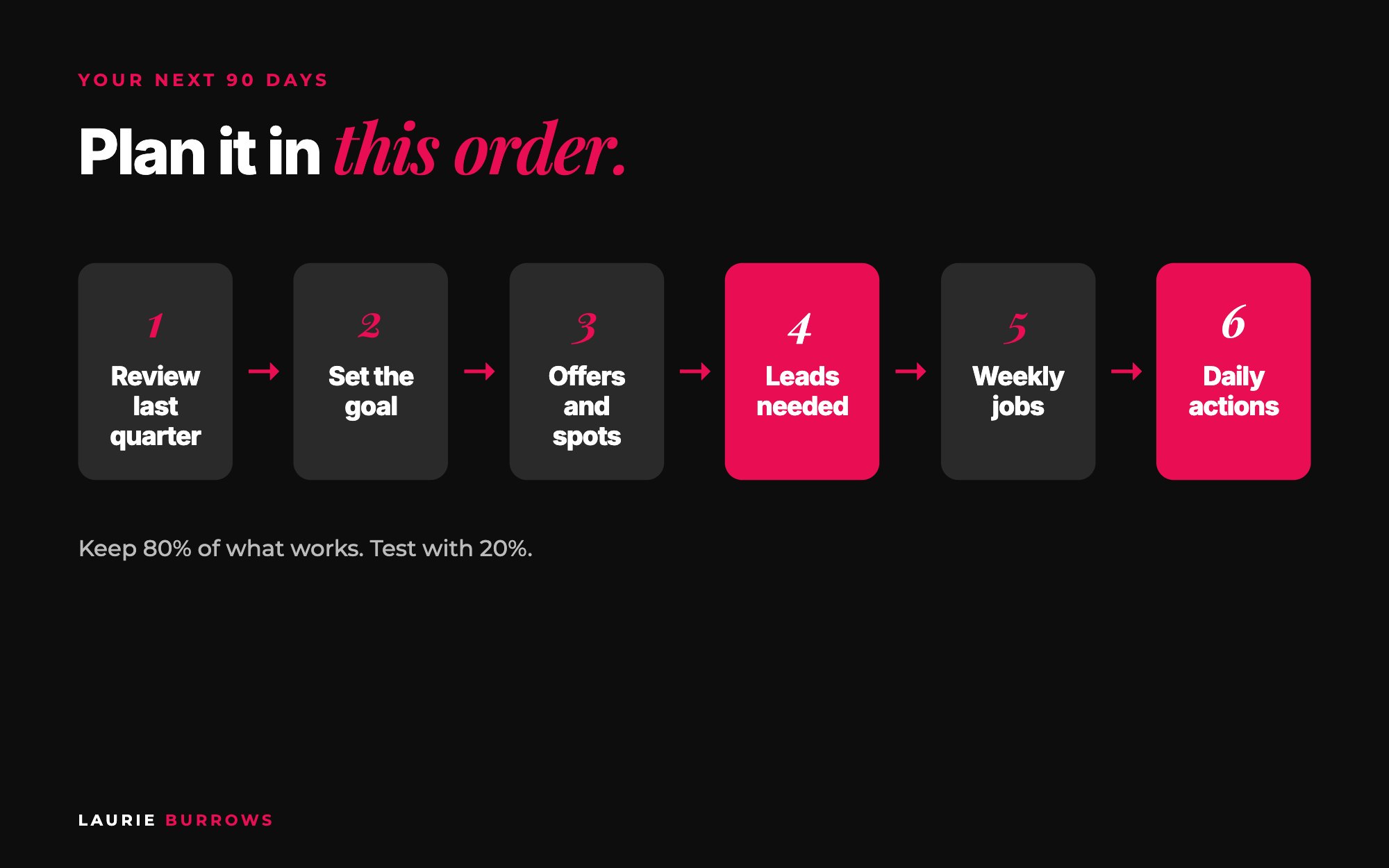
Step 1: Review the last 90 days
Before I plan anything, I answer three questions about the quarter that's just finished:
- What has gone well?
- What has not gone so well?
- What can be improved?
This step matters because so many founders have something that's working, then a shiny new idea or a new mentor's strategy comes along and they abandon it completely. My rule is to keep 80% of what's working and test with 20%. Not the other way round.
Be honest, too. When I reviewed one of my own quarters, part of what didn't go well was me. I had too many ideas and tried to do everything at once. That told me exactly what to fix next quarter: fewer things, done properly, rinse and repeat.
Time: 30 minutes. Done when: you have three bullet points under each question, and you know your best performing month and why.
Step 2: Set your goal and know what type it is
Write down what you want to hit by the end of the 90 days. Then ask what kind of number it is:
- Sales: everything you sell, whether people pay in full or on a payment plan.
- Cash: the money that actually lands in your bank account.
- Profit: cash minus all your expenses.
They're not the same. Sell nine spots on a $12,000 mastermind and that's a six figure launch in sales. But if all nine choose $1,000 a month, only $9,000 of it lands this month. If you want to pay yourself $30,000 this quarter, your business has to bring in a lot more than that to cover expenses and tax. I break this down in how to set a revenue goal (not an income goal).
Time: 15 minutes. Done when: you have one number at the top of your doc with the word sales, cash or profit next to it.
Step 3: Subtract what's already coming in
Open your recurring revenue list. If your goal is $20k a month and $10k is already recurring from payment plans and memberships, you only need $10k a month in new sales. That changes everything about how hard the quarter has to work.
Now check the end dates. If a group finishes their programme in month three, your recurring revenue drops that month, so you need to be selling something in month one or two to replace it. I learned this the hard way, and I share the whole story in the recurring revenue mistake that hurt my cash flow.
Time: 20 minutes. Done when: you know your new sales target for each of the three months, and any drop off month is circled.
Step 4: Decide what you're selling, at what price and how many spots
This is where the plan gets real. For each offer you'll sell in the next 90 days, write down what it is, the price (pay in full and payment plan) and how many spots you need to sell. You might focus on one core offer for the whole quarter, or sell something different each month. Both work. For example, a $100k quarter could be:
- Month one: 100 spots on a $1,000 signature programme.
- Month two: nine spots on a $12,000 mastermind.
- Month three: an all in package for current clients.
The biggest thing to consider is your capacity. Every extra offer is another thing to deliver and manage. When I started, I focused on one $1,000 signature programme, and that alone got me to multiple six figures. I only added more once I had a team. If you're doing most of the work yourself, keep it simple.
Think about pay in full versus payment plans too. Payment plans build recurring revenue but bring in less cash now. If you need cash this quarter, add a pay in full bonus, like a one to one, a VIP day or access to another course.
Time: 30 minutes. Done when: every month has an offer, a price and a number of spots written under it.
Step 5: Work out how many leads you need
Take the number of spots and divide it by your conversion rate. If you don't know yours, the industry average for a launch is around 3%, which is about 333 leads for every 10 sales. Then break it down by week, because a weekly number is something you can actually act on.
In one of my own quarterly plans, roughly 101 sales at a 5% conversion rate meant 2,000 leads for the quarter: about 674 a month or 156 a week. Now I know exactly what my visibility has to deliver every single week. For the full maths, read how many leads do I actually need?
Time: 15 minutes. Done when: you have a leads target for the quarter, each month and each week.
If spreadsheets make your eyes glaze over, the Strategist inside Ascendia OS does this part with you: it learns your business, sets the goal and maps what to sell, when, and how many sales you need.
Step 6: Choose how you'll sell each offer
Once you know the numbers, decide the strategy. Here's what works in my business:
- Offers around $1,000 to $2,000: a 3 to 5 day challenge or three day workshop, because it's enough time to take someone from cold to ready to buy. We do one big one per quarter, not every month, and it's where most of our marketing budget goes.
- High ticket offers: a low priced offer that upsells into it, plus content with clear calls to action, aimed at my warm audience. I once sold 10 mastermind spots in around a week from content alone, because that audience already knew me.
- After a big challenge: a low priced offer, because lots of new people won't be ready for a four figure investment yet, but they might say yes to something smaller.
Time: 20 minutes. Done when: each month has one named strategy (challenge, masterclass, low priced offer, content and email, or a free audit push).
Step 7: Split every month into weeks and give each week one job
This is my favourite part. Under each month, list the weeks as "WC" (week commencing) with the Monday's date. Then give every week one job. For a challenge launch month, it looks like this:
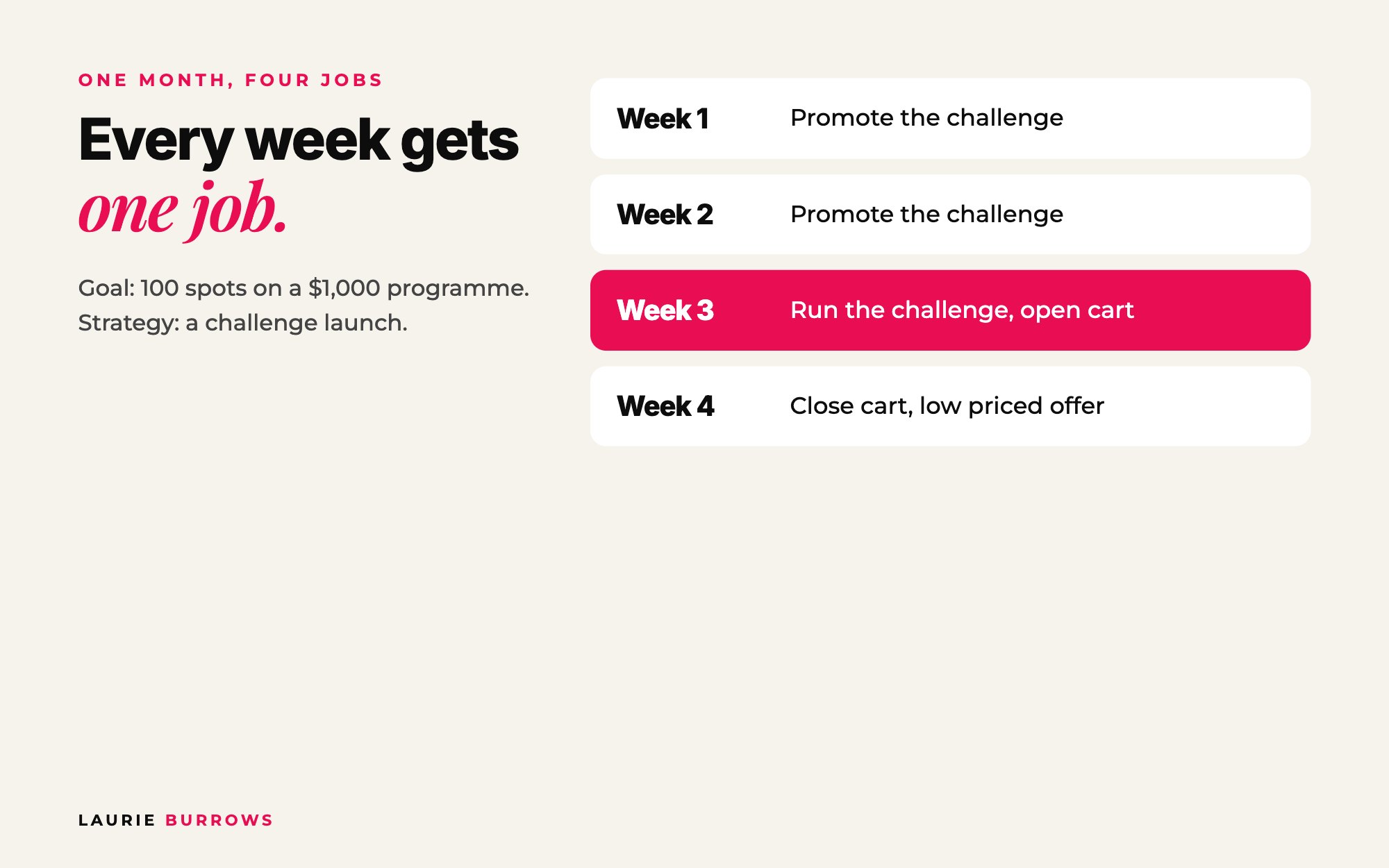
- Week one: promote the challenge.
- Week two: promote the challenge.
- Week three: run the challenge and open cart.
- Week four: close cart, then promote a low priced offer.
In my business we promote something every single week, whether it's free, low, mid or high priced. That's how we keep attracting, nurturing and converting all quarter long. If you're planning a launch in detail, how to plan a launch walks through the questions to answer first.
Time: 30 minutes. Done when: all 12 or 13 weeks have a date and a one line job.
Step 8: Turn each week into daily actions
"Promote the challenge" is still too vague to act on. Under each week, list the actual tasks: the posts, emails, stories, DMs, guest spots and lead generation activities that get it done, and who does each one.
Then, every day, ask two questions:
- What is one thing I can do today to generate leads and grow my audience?
- What is one thing I can do today to generate more sales?
Your plan covers your planned sales activities. These two questions create the unplanned ones: an exclusive offer, a message to past clients, a follow up with old leads. They're often where the extra sales in a month come from.
Finally, pick three visibility actions for the quarter and stick to them: one daily, one weekly, one monthly. For example, engaging with ideal clients every day, a guest speaking spot every week and a collaboration every month.
Time: 40 minutes. Done when: every week has 5 to 10 named tasks with an owner, and your three visibility actions are written at the top of the doc.
Short on hands to do those tasks? The Launch Manager in Ascendia OS plans each challenge, webinar or launch from first email to cart close, and the Content Creator writes and schedules the posts that promote something every week, so your plan doesn't stall in week two.
Worked example: a business coach planning a $45,000 quarter
Example only, to show the maths. A business coach sells a $1,500 programme and has $4,000 a month already coming in from payment plans.
| Line | Number | How it's worked out |
|---|---|---|
| Quarter sales goal | $45,000 | $15,000 a month |
| Recurring already coming in | $12,000 | $4,000 x 3 months |
| New sales needed | $33,000 | $45,000 minus $12,000 |
| Spots needed | 22 | $33,000 divided by $1,500 |
| Leads needed at 3% | 733 | 22 divided by 0.03 |
| Leads needed per week | about 56 | 733 divided by 13 weeks |
Her plan: month one is a 5 day challenge (target 15 spots, so 500 sign-ups), month two is a $27 offer on the thank you page plus content and DMs to the challenge leads (target 4 spots), month three is a masterclass to her warm audience (target 3 spots). Her daily visibility action is 20 minutes engaging with ideal clients, weekly is one guest spot, monthly is one collaboration. Every Monday she checks one thing: did we hit 56 new leads last week? If not, she adds another guest spot or a free audit post that week.
Copy and paste: the 90 day plan template
Copy and paste: 90 day plan template
QUARTER: [dates]
Last quarter: went well [ ] / didn't go well [ ] / improve [ ]
Goal: $[ ] in [sales / cash / profit]. Recurring already in: $[ ] a month. New sales needed: $[ ]
Recurring revenue drop offs this quarter: [month, amount]
MONTH 1 [name]: selling [offer] at $[price], [x] spots, strategy [ ], leads needed [ ]
MONTH 2 [name]: selling [offer] at $[price], [x] spots, strategy [ ], leads needed [ ]
MONTH 3 [name]: selling [offer] at $[price], [x] spots, strategy [ ], leads needed [ ]
Weekly leads target: [ ]. Daily visibility action: [ ]. Weekly: [ ]. Monthly: [ ]
WC [date]: job [ ]. Tasks: [ ] [ ] [ ] (repeat for all 13 weeks)
Every day: one thing to generate leads today [ ]. One thing to generate sales today [ ]
Benchmarks to plan with
- 3% of leads buying is the launch average. My own launches convert at 10 to 12%, but plan with a number slightly lower than you expect.
- 333 leads for every 10 sales at 3%.
- One big launch per quarter, with the month before it focused on audience growth.
- 80/20: keep 80% of what worked last quarter, test with 20%.
- Something promoted every week, free, low, mid or high priced.
Common mistakes
- Mistake: Planning around your take home figure. Fix: set a sales, cash or profit goal and add expenses and tax first.
- Mistake: Ignoring when recurring revenue ends. Fix: list end dates and sell something one to two months before each drop.
- Mistake: Five offers in one quarter when you're doing it all yourself. Fix: one core offer, sold in a few different ways.
- Mistake: A plan with months but no weeks. Fix: every week gets a date and one job.
- Mistake: Throwing the plan out in week five. Fix: check your numbers first and fix the stage that's broken: leads or conversion.
Your action plan
Today
- Open a Google Doc and paste in the template above.
- Answer the three review questions for last quarter.
- Write your goal and label it sales, cash or profit.
This week
- List every recurring payment and its end date.
- Fill in offer, price, spots and strategy for all three months.
- Calculate your weekly leads target.
- Plan the job and tasks for every week, then move the plan somewhere your team can see it.
Next 30 days
- Check leads against target every Monday.
- Ask the two daily questions every morning.
- Review on day 30: are you short on leads or on conversions? Adjust that stage only.
Want help building your next 90 days?
Inside the 90 Day Revenue Growth Accelerator we build your quarter together: the goal, the offers, the numbers and the weekly plan, then I help you make it happen. If you want to start with something free, grab the Revenue Leak Audit on my free resources page.
Prefer to start free? The Revenue Leak Audit shows you 12 places your business is quietly losing money, which is a brilliant thing to look at before you plan. For the bigger picture, read the ultimate guide to a 6 figure year.
Rather have it done for you?
Turn your 90 day plan into work that gets done
The Strategist maps your goal, offers and the sales you need, the Launch Manager plans each launch on your calendar, and the Content Creator and Email Marketer write and schedule the weekly promotion. 14 days free, no tech skills needed.
Frequently asked questions
What should a 90 day business plan include?
A review of the last quarter, your goal (sales, cash or profit), recurring revenue and when it ends, what you're selling at what price and how many spots, how many leads you need, the strategy for each offer, a week by week plan and the daily actions behind each week.
How do I plan my next quarter if I've never launched before?
Use 3% as your conversion rate, keep to one core offer and one main strategy, and treat this quarter as your data gathering quarter. What you learn becomes next quarter's plan.
Should I sell one offer or several in 90 days?
Both work. It depends on your time, your energy and who you have supporting you. If you're doing most of the work yourself, one core offer sold in a few different ways is usually the smarter choice.
How often should I review my 90 day plan?
Check your leads and sales against target every week, and do a proper review at the end of every quarter using three questions: what went well, what didn't go so well and what can be improved.
What if my plan isn't working halfway through the quarter?
Look at your numbers before you change anything. Are you short on leads, or getting leads that aren't converting? Fix the stage that's broken rather than throwing the whole plan out and starting again.
Laurie Burrows is a UK-based marketing and sales strategist who has built a business that's generated multi-seven figures in sales through social media and digital marketing. Today, Laurie helps business owners use social media, content and digital marketing to get seen, attract more clients and make more sales. She's also the founder of Ascendia OS.
Do you want to scale your business to 10K months in the next 90 days? I am looking for 10 people for my new case study program. DM me the word CASE STUDY on Instagram (@_laurieburrows) to learn more.