How to Do Market Research Before You Build an Offer

Short answer: do market research before you build an offer so you create what your ideal client actually wants instead of what you assume they want. Ask current clients why they bought, survey your audience about what they want and have already invested in, run free audits or market research calls, use social listening in groups where your ideal clients ask questions, read competitor reviews, and research who shows up when people search for what you sell. Then build the offer around what you hear.
Stop playing a guessing game. So many coaches spend months building a course, programme or membership, launch it, and hear crickets. Not because they're bad at what they do, but because they built it on assumptions. Market research is how you find out what people will buy before you spend months making it.
And it doesn't need to be complicated or expensive. Here are the methods I use and teach, starting with the easiest.
This is part of my ultimate guide to creating an offer that sells, where market research is phase one, before you build a single module.
Why market research matters for your offer
Market research helps with three things:
- The end result: what your ideal client actually wants and whether it's a priority right now.
- The point of difference: what's missing from what they've already bought, so you can make your offer stand out.
- The messaging: the exact words they use, so your sales page sounds like it's reading their mind.
1. Ask your current clients
If you already have clients, start here. If people are buying, you're doing something right, and you want to know exactly what so you can do more of it. Ask:
- Why did you buy?
- What led you to buying, and why me?
- What stepping stones did you take before you bought?
When I asked my clients, two things stood out. Lots of them chose me because of my story and because they could relate to it, so we knew we needed more of it in my messaging. And on average, clients had been through three of my free offers before they bought, which told us free resources were a key part of our strategy. Neither of those would have been obvious from guessing.
2. Ask your audience
If you've been growing your audience well, it's full of your ideal clients. So ask them what they want, what they've invested in and why, and what they'd want from an offer like yours. Surveys are the easiest way.
The surveys that get the most responses give everyone something for filling them in, not just a prize draw for one person. A short training, a template or a free resource works well. Something like "fill in this survey and get access to my training on how to make money from a masterclass" will get far more replies than "please help me out".
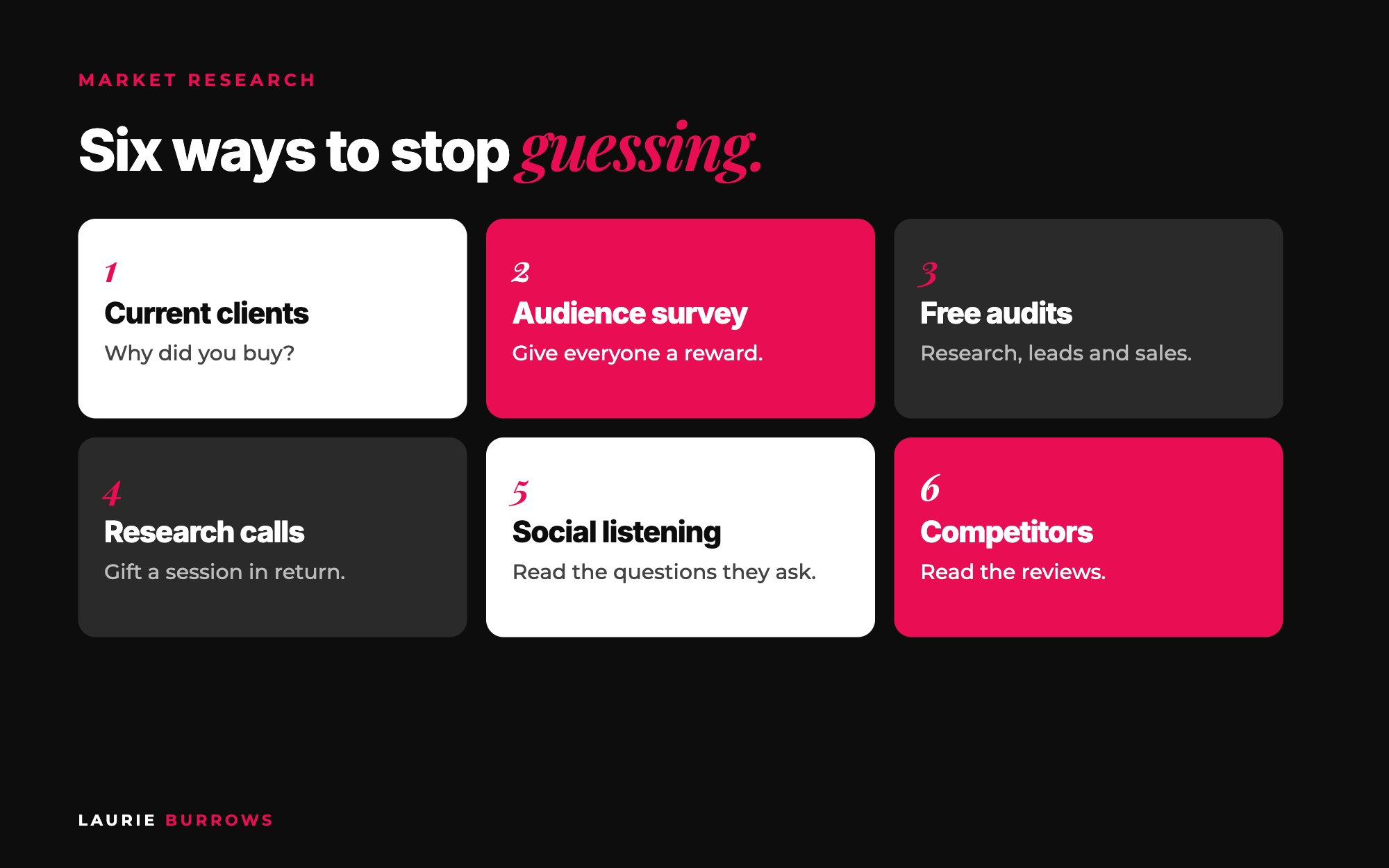
3. Run free audits
Free audits are brilliant because they do three jobs at once. People fill in a form about their business or situation, which gives you loads of valuable research. You review it and send back an audit, which helps them. And from that audit, some people will want to work with you. Market research, lead generation and sales in one.
4. Book market research calls
Tell your audience you're working on a new offer and looking for around 10 people to interview so you can make sure it's exactly what they need. In return, gift everyone who takes part a one to one session with you.
Be open about why you're asking and what you're creating. Something lovely often happens: people who are perfect for the offer hear about it and ask if they can join. Research calls can turn into your first sales.
5. Use social listening
No audience yet? Go where your ideal clients already are. Join the groups they hang out in and read the questions they ask and the struggles they post about. That's a goldmine of what people need help with and where the gaps are.
Some groups will also let you post a survey, offer free audits or ask for research call volunteers. Not all of them, because some assume you're trying to sell to their members, so always check the rules. But using other people's audiences for research is one of the fastest ways to learn when you're starting from zero.
6. Research your competitors
Look at people selling something similar, ideally those further along than you who are clearly doing well, because there's a reason they're doing what they're doing.
- Read their reviews on sites like Trustpilot or course marketplaces. Look at what people loved and, more importantly, what they didn't. The complaints are your opportunity.
- Search the terms your buyers would use on Google and on social platforms. See who shows up, then look at their offers, what they include, their pricing, their content and their funnels.
Remember there are two types of buyers. Some know they're looking for something like your offer and search for it. Others have no idea they need it until they see you talk about it. Keyword research shows you the first group. Social listening and conversations show you the second.
What to do with what you learn
If your research shows the problem you love solving isn't what your ideal client is focused on, don't ignore it. Read ideal client and offer mismatch for what to do next. And when you're ready to turn the research into an offer, work through the EVP Model and the ultimate guide to creating an offer that sells. You'll also find more help in my free resources.
Your 14 day market research plan, step by step
Here's how to put those methods together into one short sprint, so you finish with real answers instead of a vague feeling that people "might" want it.
Step 1: Write down what you think you know (day 1)
Write your offer idea in one line, the end result you think people want and the three problems you think stand in their way. These are your assumptions. The whole point of the next two weeks is to prove or disprove them.
Time: 20 minutes. Done when: you have one page of assumptions you can check answers against.
Step 2: Send a short survey with something everyone gets (days 1 to 5)
Use the questions below, five to seven of them, no more. Offer a gift that everyone who fills it in receives (a training, a template, a replay), not a prize draw, because that gets the most people taking part. Share it to your email list, your stories and anywhere your ideal clients already follow you.
Time: 1 hour to set up, then 5 days live. Done when: you have at least 20 responses.
If you need a simple page to deliver the thank you gift, the Funnel Builder inside Ascendia OS builds it for you, and the calendar in the same platform lets people book their research call without the back and forth.
Copy and paste: market research survey
Intro: I'm building something new to help [who] with [area], and I want it to be exactly what you need. Fill this in (it takes 3 minutes) and I'll send you [gift] as a thank you.
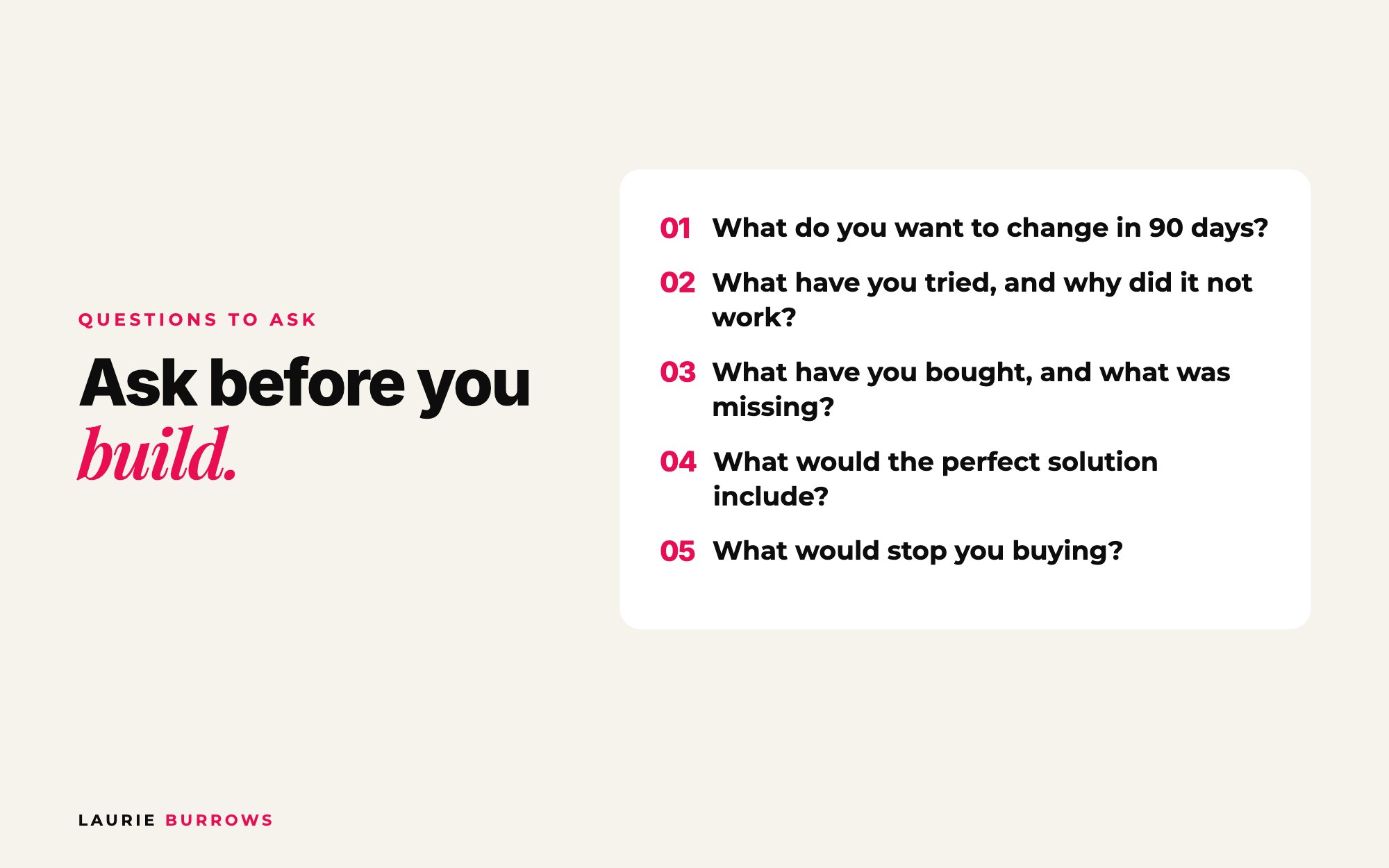
1. What's the biggest thing you want to change in [area] in the next 90 days?
2. What have you already tried, and why didn't it work?
3. What have you invested in before to fix this, and what was missing?
4. If you could wave a magic wand, what would the perfect solution look like?
5. How would you prefer to get help: on your own, in a group, or one to one?
6. Would you be open to a 20 minute chat about this? If yes, leave your email.
Step 3: Book 10 market research calls (days 3 to 10)
Invite people who said yes to question 6, plus anyone who fits your ideal client. Gift each person a short one to one session as a thank you. Be open that you're building something. Ask the survey questions again and keep asking "why?" until you get to the real reason.
Time: 20 to 30 minutes per call. Done when: you've spoken to 10 people and written down their words, not your summary of them.
Copy and paste: research call invite DM
Hey [name], thank you so much for filling in my survey! I'm building a new [programme / offer] for [who] and I'm looking for 10 people to chat to for 20 minutes so I get it exactly right.
As a thank you, I'll give you a [30 minute strategy session / audit] on [topic]. Would you be up for it? Here's my calendar: [link]
Step 4: Check the market from the outside (days 5 to 10)
Spend an hour in the groups and comment sections where your ideal clients hang out, then read reviews of two or three competitors doing well. Note what people complain is missing. That's your point of difference waiting to be claimed.
Time: 1 to 2 hours. Done when: you have a list of gaps that other offers leave open.
Step 5: Find the patterns and decide (days 11 to 14)
Put every answer in one document. Highlight anything that came up three times or more. Compare it to your day 1 assumptions. Then decide: build it as planned, change the end result, change who it's for, or don't build it. Write your offer line using their words.
Time: 2 hours. Done when: you have a go or no go decision and an offer line written in their language.
Got a go? This is where your research turns into copy. The Copywriter in Ascendia OS writes sales pages, launch emails and DMs that sound like you, so you can feed it the exact phrases your ideal clients used and get a first draft to edit rather than a blank page.
Example: testing a new programme idea
This is an illustrative example. A social media manager wants to create a course called "Content Confidence". Her assumption: her audience wants to feel more confident on camera.
Her survey (offering a free content calendar template) gets 34 responses. Twenty one people say their biggest problem is "posting every day and getting no enquiries". Only six mention confidence. Her 10 calls confirm it: they'll show up on camera if they know it will bring clients. So she changes the end result to "a content plan that brings in enquiries in 30 days" and keeps the on camera coaching as one module. Fourteen days of research saved her months of building the wrong thing.
Benchmarks to aim for
| Research method | Aim for |
|---|---|
| Survey responses | 20 or more (offer a gift everyone gets) |
| Market research calls | Around 10 |
| Patterns | Anything that comes up 3 or more times is worth acting on |
| Total time | About 14 days before you build anything |
Common mistakes (and the fix)
- Asking leading questions like "would you buy this?". Fix: ask what they want, what they have tried and what was missing.
- Treating one loud answer as a pattern. Fix: only act on what comes up again and again.
- Skipping research because you have no audience. Fix: use social listening, competitor reviews and other people's audiences.
- Doing the research and building what you wanted anyway. Fix: let the patterns change your end result, even if it stings.
Your action plan
Today
- Write your offer idea and your assumptions on one page.
- Set up the survey and pick a gift everyone receives.
This week
- Share the survey to your list, stories and wherever your ideal clients are.
- Book your first five research calls.
- Read competitor reviews and note what is missing.
Next 30 days
- Finish 10 calls and highlight every pattern.
- Decide go, change or no go, and write your offer line in their words.
- Invite your research call people to be first to join.
- Take your findings into the next phase of the ultimate guide to creating an offer that sells.
Want help turning your research into an offer that sells?
In the 90 Day Revenue Growth Accelerator I help you take what your ideal clients told you and shape it into an offer, a price and a plan to sell it.
Rather have it done for you?
Turn your research into a live offer, fast
The Copywriter turns your ideal clients' exact words into a sales page and launch emails, the Funnel Builder builds the pages and checkout, and the Email Marketer invites your research people to be first in. 14 days free, no tech skills needed.
Frequently asked questions
How do I do market research with no audience?
Use social listening in groups where your ideal clients already ask questions, read competitor reviews, and research who shows up when people search for what you sell. Some groups will also let you post a survey or ask for volunteers for research calls.
How many people do I need to speak to?
Around 10 good conversations will usually show you clear patterns. Combine that with survey responses and social listening and you'll have plenty to build from.
How do I get people to fill in a survey?
Give everyone who completes it something useful, like a short training or a template, rather than entering them into a prize draw. Keep it short and explain why you're asking.
Can market research lead to sales?
Yes. Free audits and research calls often lead to sales, because the people taking part are exactly who the offer is for, and they get to see you understand their problem.
Should I copy what competitors are doing?
No. Research competitors to learn what's working and, more importantly, what's missing. Your offer should fill the gaps their customers complain about, not repeat what they already do.
Laurie Burrows is a UK-based marketing and sales strategist who has built a business that's generated multi-seven figures in sales through social media and digital marketing. Today, Laurie helps business owners use social media, content and digital marketing to get seen, attract more clients and make more sales. She's also the founder of Ascendia OS.
Do you want to scale your business to 10K months in the next 90 days? I am looking for 10 people for my new case study program. DM me the word CASE STUDY on Instagram (@_laurieburrows) to learn more.