How to Price a Coaching Programme
Short answer: price your coaching programme from your revenue goal, not your gut. Divide your goal by the price to see how many spots you need to sell, then ask honestly whether your audience can deliver that number. Make sure the end result is worth more to your ideal client than the price, choose a model that fits the life you want (one to one, group, membership or tiers), and if you're new to an offer, start a little lower and raise the price each time you sell it.
Pricing is one of the questions I get asked most, and it's usually asked the wrong way round. "What should I charge?" The better question is: "How many of these do I need to sell, and can I actually sell that many?"
There's no single right price. High ticket works. Mid ticket works. Low ticket works. What changes is what your strategy has to focus on to sell it.
This is part of my ultimate guide to creating an offer that sells, where pricing comes after you've nailed the end result and the value.
Step 1: Start from your goal
Write down your revenue goal for the next 90 days or the next month. Then divide it by the price of your programme. That's how many spots you need to sell.
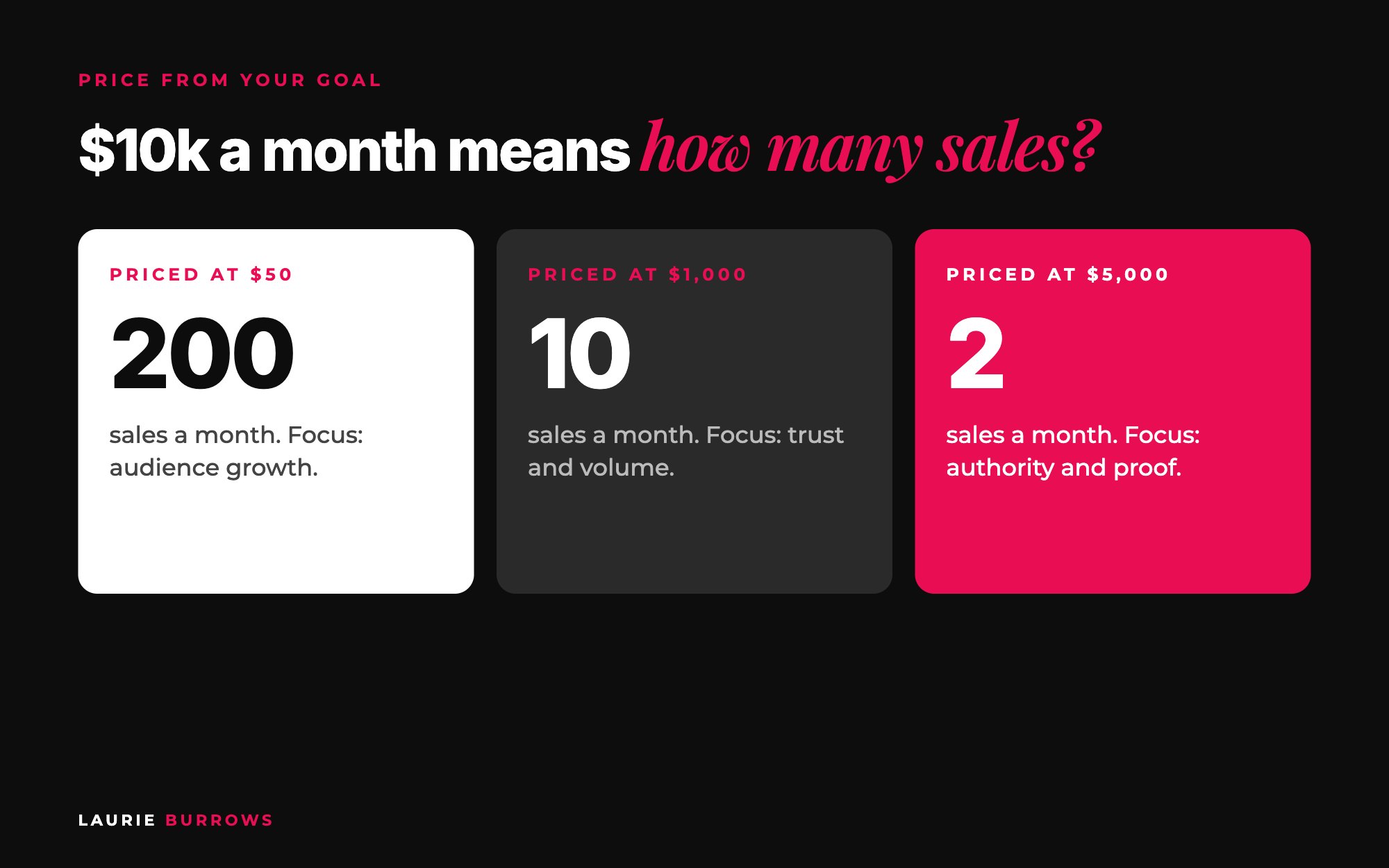
Let's use a goal of $10,000 a month:
- At $50, you need 200 sales a month.
- At $1,000, you need 10.
- At $5,000, you need two.
Now ask yourself the simple question: with the audience I have right now, could I sell that many? If your audience is 200 people, selling 200 spots at $50 means converting 100% of them, which I've never heard of anyone doing. Selling two spots at $5,000 means converting 1%. That one question often tells you more than any pricing formula.
Time: 10 minutes. Done when: you know how many sales a month your price needs.
If you'd like a second brain on the numbers, the Strategist inside Ascendia OS learns your business, sets the goal and maps what to sell, when, and how many sales you need, so you can see straight away whether a price is realistic for your audience.
Step 2: Understand what your price makes you focus on
More people can afford less. Fewer people can afford more. So:
- Lower priced programmes need volume, which means your strategy has to focus on audience growth and visibility.
- Higher priced programmes need fewer sales, but each buyer needs more trust, so your strategy has to focus on authority, proof and being seen as the go to expert.
Price also changes your conversion rate. On average I'd expect around 1 to 3% of leads to buy a four or five figure offer. Something at $50 should convert a lot higher, simply because more people can afford it. Factor that into your numbers.
And remember how differently people buy at different prices. A $27 offer is an impulse buy. Someone handing over four or five figures will want to know you, trust you and see you can get them results, so their journey is longer and they'll have more questions and objections.
Time: 10 minutes. Done when: you can say whether your price means a visibility strategy or a trust strategy.
Step 3: Check the end result is worth more than the price
This is the non negotiable. Your end result is your client's return on investment, and it has to be worth more to them than what you charge. If you're trying to sell a high ticket programme to an ideal client who would never pay that much for that result, it won't sell.
If that's where you are, you have three options: make the end result more tangible and more of a priority, target an ideal client for whom it's worth more, or change the model and price. I go into this in ideal client and offer mismatch.
Time: 20 minutes. Done when: you can say what the result is worth to your client, and it is more than the price.
Step 4: Choose your model
Pay per session
Simple, but you're always looking for new clients to fill next week. I wouldn't build a business on it.
One to one packages
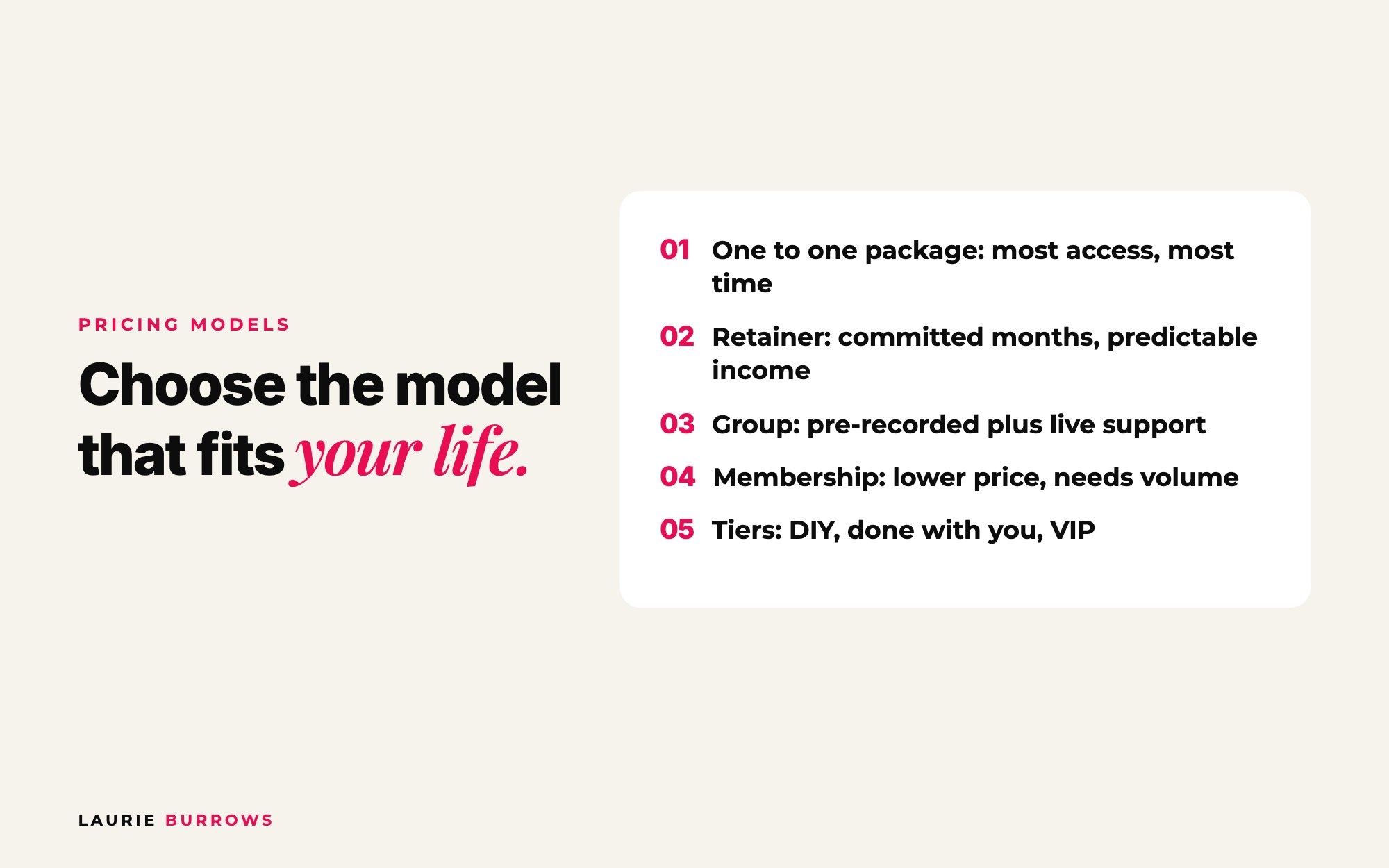
The highest price and the most access to you. Package it rather than selling sessions: for example, a call every two weeks plus messaging support on set days and hours. I liked fortnightly calls when I did one to one because it gave me flexibility to travel, take a week off or go to an event. The downside is time: there's a ceiling on how many clients you can take.
Retainers
Clients commit for a set period, say six months, either paying in full (for example $5,000) or monthly (for example $1,000 a month). Five clients on $1,000 a month means $5,000 coming in every month for six months, even if you sold nothing else.
Group programmes
Less access to you, more people, usually a mid price. Pre-recorded training plus live Q&As and a community works well, and if it's structured right you can sell it at any time.
Memberships
Lower monthly price, recurring revenue, but you need volume and you have to keep people engaged.
Tiers
One programme, three levels: do it yourself (training only), done with you (plus calls and community) and a VIP upgrade or done for you (plus one to one or something built for them). This gives you a way to upsell or downsell without running lots of separate offers.
Time: 30 minutes. Done when: you have picked one model that fits your time and your goal.
Step 5: Start lower, then raise it
If you're starting out or launching something new, I always recommend starting at a slightly lower price and increasing it each time you sell it, until you reach the price you want. I did exactly this. My signature programme launched with a flash offer at $997 and grew to around $1,500. My mastermind started at $6,000 and went up to $12,000.
Call the first round a beta. You bring people in at a lower price, you perfect the programme with their feedback and you collect results. And tell people the price is going up. It's honest, and it gives them a genuine reason to join now rather than later.
Time: 5 minutes to decide. Done when: you have a founding price and the price you will raise it to.
Step 6: Think about payment plans and length
Payment plans make higher prices accessible and create recurring revenue. If 10 people pay $1,000 a month on a 12 month programme, you know $10,000 is coming in every month before you launch anything else.
Be careful with length, though. When you give someone 12 months, it takes them 12 months. A 12 week container usually gets faster results and a natural point to sell the next step. Lifetime access raises perceived value but removes urgency, so a good middle ground is lifetime access to the training with a fixed period of live support.
Do this now: write your 90 day revenue goal, divide it by your current price, and divide that by 90 to see how many sales you need per day. Then write next to it how many leads that needs at a 3% conversion rate. If that number feels impossible with your current audience, you've found either your pricing problem or your visibility problem.
Time: 15 minutes. Done when: you have a pay in full price, a payment plan and a programme length.
Once you've decided, the Funnel Builder in Ascendia OS builds the sales page and checkout with your pay in full and payment plan options inside your account, ready to go live.
Example: pricing a group programme for a $10,000 month
This is an illustrative example with round numbers. A coach has an email list and audience of around 1,000 people and wants $10,000 a month from her group programme.
| Price | Sales needed for $10,000 | Leads needed at 3% | Verdict |
|---|---|---|---|
| $97 | 104 | Around 3,470 a month | Too many for her audience right now |
| $497 | 21 | Around 700 a month | Possible, but a stretch every month |
| $997 | 11 | Around 370 a month | Realistic with a monthly free event |
| $2,000 | 5 | Around 170 a month | Realistic if the end result is worth it and trust is high |
She picks $997 with a founding price of $797 for the first round, a 3 month container (12 weeks of support), and, at full price, a payment plan of 3 x $347. Her end result ("sign 4 new clients a month in 90 days") is easily worth more than $997 to someone whose client is worth $1,000 or more. Each time she sells it, the price goes up until it reaches $997.
Copy and paste: programme pricing worksheet
Monthly revenue goal: $[goal]
Price option A: $[price] | Sales needed: [goal / price] | Leads needed at 3%: [sales x 33]
Price option B: $[price] | Sales needed: [goal / price] | Leads needed at 3%: [sales x 33]
Can my audience realistically give me that many leads a month? [yes / no]
What is the end result worth to my client in money, time or feeling? $[value] | Is it clearly more than the price? [yes / no]
Model: [one to one / retainer / group / membership / tiers] | Length: [weeks] | Founding price: $[x] | Full price: $[y] | Payment plan: [number] x $[amount]
Benchmarks to aim for
| What you measure | Benchmark |
|---|---|
| Leads to sales | Around 3% on average. My own launches convert at 10 to 12%. |
| Leads per 10 sales at 3% | Around 333 |
| Mid priced core offer | Usually around $1,000 (four figures) |
| High ticket offer | Usually five figures, for example a $10,000 mastermind |
Common mistakes (and the fix)
- Picking a price because it feels comfortable. Fix: start from your goal and work out how many sales and leads it needs.
- Going low ticket with a small audience. Fix: at $50 you need 200 sales for $10,000. With 200 people, that is 100% conversion.
- Raising the price without raising the value. Fix: add support or results that justify the jump.
- Twelve month programmes with no reason to start. Fix: shorter containers get faster results and a natural point to upsell.
Should I lower my price if it isn't selling?
Usually not first. If the end result isn't clear, the value isn't stacked or not enough people are seeing it, a lower price won't fix it. Check those first. If the price genuinely isn't worth it to your ideal client, then change the model rather than just discounting. For the full process of building an offer people want to pay for, read the ultimate guide to creating an offer that sells, and for how prices fit together across your offers, how to build a product suite.
If you'd like help working out the right price and model for your goal, have a look at working with me.
Your action plan
Today
- Write your monthly revenue goal.
- Fill in the pricing worksheet for two price options.
This week
- Check your end result is worth more than the price you chose.
- Choose your model, length and payment plan.
- Set a founding price and the price you will raise it to.
Next 30 days
- Sell the first round at the founding price.
- Track leads, sales and conversion rate.
- Raise the price for the next round and add any value your first clients asked for.
- Check the rest of your offer against the ultimate guide to creating an offer that sells.
Free 5 day event · 12th to 16th October
The 6 Figure Game Plan
Want to see exactly how many sales your price needs to reach 6 figures? In my free 5 day event you'll map your strategy and get the plan, content and pages created for you.
Want help setting the right price and the plan to sell it?
In the 90 Day Revenue Growth Accelerator I help you price your offers, map how many leads you need and build the 90 day plan to hit your goal.
Rather have it done for you?
Know your numbers and sell at your new price
The Strategist works out how many sales your price needs and what to sell when, and the Funnel Builder builds your sales page and checkout with pay in full and payment plan options. 14 days free, no tech skills needed.
Frequently asked questions
How much should I charge for a coaching programme?
Work backwards from your revenue goal. Divide the goal by your price to get the number of spots you need, then check your audience can realistically deliver that. The end result also has to be worth more to your ideal client than the price.
Is high ticket or low ticket better?
Both work. Low ticket needs volume, so your focus is audience growth. High ticket needs fewer sales but more trust, so your focus is authority and proof. Choose based on your audience, your time and the life you want.
Can I sell high ticket if I'm new?
Yes, if you build enough trust. Share your experience, your story and evidence of results. Many people find it easier to start with a lower priced offer so buyers can try before they buy, then sell high ticket to the people who loved it.
When should I raise my prices?
Each time you sell the programme and it delivers results. Start at an introductory or beta price, improve it with feedback, then increase the price for the next round and tell people it's going up.
Should I offer a payment plan?
For four and five figure programmes, usually yes. It makes the investment more accessible and creates predictable monthly revenue for you.
Laurie Burrows is a UK-based marketing and sales strategist who has built a business that's generated multi-seven figures in sales through social media and digital marketing. Today, Laurie helps business owners use social media, content and digital marketing to get seen, attract more clients and make more sales. She's also the founder of Ascendia OS.
Do you want to scale your business to 10K months in the next 90 days? I am looking for 10 people for my new case study program. DM me the word CASE STUDY on Instagram (@_laurieburrows) to learn more.