3 Reasons People Buy (and Why Your Offer Misses Them)
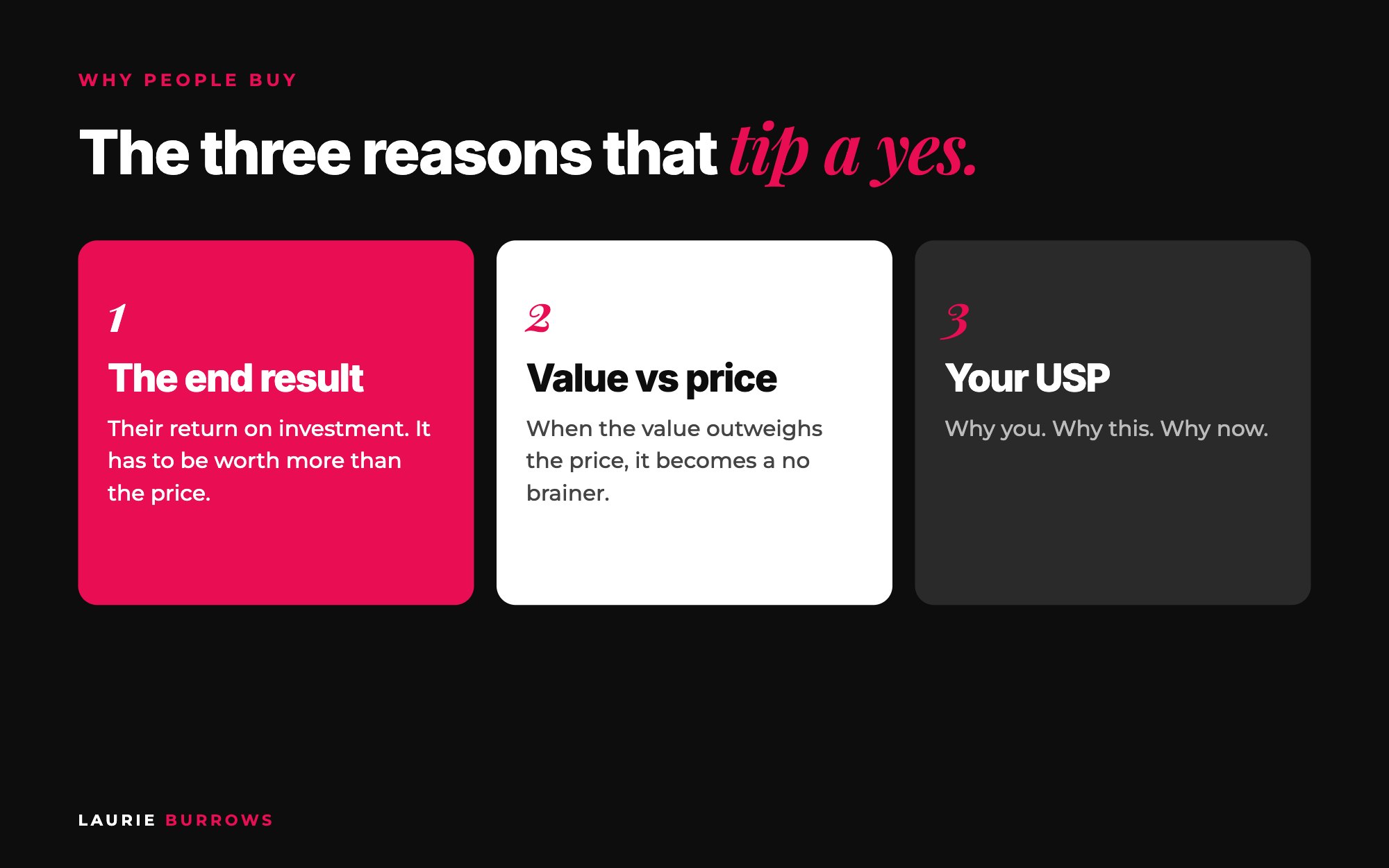
Short answer: people buy for three main reasons. First, the end result: the transformation they get, which has to be worth more to them than the price. Second, value versus price: when the value clearly outweighs what they pay, it becomes a no brainer. Third, your unique selling point: why you, why this offer and why now. Most offers that don't sell are missing at least one of the three, usually because the end result is vague or isn't a priority for the buyer right now.
When I started teaching offers, I didn't want to rely on theory. So I did the research. I asked people why they'd made the buying decisions they made, what pushed them to a yes and what held them back. The same three reasons came up again and again.
Once you can see them, you can't unsee them. You'll notice them on every sales page you land on and in every launch that makes you reach for your card. And you'll start to see exactly where your own offer is leaking sales.
This is part of my ultimate guide to creating an offer that sells, which takes you through the whole offer build from research to testing.
What are the 3 reasons people buy?
- The end result. The biggest reason anyone parts with their money.
- Value versus price. When the value outweighs the price, the decision gets easy.
- Your unique selling point. What makes you and your offer the obvious choice over everything else out there.
These map onto my EVP Model: End Result, Value Stacked and Point of Difference. Let's look at each one properly, and at the specific ways offers miss them.
Free 5 day event · 12th to 16th October
The 6 Figure Game Plan
Once your offer hits all three reasons, the next question is how many sales you need and how you'll get them. In my free 5 day event you'll map your strategy to 6 figures and get the plan, content and pages created for you.
Reason 1: The end result
The end result is the goal. It's the transformation. Most importantly, it's your client's return on investment. That return doesn't have to be money. It's whatever they get from working with you: feeling healthier, landing clients, getting their evenings back. The rule is simple: the end result has to be worth more to them than the price you're charging. If it is, they'll find the money. If it isn't, no discount will save it.
How offers miss reason 1
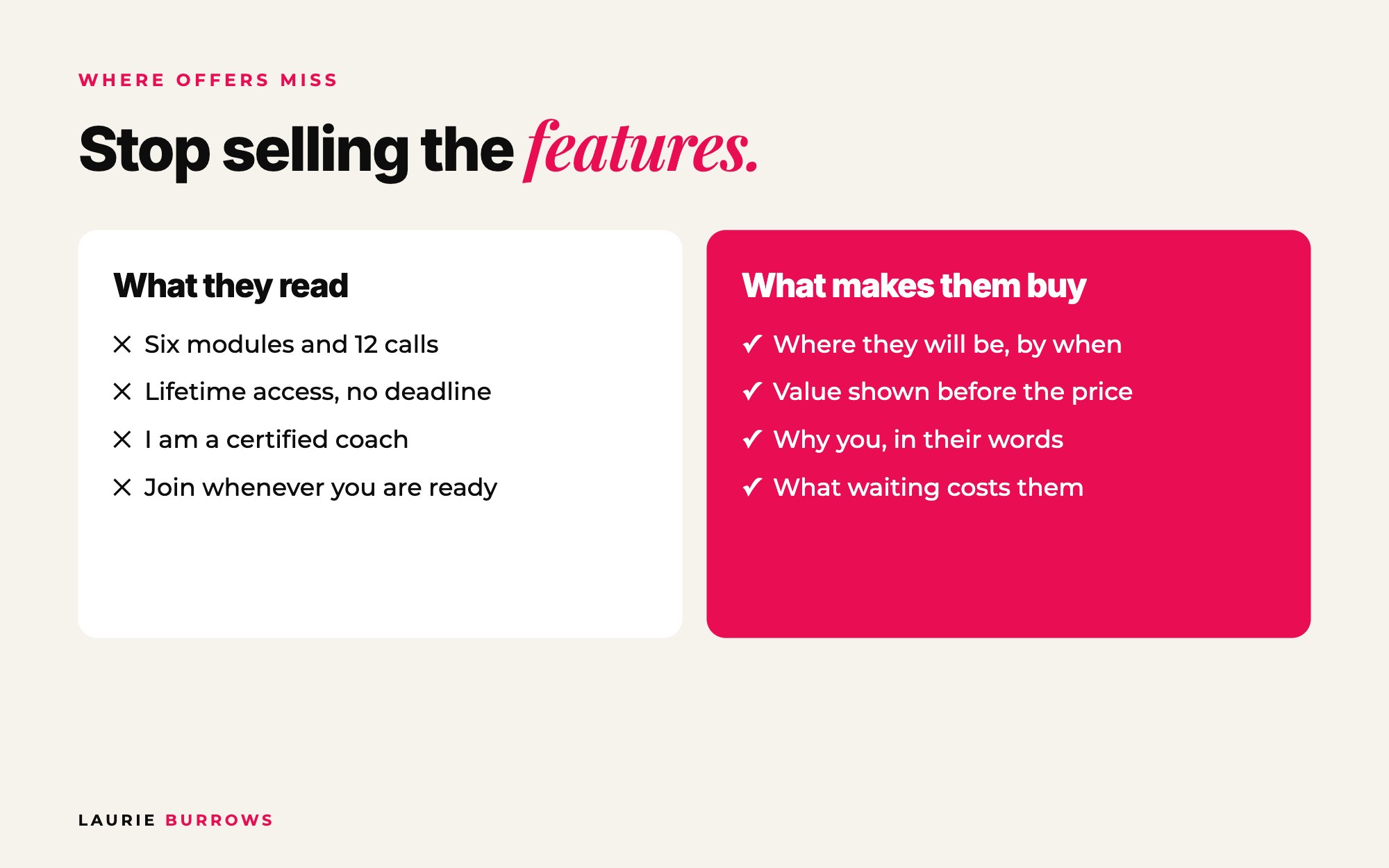
- The end result is buried under features. "Six modules and 12 calls" tells them what they get, not where they'll be.
- The result isn't a priority right now. If they have bigger problems to solve first, they won't invest in yours today, however good it is.
- The result is too intangible. "More confidence" is hard to put a price on. "The confidence to speak on stage and win clients from it" is not.
Talk to the end result, not just the problem
There are two types of buyer here. I call them Buyer A and Buyer B. Buyer A knows exactly what their problems are. If their goal is $10,000 months, they know their content is weak, or their mindset is getting in the way, or they don't have a strategy. Buyer B knows they want $10,000 months but genuinely has no idea why they're not there yet.
If you only talk about problems, Buyer B doesn't recognise themselves. If you talk about the end result, both of them do. That's why I always lead with the end result over the problem.
Reason 2: Value versus price
The next thing a buyer looks at after the end result is whether it's worth it. When the value clearly outweighs the price, it becomes a no brainer. If someone can see they're getting $23,000 worth of value and you're only asking $3,000, the maths does a lot of the selling for you.
This is why you see sales pages and presentations that list what's included with a value next to each item, then add something else, then something else, before revealing the price. It's not a trick. It's helping the buyer see what they're actually getting.
How offers miss reason 2
- Nothing is valued. You list what's inside but never show what it's worth, so the price feels high.
- The value is all your time. Piling on one to one calls caps how many clients you can take and burns you out.
- The value kills the urgency. Lifetime access sounds generous and does increase perceived value, but there's no reason to start, so people don't finish and you struggle to sell them into anything else. A better option is lifetime access to the curriculum with 12 weeks or 12 months of live support.
The best things to add are the ones that get clients better or faster results without needing more of your time: templates, a community, group workshops, a custom AI trained on your method. I walk through the whole process in how to build a value stack.
Reason 3: Your unique selling point
Your unique selling point is what makes you and your offer different to everything else out there. And here's the part people forget: one of your biggest USPs is you.
There are other people doing what you do. There are other people doing what I do. Your experience, your story and your results are things nobody else has. When I share how I started my business in January 2020, found out I was pregnant the same month, went into lockdown weeks later and still built it, people see why me. I didn't just pop up one day and decide to be an expert. You need to give people the same answer.
Your USP has three parts:
- Why you? What makes you the expert? Why should they give a damn about you specifically?
- Why this? What makes your offer different to what your competitors offer and to everything they've already bought?
- Why now? What does it cost them every month they wait? Why not leave it six or 12 months?
That's my Different You Now framework. I go deeper into it, and how it ties into your messaging, in why is no one buying my offer.
How offers miss reason 3
- It looks like everything else. If it reads like another course, it gets treated like another course.
- You never say why you. Even faceless businesses have a reason they exist and an expert behind them. Tell people.
- There's no reason to act now. No urgency means "I'll come back to it", and they never do.
Do this now: open your sales page and highlight it in three colours: one for the end result, one for anything that shows value, one for why you, why this and why now. Whichever colour is missing or barely there is the reason your offer isn't converting.
Why logic alone won't sell your offer
All three reasons sound logical, but people don't buy on logic alone. They buy on emotion and then justify it with logic. The end result is the emotional pull (how their life feels when the problem is gone). The value stack and your credentials are the logic they use to justify it to themselves, and sometimes to their partner.
So when you write about your end result, go deeper than the surface. Not "make more money", but "stop waking up at 3am wondering where your next client is coming from". I unpack the emotional side in the psychology of why people buy.
Use your own buying decisions to check this
Here's a quick exercise. Write down three things you've invested in over the last year: a course, a mentor, a service, anything. For each one, write down which of the three reasons tipped you into a yes. Was it the result? Was it how much you got for the money? Was it the person?
Then do the opposite. Write down something you nearly bought and didn't. Which reason was missing? Nine times out of ten you'll find it was the end result not being clear enough, or not being a priority for you at that moment. Your clients are exactly the same.
Which reason should you fix first?
Always the end result. If the end result is vague or isn't a priority for your ideal client right now, stacking value and polishing your story won't help, because they've already decided it isn't for them. Get the end result specific and worth more than the price. Then stack the value. Then sharpen your USP.
If you want the full step by step process for building an offer around all three, read the ultimate guide to creating an offer that sells, or grab one of my free resources.
How to fix your offer for all three reasons, step by step
Here's the exact order I use when I rework an offer, mine or anyone else's. Give yourself one focused afternoon and you'll come out the other side with an offer that hits all three reasons people buy.
Step 1: Write the end result as a before and after
Draw a line down a page. On the left, write where your ideal client is right now in their words: what they're struggling with, what it's costing them, how it feels. On the right, write where they'll be when they finish working with you. Be specific: a number, a timeframe, a moment they'll notice.
Then check it's a priority. Would your ideal client throw money at this problem this month? If you have to convince them it matters, pick a different end result to lead with.
Time: 30 minutes. Done when: your right hand column has at least one number and one timeframe in it.
Step 2: Put a value on everything inside
List every part of your offer: the curriculum, the live support, templates, community, workshops, any done-for-you element. Next to each one, write what it would cost to buy on its own. Add it up. Your total value should be clearly higher than your price, ideally several times higher.
If most of the value is your one to one time, swap some of it for things that get results faster without needing more of you: templates, swipe files, group workshops, a community.
Time: 45 minutes. Done when: you have a written value stack with a total value well above your price.
Step 3: Answer why you, why this, why now
Write one short paragraph for each. Why you: your experience, your story and your results. Why this: what your offer does differently to what they've already tried. Why now: what waiting six more months costs them. This is your Different You Now.
Time: 30 minutes. Done when: each answer has something in it that nobody else could say.
Step 4: Run the three colour test on your sales page
Go back to the highlighter exercise from earlier. Every section of your sales page should be doing one of three jobs: showing the end result, showing value, or answering why you, why this and why now. Anything that does none of those either gets rewritten or deleted.
Time: 30 minutes. Done when: all three colours appear above the price, and the end result appears first.
If rewriting the page feels like a mountain, the Copywriter inside Ascendia OS writes sales pages that sound like you. Give it your before and after, your value stack and your Different You Now answers and it drafts each section for you to approve.
Step 5: Say it out loud to real people
Use the offer pitch below in your next three posts, a story, an email and any sales conversation you have this week. Watch what people ask. Questions about the result mean reason 1 is landing. Questions about price mean reason 2 needs work. "Why should I do this with you?" means reason 3 does.
Time: 1 week. Done when: you've shared it at least five times and written down every question you got.
Short on time to turn the pitch into posts? The Content Creator in Ascendia OS plans your month, writes the posts in your voice and schedules them, so the three reasons show up in your content every week, not just on launch day.
Copy and paste: three reason offer pitch
If you are [where they are now, in their words], this is for you.
In [timeframe], [offer name] takes you from [before] to [specific end result].
Inside you get [item] (worth $[x]), [item] (worth $[x]) and [item] (worth $[x]). That is $[total] of value for $[price].
Why me? I [your story or proof in one line].
Why now? Every month you wait costs you [money, time or feeling]. Doors close on [date] / The next round starts [date].
Example: a health coach with a $1,500 programme
This is an illustrative example. A health coach sells a $1,500 programme called "Feel Better". It isn't selling.
- Reason 1 before: "Feel healthier and more energised." After: "Get your energy back and stop the 3pm crash in 8 weeks, without giving up the foods you love."
- Reason 2 before: six modules and weekly calls, no values shown. After: 8 week curriculum ($1,200), weekly group coaching ($2,400), meal templates and shopping lists ($297), private community ($500). Total value $4,397 for $1,500.
- Reason 3 before: "I'm a certified health coach." After: "I spent years running on coffee and willpower until I fixed it myself, and this is the exact process I used. Every month you wait is another month of dragging yourself through the afternoon."
Same programme, same price. Now a buyer can see the result, the value and the reason to start this month.
Benchmarks to aim for
| Check | Aim for |
|---|---|
| End result | One sentence with a specific result and a timeframe |
| Value stack | Total value clearly higher than the price, ideally several times |
| Different You Now | One sentence for each that nobody else could copy |
| Leads to sales once all three are fixed | Around 3% on average. My own launches convert at 10 to 12%. |
Common mistakes (and the fix)
- Leading with the problem only. Fix: lead with the end result so Buyer A and Buyer B both recognise themselves.
- Stacking value with more of your time. Fix: add templates, community and group support that get results faster without burning you out.
- Hiding your story. Fix: tell people why you. It is the one part of your offer nobody can copy.
- Fake urgency. Fix: give a real reason to act now: a start date, a bonus that ends, a cohort that closes.
Your action plan
Today
- Write your before and after on one page.
- Highlight your sales page in three colours and note what is missing.
This week
- Build your value stack with a value next to every item.
- Write your why you, why this and why now.
- Post the three reason offer pitch at least five times.
Next 30 days
- Update your sales page so the end result comes first.
- Track the questions people ask and fix the reason they point to.
- Measure your leads to sales conversion and compare it to the 3% average.
- Work through the full build in the ultimate guide to creating an offer that sells.
Want help building an offer people say yes to?
In the 90 Day Revenue Growth Accelerator I help you shape your end result, value stack and messaging, then build the plan to sell it.
Rather have it done for you?
Let Ascendia OS write the offer into your pages and posts
The Copywriter turns your end result, value stack and why you, why this, why now into a sales page that sounds like you, and the Content Creator writes and schedules the posts that keep all three in front of your audience. 14 days free, no tech skills needed.
Frequently asked questions
What is the number one reason people buy?
The end result. People buy because they want a specific transformation, and that transformation is their return on investment. It has to be worth more to them than the price you're charging.
Is price the main reason people don't buy?
Usually not. Price becomes an objection when the end result isn't clear, isn't a priority, or the value hasn't been shown. When the value clearly outweighs the price, price stops being the sticking point.
What is a unique selling point for a coach?
It's what makes you and your offer different from everyone else helping with the same problem. Your experience, your story and your results are part of it, alongside what your offer does differently, like removing a frustration other solutions ignore.
Should I focus on the problem or the end result in my marketing?
Lead with the end result. Some buyers know exactly what their problems are, but many only know where they want to be. Talking to the end result speaks to both.
Do people buy on emotion or logic?
Emotion first, then they justify it with logic. Your end result creates the emotional pull, and your value stack and credentials give them the logical reasons to say yes.
Laurie Burrows is a UK-based marketing and sales strategist who has built a business that's generated multi-seven figures in sales through social media and digital marketing. Today, Laurie helps business owners use social media, content and digital marketing to get seen, attract more clients and make more sales. She's also the founder of Ascendia OS.
Do you want to scale your business to 10K months in the next 90 days? I am looking for 10 people for my new case study program. DM me the word CASE STUDY on Instagram (@_laurieburrows) to learn more.