How to Build a Value Stack
Short answer: a value stack lists everything included in your offer with a value next to each item, so buyers can see the total value is far higher than the price. Start with a clear end result, explain what each part is and why it matters, put an honest standalone value on each piece, add real bonuses (ideally ones that get faster results without costing you more time), then reveal the total value before the price. When the value outweighs the price, your offer becomes a no brainer.
Have you ever watched a presentation where someone shows you what's included, then adds something else, then something else, and by the time they reveal the price it feels like a steal? That's a value stack. It's one of the simplest ways to make an offer easier to say yes to, and most coaches either skip it or do it badly. Below is exactly how to build one in six steps, with a value stack template and script to copy, a worked example and an action plan.
This is part of my ultimate guide to webinars that sell, where the value stack sits inside the pitch.
Where does the value stack fit?
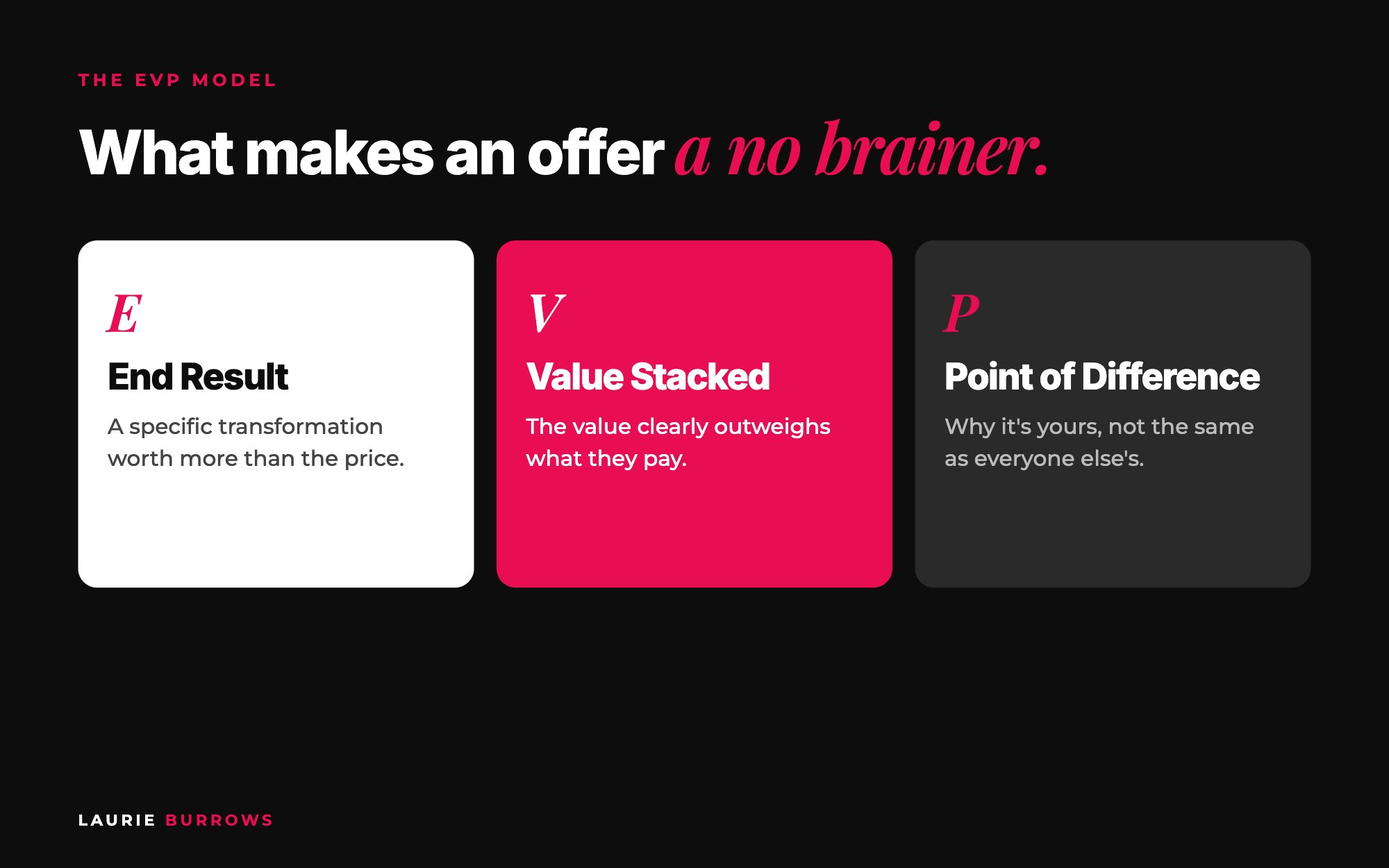
I teach offers using my EVP Model. Every offer that sells has three things nailed:
- E, End Result: the specific transformation, which is your client's return on investment. This is the number one reason people buy, and it has to be worth more to them than the price.
- V, Value Stacked: the perceived value clearly outweighs what they pay.
- P, Point of Difference: the reason it's yours and not the same as everyone else's.
The first thing a buyer looks at is the end result. The next thing they look at is the value versus the price. So the value stack only works if the end result is already clear. "An eight module programme on gut health" isn't an end result. "Heal your gut and stop feeling bloated in 30 days, without restrictive dieting" is.
How to build a value stack, step by step
Step 1: Write the end result in one sentence
Before you list anything, write the transformation: "[Result] in [timeframe] without [the thing they hate]." Every item in the stack has to point back to this sentence.
Time: 15 minutes. Done when: someone outside your industry could read the sentence and know what they'd get.
Step 2: List everything that's included
Write down every part of your offer: the core training, live calls, the community, templates, tools, feedback, resources. Everything someone gets when they join.
Time: 15 minutes. Done when: nothing is missing, including the small things like templates and the community.
Step 3: Explain why each part matters
Don't just name it. Say what it is, why they need it and how it gets them closer to the result. Buyers don't want features. They want outcomes.
Not: "You'll get eight modules."
Instead: "You'll get the full eight module system. This isn't just training. It's a framework that does the selling for you, so you'll finally know what to say, where to say it and how to automate it."
Time: 30 minutes. Done when: every item has a "so that" line linking it to the end result.
Step 4: Put an honest value on each item
Give each piece a value, the way you'd see it on a well structured sales page. A good guide is what that piece would cost if you sold it on its own. Be honest. An inflated number that nobody believes damages trust instead of building it.
Time: 20 minutes. Done when: you could defend every number if someone asked "would you really sell that on its own for that?"
Step 5: Add real bonuses
Bonuses increase the perceived value further, and fast action bonuses (for joining within 24 to 48 hours) create genuine urgency. Explain why each bonus matters, just like the core parts. And only use bonuses that are real, with deadlines you'll honour.
Time: 20 minutes. Done when: each bonus passes the two questions further down: faster results, and no extra one to one time.
Step 6: Show the total, then the price
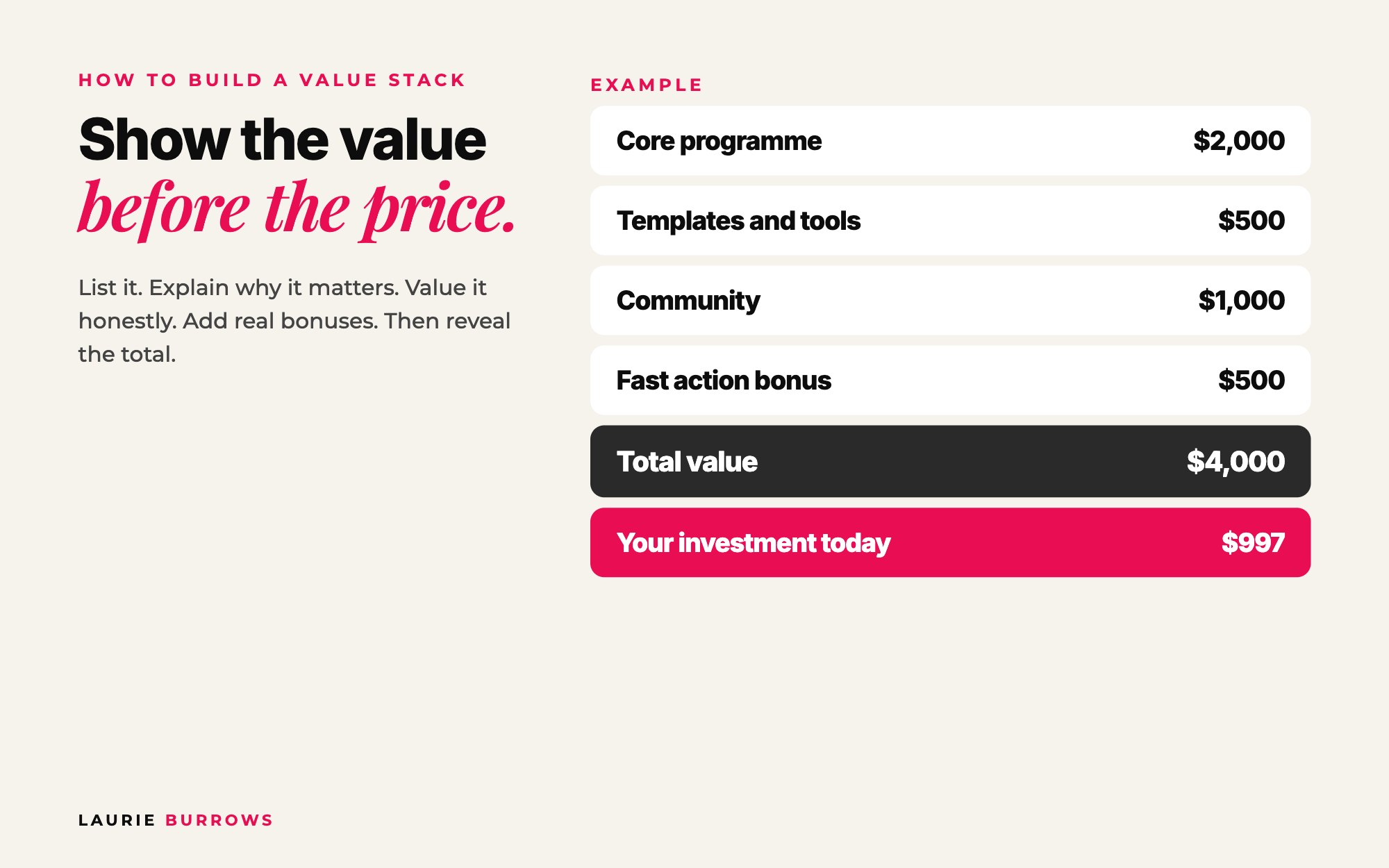
Recap everything with its value, add the bonuses, and show the total. Then reveal the price with confidence: "The total value is X. You're not going to pay that today. Your investment is Y."
Copy and paste: value stack script
"Let's recap everything you get when you join [offer] today."
"[Item one], so that you [outcome]. That's valued at $[value]."
"[Item two], so that you [outcome]. Valued at $[value]."
"[Item three], so that you [outcome]. Valued at $[value]."
"And if you join in the next [48] hours, you'll also get [bonus], so that you [faster result]. Valued at $[value]."
"That's a total value of $[total]. You're not going to pay that today. Your investment is $[price]." (Pause. Stop talking.)
Time: 30 minutes to write, 10 minutes to rehearse. Done when: you can say the whole stack out loud without notes and the total is clearly higher than the price.
What should you add to a value stack?
This is where people go wrong. They add more and more of their own time until they're drowning. Before you add anything, ask two questions:
- Does it get my clients better or faster results?
- Can I deliver it without needing more of my time?
The best additions are a yes to both. One to one time is the classic mistake. If every client gets one to one calls, there are only so many clients you can take on, and you've capped your revenue. If you're building an offer that could have hundreds of people in it, one to one doesn't scale.
Great additions tend to be things like:
- Templates and swipe files, so they don't start from a blank page.
- A custom AI trained on your method, so they get instant answers and support. In one of my programmes, an AI tool meant people could get help with their action steps straight away instead of waiting for a reply. It gets them faster results, and it doesn't matter whether 100 or 1,000 people are using it. It doesn't take more of my time.
- A community, where people ask questions, get feedback and connect. Your network becomes your net worth.
- Visibility opportunities, like a guest spot in front of your audience.
- A live workshop or strategy day as a fast action bonus, delivered to everyone at once.
An example from my own launch
When I launched Ascendia OS to founding members, the stack included the platform itself, brand voice training so everything it creates sounds like you, a university of the frameworks behind it, a community, and every new feature as it's released, with the founding rate locked in for good. Then there were bonuses for joining in the founding window: a virtual strategy day to plan their next 90 days, a visibility opportunity in front of my audience, a behind the scenes launch breakdown workshop, our funnel builder and template library free for 12 months, and a guided 12 week build.
Every piece tied back to one result: a marketing and sales system that makes you money, saves you money and saves you time. Every bonus was something that helped people get results faster, and most of it was delivered once to everyone. That's what a good stack looks like.
Bonuses beat discounts
When people want to make an offer more attractive, they often drop the price. I'd almost always add value instead. Discounts reduce the perceived value of your offer and they're unfair to people who paid full price. Bonuses increase the value and reward people for deciding quickly.
If you do want to offer money off for fast action, frame it as "I'm giving you $500 towards your tuition if you join in the next 48 hours", not "$500 off". I go into this in ethical urgency and scarcity.
Where to use your value stack
- On your sales page, with a summary of everything included near the bottom. People read the top, then scroll straight to the bottom.
- In your webinar or challenge pitch, after explaining what's included and before revealing the price. See the ultimate guide to webinars that sell.
- In your launch emails, especially as the fast action bonus is ending.
- In sales conversations, to reframe cost against value.
That's the same stack written four different ways. If you'd rather not do that yourself, the Copywriter inside Ascendia OS writes your sales page and launch emails in your voice, and the Funnel Builder builds the checkout, including order bumps and upsells, ready to go live.
And when you present it, say it with confidence. The stack does the heavy lifting, but if you sound unsure of the price, you undo all of it. If that's the hard part for you, read how to pitch without feeling icky. And if you want the value stack built into a full webinar, The 5-Figure Webinar Formula gives you the 10-step framework, the slides and the pitch script for $27.
Worked example: a $997 group programme
Example (illustrative): a business coach selling a 12 week group programme to get consistent clients from content.
| Item | Why it matters | Value |
|---|---|---|
| 12 week content to clients training | The exact system, step by step, so they stop guessing | $1,500 |
| Weekly group coaching calls | Feedback on their actual content, so they fix things fast | $1,200 |
| Post and DM template library | Never start from a blank page | $300 |
| Private community | Questions answered between calls, and accountability | $300 |
| Fast action bonus: live content planning workshop | A month of content planned in one sitting | $500 |
| Total value | $3,800 | |
| Price | $997 |
Every item is delivered to the whole group at once, so the coach can take 20 people or 200 without working more hours. And every line ties back to one end result: consistent clients from content.
Value stack benchmarks
| Decision | What I use |
|---|---|
| How to value an item | What it would cost if you sold it on its own |
| Fast action bonus window | 24 to 48 hours |
| Money off for fast action | Framed as "$500 towards your tuition", not "$500 off" |
| Where it goes in a pitch | After what's included, before the price |
| Where it goes on a sales page | A summary near the bottom |
Common value stack mistakes
- Mistake: Stacking before the end result is clear. Fix: Write the end result first.
- Mistake: Listing features. Fix: Add a "so that" to every item.
- Mistake: Values nobody believes. Fix: Use honest standalone prices.
- Mistake: Piling on one to one time. Fix: Add things that scale: templates, community, group workshops, tools.
- Mistake: Discounting instead of adding value. Fix: Add a fast action bonus.
Your action plan
Day 1
- Write your end result sentence.
- List everything included.
Day 2
- Add a "so that" line and an honest value to every item.
Day 3
- Choose one or two bonuses that pass the two questions.
Day 4
- Write your stack using the script above.
Day 5 to 7
- Add the stack to your sales page summary, your pitch and your cart emails, and rehearse it out loud.
- Read the ultimate guide to webinars that sell to see where the stack sits in the full pitch.
Want the value stack and pitch slides ready to go?
The 5-Figure Webinar Formula is my 10-step webinar framework for $27, with the slide deck template, the pitch script and the objection handling slides, so you can build an event that sells without starting from a blank page.
Rather have it done for you?
Let Ascendia OS put your value stack everywhere it needs to be
The Copywriter writes the stack into your sales page and launch emails in your voice, and the Funnel Builder builds your checkout with order bumps and upsells. 14 days free, no tech skills needed.
Frequently asked questions
What is a value stack?
A value stack is a list of everything included in your offer, with a value on each item, presented before the price. It shows buyers the total value is much higher than what they'll pay, which makes the offer an easier yes.
How do I put a value on each part of my offer?
Use what that piece would reasonably cost if you sold it on its own. Keep it honest and believable. Inflated values that nobody believes hurt trust instead of building it.
What should I add to make my offer more valuable?
Things that get clients better or faster results without needing more of your time, like templates, a custom AI tool, a community, group workshops or visibility opportunities. Avoid adding lots of one to one time, because it caps your revenue.
Should I add bonuses or lower my price?
Add bonuses. They increase perceived value and reward fast decisions, while discounts reduce perceived value and can feel unfair to people who paid full price.
Where does the value stack go in a pitch?
After you've named the solution, shown proof and explained what's included and why it matters, and before you reveal the price. Then add the bonuses, show the total value and reveal the price with confidence.
Laurie Burrows is a UK-based marketing and sales strategist who has built a business that's generated multi-seven figures in sales through social media and digital marketing. Today, Laurie helps business owners use social media, content and digital marketing to get seen, attract more clients and make more sales. She's also the founder of Ascendia OS.
Do you want to scale your business to 10K months in the next 90 days? I am looking for 10 people for my new case study program. DM me the word CASE STUDY on Instagram (@_laurieburrows) to learn more.