The Psychology of Why People Buy
Short answer: people buy on emotion and justify it with logic. Six emotional triggers drive most buying decisions: fear of loss, desire for gain, social proof and belonging, authority and trust, scarcity and urgency, and identity. Someone moves from interested to "take my money" when they feel understood, trust you can deliver, believe it will work for them specifically, find staying the same more painful than changing, can see a clear path from A to B, and feel the risk is lower than the reward.
The more you understand why someone buys, the better every part of your strategy gets: your offer, your content, your launches, your emails, your pitch. And the good news is you don't need a psychology degree to get it. You need to start paying attention to your own buying decisions.
This is part of my ultimate guide to creating an offer that sells, because the psychology of buying shapes every part of an offer that sells.
Start with your own customer journey
Think of something you invested in that cost real money: a mentor, a programme, a mastermind. Now map it out. On one side of a page write how you first found them (an ad, a recommendation, a podcast). On the other side write what you bought. In between, write every stepping stone you took. Joined their masterclass and didn't buy? Write down why. Joined their challenge and still didn't buy? Why? Then bought their low priced offer and went into their mastermind from there? What changed?
When I did this with the first big investment I made in my business ($20,000 into a mastermind, three days after I'd first heard of the mentor), the reasons were obvious once they were on paper: someone I trusted recommended them, their content was full of proof, and they took the time to speak to me personally. I built all three into my own strategy straight away.
Do the same and I promise you'll learn more about buyer psychology in 20 minutes than from any textbook, because you're watching it happen in yourself.
Emotion first, logic second
Nobody buys purely on logic. They feel something (relief, excitement, fear of missing out, the pull of who they could become) and then they use logic to justify it to themselves. The logic matters. It's what they'll tell their partner, and it's what stops buyer's remorse. But the emotion is what gets them to the checkout.
So if your marketing is all logic (features, modules, hours, price), you're giving people reasons with no desire behind them.
The 6 emotional triggers behind buying decisions
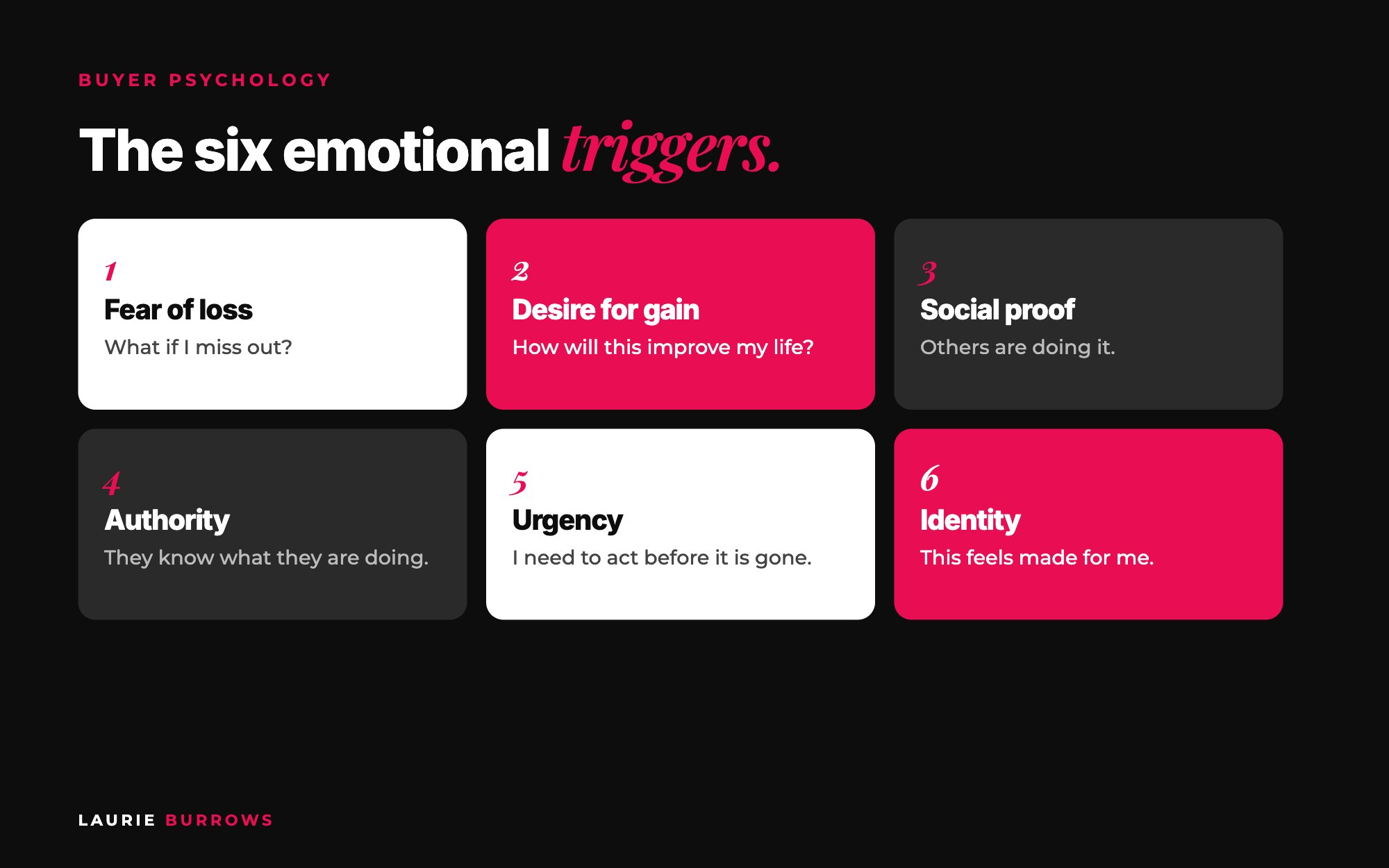
1. Fear and loss aversion: "What if I miss out?"
People fear losing more than they desire gaining. That's why a genuinely limited number of spots or a bonus that expires works so well. The key word is genuinely. Never invent scarcity. If you want to do this well, read ethical urgency and scarcity.
2. Desire for gain and transformation: "How will this improve my life?"
People buy to get out of a situation or into a better one, and they want it faster. Sell the transformation, not the product. Not "buy my fitness programme" but "get the body you've always wanted without giving up your favourite foods".
3. Social proof and belonging: "If others are doing it, I should too."
People trust reviews, testimonials and case studies far more than your own claims. I call this evidence based content: not just talking the talk, but showing you walk the walk. When buyers see people like them getting results, they want to belong to that group too.
4. Authority and trust: "I'll follow someone who knows what they're doing."
If two people sell exactly the same thing, buyers go with the one they trust most. If you're struggling to sell, there's a good chance you haven't built enough authority yet. Share your experience, your results, your credentials and your stories. Show people you didn't just pop up one day.
5. Scarcity and urgency: "I need to act before it's gone."
Scarcity increases perceived value. Urgency stops procrastination. Both need to be real: a fast action bonus that genuinely ends, a cohort that genuinely has limited spaces.
6. Identity and personal connection: "This feels like it's made for me."
People buy things that match who they are or who they want to be. Apple doesn't just sell technology, it sells creativity and status. Nike doesn't just sell shoes, it sells the identity of an athlete. Your messaging should speak to the identity your ideal client is stepping into.
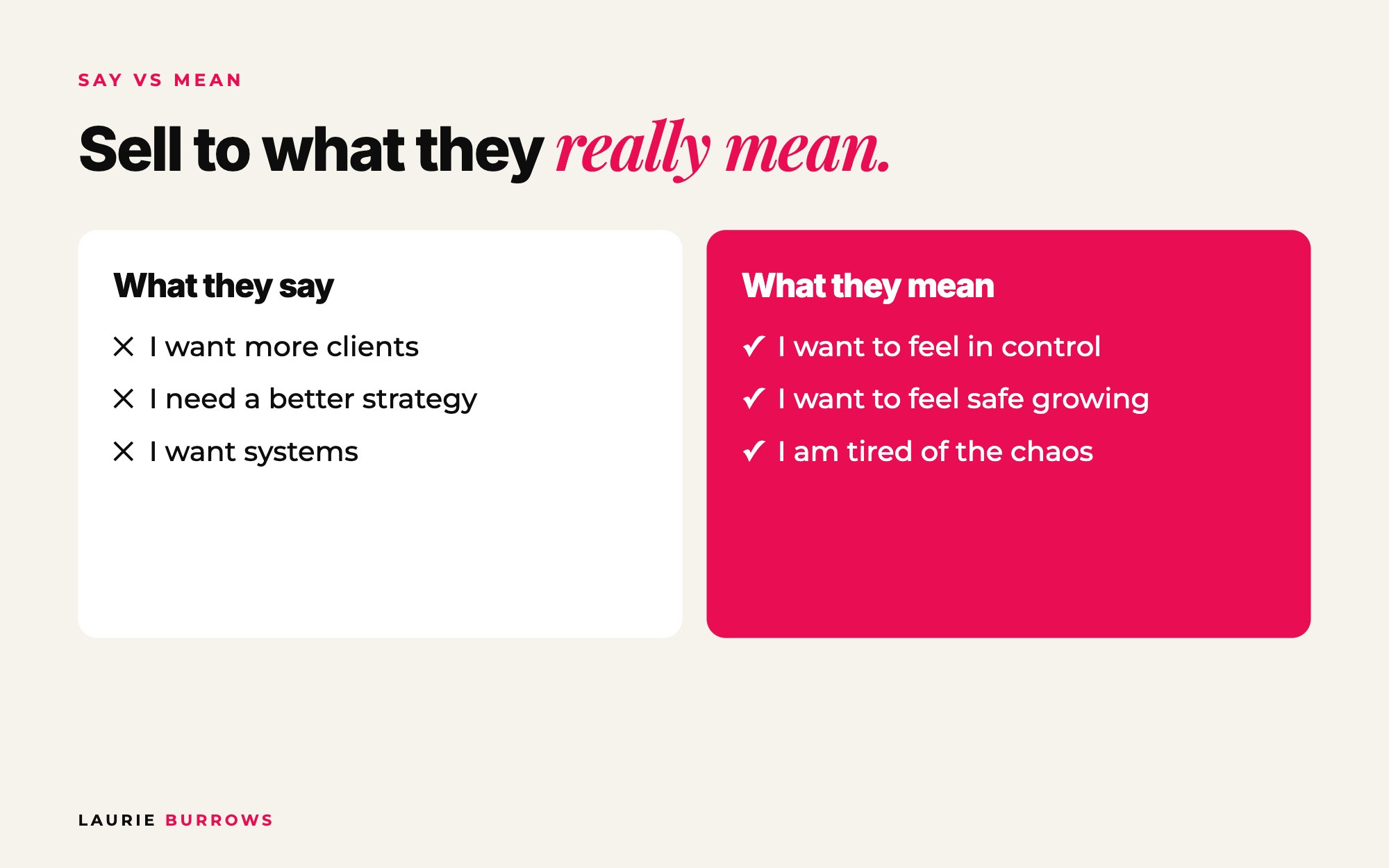
What they say vs what they mean
This is the bit most people miss. What your ideal client says they want often isn't what they mean.
- They say "I want more clients." They mean "I want to feel in control of my life."
- They say "I need a better strategy." They mean "I want to feel safe and confident that my business is growing."
- They say "I want systems." They mean "I'm tired of the chaos."
The surface want gets their attention. The deeper meaning is what makes them feel understood, and feeling understood is a huge buying trigger.
The 6 buying triggers: from interested to hell yes
Emotional triggers create desire. These six buying triggers are what tip someone over the line:
- They feel understood. They read your content and think, "She's talking about me." This is why I share so many relatable stories.
- They trust you can deliver. Not enough people show this. Show results, process and proof.
- They believe it will work for them specifically. Not just in general, but for someone in their situation.
- The pain of staying the same becomes unbearable. How would they feel if, 12 months from now, nothing had changed? Disappointed, exhausted, probably pretty fed up.
- They see a clear path from A to B. A named framework with clear steps does this beautifully.
- The risk feels lower than the reward. When the end result is clearly worth more than the price, the investment stops feeling risky.
Do this now: take your last five posts or emails and score each one against the six buying triggers. Which ones do you hit all the time, and which do you never touch? Most coaches are great at "feel understood" and almost never show they can deliver. Write your next three posts to fill the gaps.
Why price changes the psychology
How someone buys a $27 offer is completely different to how they buy a $5,000 offer. A $27 offer is an impulse buy. It's low risk, so people will buy it even if they barely know you, because they're buying the content rather than the person. A four or five figure offer is a considered decision. It needs far more trust, far more proof, and usually a longer journey with more questions and objections along the way.
That's why the higher your price, the more your strategy needs to focus on authority and trust, and the lower your price, the more it needs volume. Same psychology, different weighting.
How to put buyer psychology into your marketing, step by step
Here's how to turn all of this into content, emails and a sales page that move people from interested to hell yes. Work through it once properly and you'll have a messaging bank you can use for months.
Step 1: Build a say vs mean list
Go through your DMs, comments, sales calls and enquiry forms. Write down 20 things your ideal clients actually say, word for word. Next to each one, write what they really mean: the feeling underneath. "I need more clients" next to "I want to stop worrying about paying the bills."
Time: 45 minutes. Done when: you have 20 rows, each with a say and a mean.
Step 2: Audit your content against the six triggers
Look at your last 20 posts and tag each one with the trigger it hits: fear of loss, desire for gain, social proof, authority, scarcity and urgency, or identity. Most people find they're heavy on one or two and missing the rest. Social proof and authority are usually the gaps.
Time: 30 minutes. Done when: you know which triggers you are using and which are missing.
Step 3: Plan one week of content that covers all six
Use the plan below. Each post uses one say vs mean line from step 1 as the hook. Keep it simple: written posts, stories or short videos all work.
Time: 1 hour to plan. Done when: you have six posts planned, one per trigger.
| Day | Trigger | Post idea |
|---|---|---|
| Monday | Desire for gain | Paint the after: a day in the life once the problem is gone |
| Tuesday | Authority and trust | Teach one step of your method properly, with your reasoning |
| Wednesday | Social proof | A testimonial or result, told as a story with the before and after |
| Thursday | Identity | "This is for you if..." describing who they are becoming |
| Friday | Fear of loss | What staying stuck for another six months really costs |
| Saturday | Scarcity and urgency | A genuine deadline: doors closing, bonus ending, spaces left |
Step 4: Write your posts with the say vs mean formula
Use the template below for at least three of your six posts. It opens with what they say, names what they mean, and gives them the logic to justify the emotion.
Time: 20 minutes per post. Done when: three posts are written and scheduled.
If writing and scheduling is the bit that never happens, hand it off. The Content Creator inside Ascendia OS plans your month, writes posts in your voice and schedules them straight to Instagram, Facebook, LinkedIn and more. Give it your say vs mean list and the six triggers, and approve what it writes.
Copy and paste: say vs mean post
Hook: "[What they say, word for word]."
Turn: That's what you say. What you actually mean is [what they mean].
Story: I know, because [a moment from your own experience or what you see every week].
Shift: The problem isn't [what they think]. It's [what is really going on].
Logic: Here's what changes when you fix it: [result 1], [result 2], [result 3].
Call to action: If that's you, [comment X / click the link / reply to this] and I'll [send the details / the free training].
Step 5: Add proof and real urgency to your sales page
Under every big claim on your sales page, add proof: a testimonial, a result, a screenshot or your own story. Then add one genuine reason to act now: a start date, a bonus that ends, a cohort that closes. If you don't have a real one, create one by running the offer in rounds.
Time: 1 hour. Done when: every claim has proof underneath and there is one honest deadline.
The Copywriter in Ascendia OS can do the same for your sales page and launch emails, weaving in your proof and your real deadline in words that sound like you.
Example: the same coach, two price points
This is an illustrative example. A mindset coach sells a $27 workshop and a $3,000 programme. For the $27 workshop she leads with desire for gain and urgency: "Stop overthinking every post in 60 minutes. $27 until Friday." It's an impulse buy, so a clear result and a deadline are enough.
For the $3,000 programme she leans on authority, social proof and identity: her story of rebuilding her own confidence, three client stories told as before and afters, and "This is for the coach who is ready to be seen as the expert in her niche." Same audience. Different psychology because the price changes how people decide.
Benchmarks to aim for
| What you measure | Aim for |
|---|---|
| Triggers covered in a week of content | All six |
| Funnel email open rates | 40 to 50% |
| Leads to sales | Around 3% on average. My own launches convert at 10 to 12%. |
| Order bump take up on a low priced offer | 70 to 80% of buyers when the bump is a clear yes |
Common mistakes when using buyer psychology
- Overusing fear. Don't scare people into buying. It might work once. It won't build a business people trust.
- Fake scarcity. "Only three spots left" when there are 300 is a fast way to lose trust for good.
- Generic messaging. If it could be about anyone, it won't make anyone feel understood.
- Ignoring emotion. Logic alone won't sell. Neither will emotion with nothing to back it up. You need both.
If you want my full system for writing content that sells using these triggers, it's all inside Content To Clients®.
Understanding the psychology is one half. The other half is building an offer that gives people good reasons to say yes. Start with the 3 reasons people buy and why your offer sounds too vague to buy. For more help, have a look at my free resources.
Your action plan
Today
- Write down 10 things your ideal clients say and what they mean.
- Tag your last 20 posts with the trigger each one uses.
This week
- Finish your say vs mean list to 20 rows.
- Plan and post one piece of content per trigger.
- Add proof under every claim on your sales page.
Next 30 days
- Repeat the six trigger week four times with new hooks.
- Add one genuine deadline to your offer.
- Track which trigger posts get the most replies and enquiries, and do more of those.
- Use the ultimate guide to creating an offer that sells to build the triggers into the offer itself.
Want the whole system for turning content into sales?
Content To Clients® is my course for turning your content into repeat sales, with every tool and template I use, from hooks and posts to the funnel behind them.
Rather have it done for you?
Let Ascendia OS write the six-trigger week for you
The Content Creator plans and writes a week of posts covering all six triggers in your voice and schedules them for you, and the Copywriter adds proof and honest urgency to your sales page and emails. 14 days free, no tech skills needed.
Frequently asked questions
Do people buy on emotion or logic?
Both, in that order. People buy on emotion and then justify the decision with logic. Your marketing needs to create the emotional pull and give them the logical reasons to back it up.
What are the main emotional triggers in marketing?
Fear and loss aversion, desire for gain and transformation, social proof and belonging, authority and trust, scarcity and urgency, and identity and personal connection.
Is using buyer psychology manipulative?
Not when it's honest. Understanding why people buy helps you explain your offer in a way that genuinely connects. It becomes manipulative when you use fake scarcity, false claims or fear to push people into something that isn't right for them.
Why do people take months to buy from me?
Some people are impulsive buyers and some take three, six or even 12 months in your world before they buy, especially for higher priced offers. Build trust consistently with evidence based content and stories so you're the obvious choice when they're ready.
How do I make my ideal client feel understood?
Use their words, not yours. Talk about what they mean, not just what they say, and share relatable stories from your own experience. Market research and conversations with your audience are the fastest way to learn their language.
Laurie Burrows is a UK-based marketing and sales strategist who has built a business that's generated multi-seven figures in sales through social media and digital marketing. Today, Laurie helps business owners use social media, content and digital marketing to get seen, attract more clients and make more sales. She's also the founder of Ascendia OS.
Do you want to scale your business to 10K months in the next 90 days? I am looking for 10 people for my new case study program. DM me the word CASE STUDY on Instagram (@_laurieburrows) to learn more.