Why Your Offer Sounds Too Vague to Buy
Short answer: your offer sounds too vague to buy when a buyer can't picture exactly what changes for them. It usually happens because you describe what's inside (modules, calls, hours) instead of the end result, you try to speak to everyone, or your language is so general it could belong to any coach in your industry. Fix it by naming who it's for, the specific result, the timeframe and what they won't have to do, then go deeper into the words your ideal client uses at 3am.
On a recent live session, I asked everyone to put the clear outcome of their offer in the chat. "If I came to work with you right now, what would I walk away with?" The answers flooded in. And for most of them, I honestly couldn't tell you what I'd get.
These were brilliant people with offers that genuinely change lives. But if I couldn't picture the result, neither could their buyers. And if a buyer can't picture the result, they're not going to buy.
This is part of my ultimate guide to creating an offer that sells, where nailing a specific end result is the foundation everything else is built on.
Vague is the number one offer killer I see. Here's how to spot it and fix it.
Why vague offers don't sell
The end result is the biggest reason anyone invests. It's their return on investment. If they can't see the end result clearly, they can't work out whether it's worth the price, which means they can't justify saying yes, even if they like you and love your content.
Vague also makes you invisible. "I help entrepreneurs grow their business" sounds like hundreds of other people. When you sound like everyone else, buyers have no reason to choose you, so they either go with whoever they trust most or do nothing at all.
Free 5 day event · 12th to 16th October
The 6 Figure Game Plan
Once your offer is specific, the next step is a plan to sell it. In my free 5 day event you'll map your strategy to 6 figures and get the plan, content and pages created for you.
The 4 signs your offer is too vague
1. You describe features, not transformation
"You get six modules and 12 calls." Some buyers will care what's inside, because value versus price matters. But what they care about most is where they'll be at the end. Features answer "what do I get?" Buyers are asking "what will change?"
2. It's about you, not them
"I'm a certified coach with 10 years of experience." That's useful later, as proof. As a headline, your buyer is thinking: so what? Messaging that converts is about their situation, not your credentials.
3. You're trying to appeal to everyone
When you try to speak to everyone, you resonate with no one. "Business owners", "people who want more confidence" and "anyone ready to change their life" are too wide for anyone to see themselves in.
4. It's surface level
"Make more money." "Feel better." "Grow your business." Everyone says this, and your buyer has heard it a thousand times. Surface level language slides straight past them.
What specific looks like
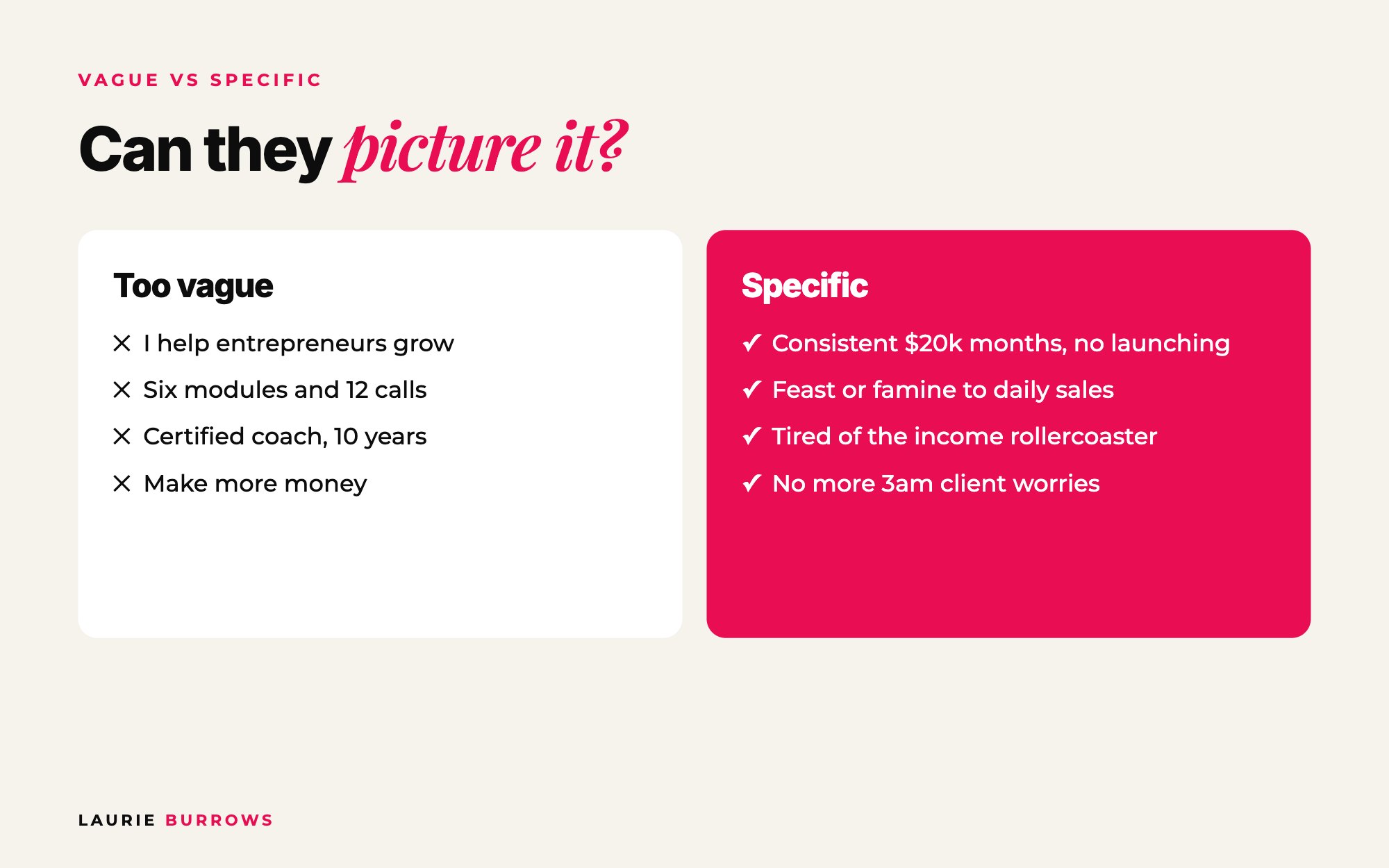
Here's the difference, side by side:
- Vague: "I help entrepreneurs grow their business." Specific: "I help service providers hit consistent $20,000 months without launching."
- Vague: "My programme has six modules and 12 calls." Specific: "Go from feast or famine to predictable daily sales."
- Vague: "I'm a certified coach with 10 years of experience." Specific: "You're tired of the income rollercoaster."
- Vague: "Make more money." Specific: "Stop waking up at 3am wondering where your next client is coming from."
The specific versions are specific about who it's for, about them rather than you, focused on the transformation, and they go deep enough that the reader feels seen.
How to make your offer specific, layer by layer
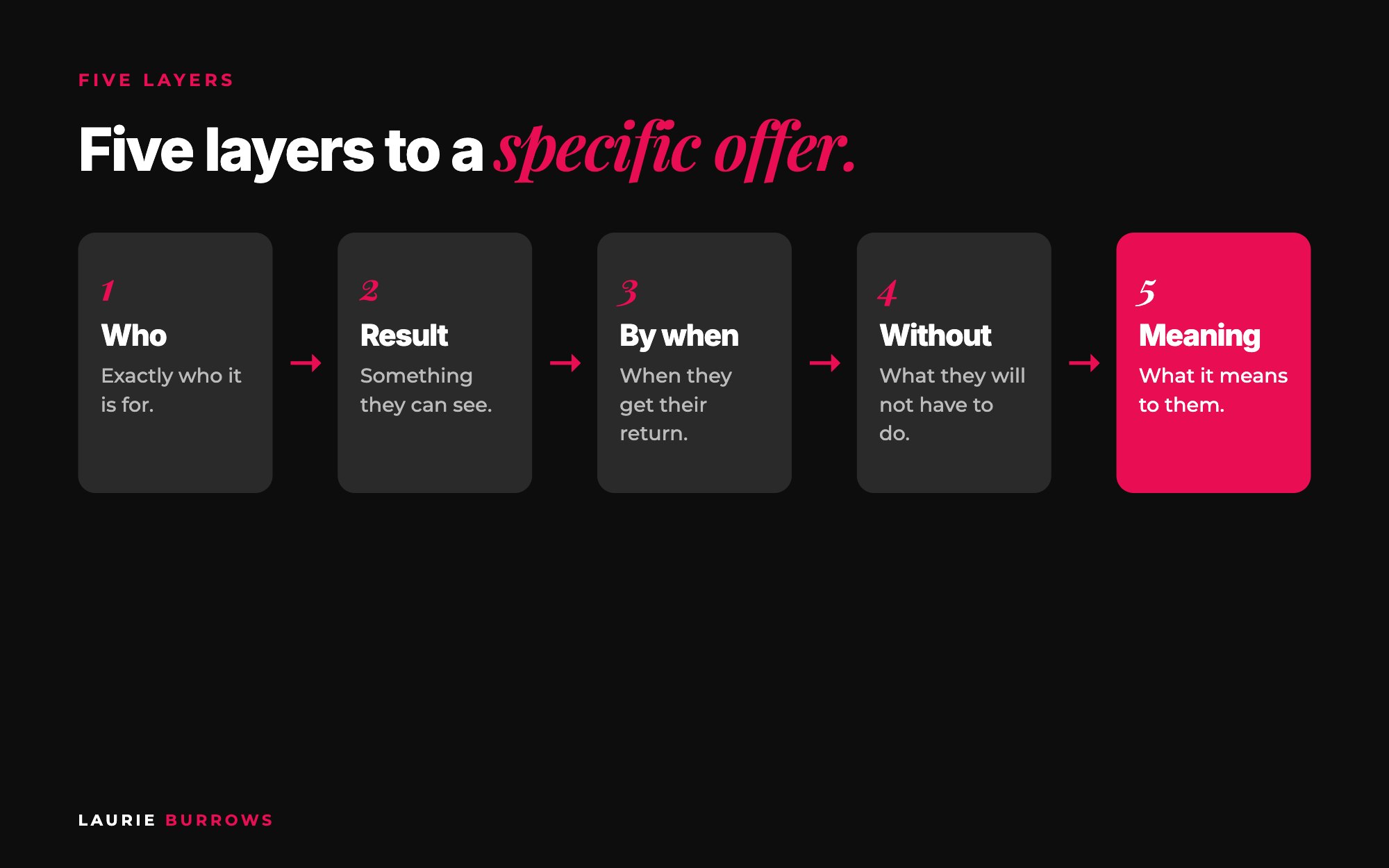
When I rewrite an offer, I build it up in five layers.
Layer 1: Who exactly is it for?
Not "coaches". Which coaches? At what stage? With what situation? "Service providers who are already booked out" is a different person from "new coaches who haven't had a paying client yet".
Layer 2: What's the specific end result?
Something they can see or measure. If your result feels intangible, ask the why behind the why. Why do they want confidence? To speak on stage. Why? To get more clients. Now you have a result people will pay for.
Layer 3: By when?
A timeframe shows them when they'll see their return. "Heal your gut and stop feeling bloated in 30 days" is far stronger than "heal your gut".
Layer 4: Without what?
What do they not want to do or give up to get there? "Without restrictive dieting." "Without launching." "Without posting every day." This speaks straight to the objection already in their head.
Layer 5: What does it mean to them?
What your client says they want often isn't what they mean. They say "I want more clients" and mean "I want to feel in control". They say "I need systems" and mean "I'm tired of the chaos". Put the deeper meaning into your messaging and they'll feel like you're reading their mind.
An example from my own offer
When I sold my done for you Million Dollar Revenue Machine, I didn't describe it as "a done for you marketing package". The end result was a fully installed revenue machine in 30 days: leads coming in, a funnel running, an email sequence firing and revenue being generated every day. Who it's for, what they get, by when. Nobody had to guess what would change.
Then the value and the point of difference sat underneath it: built by me and my team, using the methodology behind a business that's generated multi-seven figures in sales. Clear result first, proof second.
Do this now: write your offer in one sentence using this template: "I help [who exactly] get [specific result] in [timeframe] without [thing they don't want to do]." Then read it to someone who matches your ideal client and ask, "Can you picture what changes for you?" If they hesitate, go another layer deeper.
Where vagueness hides
Once your offer sentence is specific, check it's showing up that way everywhere a buyer meets it:
- Your bio. Does it say who you help and what result, or just your job title?
- Your sales page headline. Is the end result the first thing they read, or the name of your programme?
- Your launch emails and posts. Are you talking about the transformation, or about what's included?
- Your replies when someone asks "what do you do?" This is the one most people fumble. Have your one sentence ready.
Consistency matters here. If your bio says one thing, your sales page another and your posts something else, buyers get a blurry picture, and blurry reads as vague.
Is it my offer or my messaging?
Often it's both. Sometimes the offer itself is vague because it was built around what you wanted to teach rather than a specific result. Sometimes the offer is clear in your head but the messaging around it (sales page, posts, emails) is vague. Check both. If your sales page lists what's inside but never says where they'll be at the end, start there.
And if you've fixed the vagueness and it still isn't selling, look at the other offer killers: not enough perceived value, nothing unique, no proof, or a result that isn't a priority for your ideal client right now. I cover all five in the ultimate guide to creating an offer that sells, and the three questions every buyer asks in why is no one buying my offer.
Specific feels scary. Do it anyway.
The reason most people stay vague is fear. If I get specific, I'll put people off. If I name a result, what if someone doesn't get it? But vague doesn't protect you, it just makes you forgettable. Specific is what makes the right people put their hand up. The people it puts off were never going to buy anyway.
If you want to understand why specific language works so well, read the psychology of why people buy. Or grab one of my free resources to work through your offer.
How to rewrite a vague offer in one afternoon, step by step
Knowing the five layers is one thing. Here's exactly how to use them to rewrite your offer and get the new version in front of buyers this week.
Step 1: Collect every description of your offer
Copy your bio, sales page headline, the first paragraph of your sales page, how you describe it in DMs, and the last three posts where you mentioned it. Paste them into one document. You'll probably find you describe the same offer five different ways, and most of them are vague.
Time: 20 minutes. Done when: everything a buyer reads about your offer is in one place.
Step 2: Ask the why behind the why
Take the result you currently promise and ask "why do they want that?" three times. Write each answer down. "More confidence" becomes "to speak on stage", becomes "to win clients from stages", becomes "so they stop relying on social media for every sale". The third or fourth answer is usually the one people pay for.
Time: 15 minutes. Done when: you've got a result someone could see or measure.
Step 3: Build your offer sentence with the five layers
Fill in the formula below. Write three versions, then pick the one that sounds most like how your ideal client talks. Use their words from DMs and comments, not your industry words.
Time: 30 minutes. Done when: you have one sentence with a who, a result, a timeframe and a without.
Copy and paste: specific offer formula
Offer sentence: I help [who, at what stage] to [specific, measurable end result] in [timeframe], without [what they do not want to do].
What it means to them: so you can finally [the deeper meaning: control, safety, time back, pride].
Bio version: Helping [who] [end result] without [objection] | [one line of proof]
DM version: "It's basically for [who] who want [end result] in [timeframe], without [objection]. Want me to send you the details?"
Step 4: Run the stranger test
Send your new sentence to three people who don't know your business well. Ask them one question: "What would I get if I bought this?" If they can repeat the result and timeframe back to you, it's specific. If they say "help with your business", go back to step 2.
Time: 1 day (waiting for replies). Done when: three people can tell you what changes for them.
Step 5: Replace every vague version
Update your bio, sales page headline, the first paragraph of your sales page, your pinned post and your DM wording with the new sentence. Then write three posts this week that each take one layer and expand on it: one on the result, one on the timeframe, one on the without.
Time: 1 to 2 hours. Done when: every place a buyer meets your offer says the same specific thing.
This is the step most people half do, because there are so many places to update. The Copywriter inside Ascendia OS can rewrite your sales page, emails, ad copy and DMs around your new offer sentence in your voice, so the specific version shows up everywhere at once.
Example: a business coach with a $1,200 programme
This is an illustrative example.
- Before: "I help entrepreneurs grow their business with strategy and accountability."
- Why behind the why: grow their business, to have consistent income, to stop the feast or famine months, so they can stop panicking every time a client finishes.
- After: "I help coaches who've had a few clients book 4 new clients a month in 90 days, without launching or posting every day, so you can finally stop panicking every time a client finishes."
- Bio: "Helping coaches book 4 new clients a month without launching | 10 years coaching business owners"
The programme hasn't changed at all. What's changed is that a coach with an empty diary can read it and know in five seconds whether it's for them.
Benchmarks to aim for
| Check | Aim for |
|---|---|
| Stranger test | 3 out of 3 people can repeat the result back to you |
| Offer sentence | Under 30 words, with a number or timeframe in it |
| Opt-in page conversion | 40% plus, which is much easier when the result is specific |
| Leads to sales | Around 3% on average. My own launches convert at 10 to 12%. |
Common mistakes (and the fix)
- Rewriting the headline but leaving the bio and DMs vague. Fix: update every place a buyer meets your offer in the same week.
- Using your industry words. Fix: copy the exact words your ideal clients use in comments and DMs.
- Promising everything. Fix: pick one end result. You can mention the extras further down the page.
- Leaving out the timeframe because it feels risky. Fix: give a realistic timeframe for doing the work, not a guarantee.
Your action plan
Today
- Collect every description of your offer in one document.
- Ask the why behind the why three times.
This week
- Write three versions of your offer sentence and pick one.
- Run the stranger test with three people.
- Update your bio, headline, pinned post and DM wording.
Next 30 days
- Post three times a week, each post expanding one layer.
- Hand off the writing if it keeps slipping: the Content Creator in Ascendia OS plans, writes and schedules posts in your voice.
- Track enquiries and opt-ins against the previous month.
- Refine the sentence using the questions people ask you.
- Build the rest of your offer with the ultimate guide to creating an offer that sells.
Want help making your offer impossible to misread?
In the 90 Day Revenue Growth Accelerator I work with you on your end result, your messaging and your sales plan, so the right people know exactly why to buy.
Rather have it done for you?
Get your specific offer into every page and post
The Copywriter rewrites your sales page, emails and DMs around your new offer sentence, and the Content Creator writes and schedules a month of posts that each expand one layer, all in your voice. 14 days free, no tech skills needed.
Frequently asked questions
How do I know if my offer is too vague?
Ask someone who matches your ideal client to explain back what they'd get from your offer. If they describe the format (calls, modules) rather than a specific result, or they can't picture what changes for them, it's too vague.
Won't niching down mean fewer sales?
Usually the opposite. When you speak to everyone you resonate with no one. A specific offer makes the right people feel seen, which is what gets them to buy.
What if my result is hard to measure, like confidence?
Ask the why behind the why until you reach something tangible. Confidence becomes the confidence to speak on stage, which becomes being seen as the expert, which becomes getting more clients.
Should I include a timeframe in my offer?
Where you honestly can, yes. A timeframe shows buyers when they'll see their return on investment, which makes the offer far easier to say yes to. Only promise what your offer can realistically deliver.
What's the difference between vague and broad?
Vague means the result isn't clear. Broad means you're trying to speak to too many people. Both make it hard for a buyer to see themselves in your offer, and they often show up together.
Laurie Burrows is a UK-based marketing and sales strategist who has built a business that's generated multi-seven figures in sales through social media and digital marketing. Today, Laurie helps business owners use social media, content and digital marketing to get seen, attract more clients and make more sales. She's also the founder of Ascendia OS.
Do you want to scale your business to 10K months in the next 90 days? I am looking for 10 people for my new case study program. DM me the word CASE STUDY on Instagram (@_laurieburrows) to learn more.