Why My Old Launch Strategy Stopped Working (and What I Do Now)
Short answer: launches stopped working the way they used to because buyers changed. People are tired of courses, they take longer to decide, they want implementation over information and they expect conversations before they buy. Long live challenges also lose most people before the pitch. What works now is a short, pre-recorded experience that lets people try before they buy, with a community, a day three pitch and personal follow up. That's how my launches convert at 10 to 12% when the average is 1 to 3%.
In May 2021, about 18 months after I started my business, I launched a new programme and hit my first six figure month. Cash in the bank. And honestly? It felt easy. I put the offer out, did a little launch, and it went mad.
A few years later, with a bigger audience, a bigger reputation and an email list around five times the size, we tried to replicate it. Same offer with a different name. Same style of launch. It flopped. Completely.
That told me everything. It wasn't the offer and it wasn't me. How people buy, and what they're willing to invest in, had changed. If your launches used to work and now don't, this is probably what's happening to you too. Below I'll show you the five shifts, then the exact step-by-step launch I run now, with the scripts, the numbers to aim for and an action plan.
This is part of my ultimate guide to a 6 figure course launch, which walks through the whole launch from pre-launch to post-launch.
Why did my launch strategy stop working?
When I look at launches that haven't gone to plan, the same shifts come up again and again.
1. We're in a trust economy
People are thinking far more carefully about where they spend their money and who they invest in. The time it takes someone to go from finding you to buying from you has got longer. A launch that relies on someone meeting you on Monday and buying on Wednesday needs to build a lot more trust, a lot faster, than it used to.
2. People are bored of courses
Your ideal client has already bought the courses and the programmes. Many of them never finished them. They've had enough information. What they want now is implementation and faster results. So if your launch is selling "more training", it's selling the thing people are tired of.
3. Long live sessions lose people before the pitch
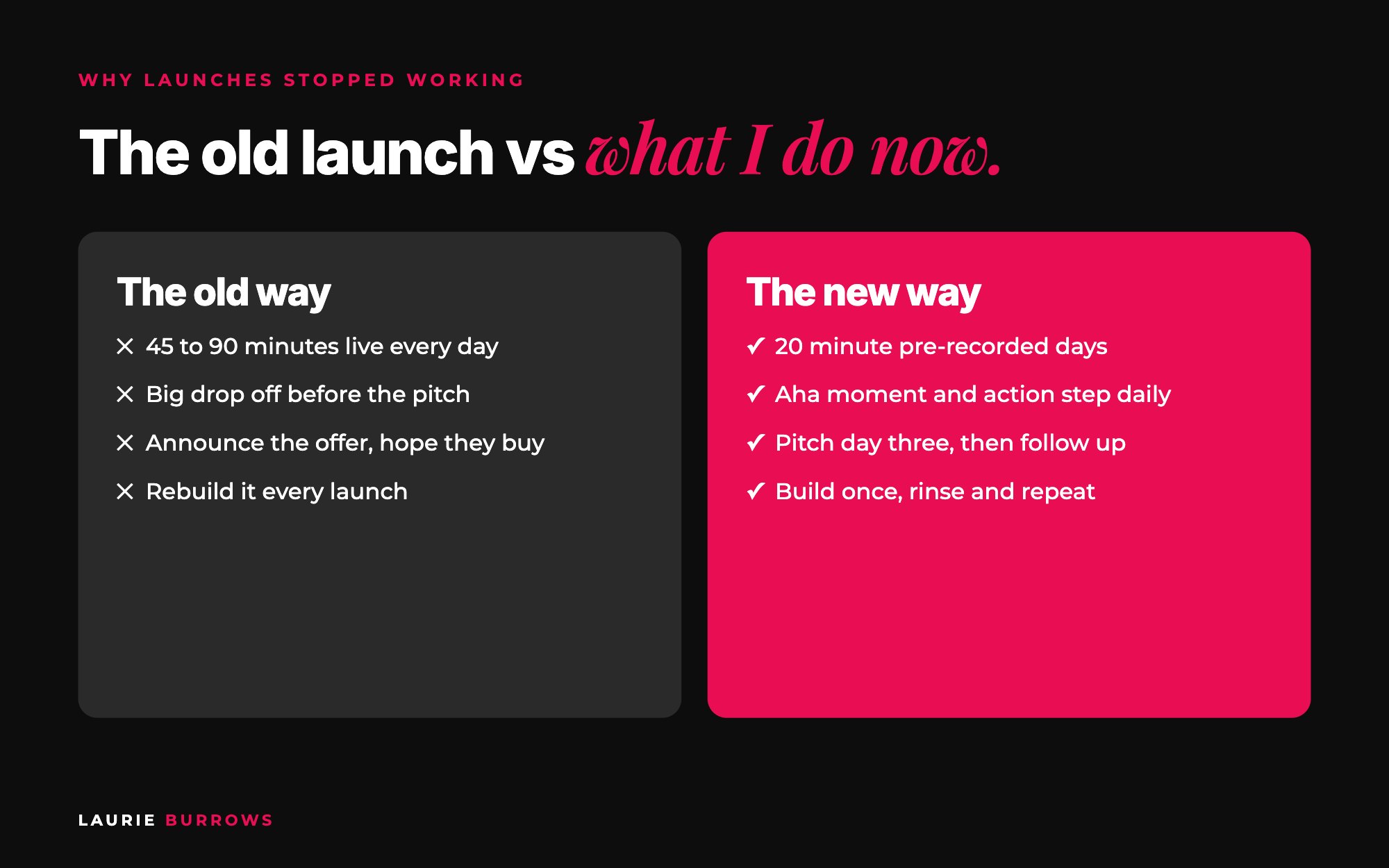
The old model was 45 to 90 minutes live every day for three to five days. The problem is your audience is tight for time. You might get a 25% show up rate on day one, 20% on day two and 15% on day three. By pitch day, hardly anyone is watching. I've done the five live days myself. By day five I was exhausted, and so was everyone watching.
4. Announcing the offer isn't enough anymore
It used to be as easy as going live, announcing your offer on day two or three and sending people to a sales page. They'd buy straight from your content and emails. Now people want to ask questions, have conversations and get reminders. If all you're doing is posting and emailing, that's a huge reason your sales aren't where you want them to be.
5. The pitch got weaker
I've watched so many challenge pitches lately that are, honestly, weak. People get to the moment, panic, and mention their offer in two sentences on the way out. If you don't sell properly, people don't buy properly.
What I do now instead, step by step
I didn't throw launching out. I rebuilt it around how people buy now. I call the free part The 5 Day Experience, and it runs like a launch without me having to be live. Here's how to rebuild yours.
Step 1: Find exactly where your last launch broke
Before you change anything, pull four numbers from your last launch: sign-ups, how many watched live (or opened day one), how many were still there on pitch day, and sales. Then find the biggest drop. Not enough sign-ups is a leads problem. People signing up and not showing is a length and reminders problem. People showing up and not buying is a pitch and follow up problem.
Time: 30 minutes. Done when: you can name the one stage where most people fell out.
Step 2: Make it pre-recorded, short and set to a start date
Each day is a pre-recorded session of around 20 minutes. Short sessions mean people actually finish them, so far more of them are still watching when I pitch. I explain why this works so well in why 20 minute trainings sell better than 2 hour masterclasses.
But it still has a start date, just like a live launch. Everyone starts on the same day and goes through it together. That's how you keep the buzz and energy of a live launch without the live part. Sessions go out by email and WhatsApp at the same time each day, so people can fit them around their lives and there are no time zone problems or "sorry, I missed it" messages.
When I asked my own community whether they preferred live or pre-recorded, around 80% said pre-recorded.
Time: One or two afternoons to record five sessions of around 20 minutes. Done when: each day is recorded, under 25 minutes, and scheduled to go out by email and WhatsApp at the same time each day.
Step 3: Build a real try before you buy
The free experience is a snippet of the paid offer. Think of a gym's free three day pass or a software free trial. Every day has one aha moment (the thing they didn't realise was missing) and one action step (so they implement and get a small result). Small results build trust, and trust creates the sale.
When I launched a passive AI product, the action step each day was to use the product itself. By the end of five days, people had experienced it and couldn't imagine going back. That launch sold at four figures and had over 100 sign-ups at a time when lots of businesses were struggling to sell anything. You don't need AI or software to do this. You just need to ask: how can people experience working with me before they pay?
Time: 1 hour to plan. Done when: you can write one aha moment and one action step for every day on a single page.
Step 4: Open the community and add a bit of fun
Everyone who opts in is invited straight into a community. People introduce themselves, share wins and post about what they're loving. Those posts pull back the people who signed up and forgot. We run prizes for the most engaged person, which gets people posting and taking action. When one person joins the paid offer and celebrates, others want in too.
Time: 1 hour to set up. Done when: the community is open, there is a pinned welcome post asking people to introduce themselves, and the prize is announced.
Step 5: Pitch on day three, with a reason to act now
Days one and two build trust. On day three, attention is at its peak, so that's when I pitch, with a 48 hour fast action bonus. I want people buying while they're in the experience and getting results, not ten days later when they've moved on. Days four and five give me two more chances to pitch and handle objections.
Small tweak that made a difference: I now close cart on a Monday, not a Sunday. On Sundays people are resting or out with family. On Mondays they're back at their desks.
If you want the full pitch structure and a script to work from, The 5-Figure Webinar Formula walks you through it for $27. Here's the email I'd send the moment the doors open:
Copy and paste: day three pitch email
Subject: The doors are open (and the bonus ends in 48 hours)
Hey [name], today in [event name] you [the result from today's action step]. That's the bit most people never get to on their own.
If you want me to help you go all the way to [end result], [offer name] is now open. Inside you get [three biggest things, each tied to the outcome].
Join in the next 48 hours and you'll also get [fast action bonus]. That bonus goes on [day and time]. Doors close on Monday at [time].
[Join here]. Any questions, reply to this email or message me and I'll answer personally.
Time: 2 hours to write the pitch, bonus and cart emails. Done when: your day three pitch, a 48 hour fast action bonus and a Monday cart close are written and scheduled.
Step 6: Follow up personally, then run an encore
Content and emails alone aren't enough, so we follow up through WhatsApp, DMs and conversations. And because even a strong launch means most people didn't buy, I run an encore afterwards ("life got in the way, so here's another chance") or a low priced down sell. Those people are still leads.
Copy and paste: follow up DM
Hey [name], I saw you did the day three task in [event name]. How did it go?
Quick question: will you be joining us inside [offer name]? The [fast action bonus] goes at [time].
If it's a "yes, but", tell me the but and I'll help you figure it out. If it's a no, can I ask why? It's really helpful feedback for me.
Time: 30 to 60 minutes a day during cart open. Done when: everyone who engaged has had a personal message, and your encore or down sell date is booked.
Step 7: Review, tweak and rinse and repeat
When the cart closes, record the same four numbers as Step 1 and compare. Keep what worked, change one thing that didn't, and run it again. Because it's all pre-recorded, the second and third rounds take a fraction of the effort of the first. And if you'd rather not rebuild the emails, pages and schedule every time, the Launch Manager inside Ascendia OS plans the launch from first email to cart close, then sets it up to run again on repeat.
Time: 1 hour. Done when: you have written down your conversion rate and the one change you're making next round.
Do this now: look at your last launch and find the biggest drop. Was it sign-ups (not enough leads), show up (sessions too long or not enough reminders), or sales (weak pitch, no follow up)? Fix that one stage first before you change anything else.
Free 5 day event · 12th to 16th October
The 6 Figure Game Plan
Want to see this way of launching from the inside? Join my free 5 day event (12th to 16th October). You'll map your strategy to 6 figures and get the plan, content and pages created for you.
Does the new way actually convert better?
Yes. The industry average for a launch is around 1 to 3%. This model converts at 10 to 12% for me. Here's what that means in real numbers.
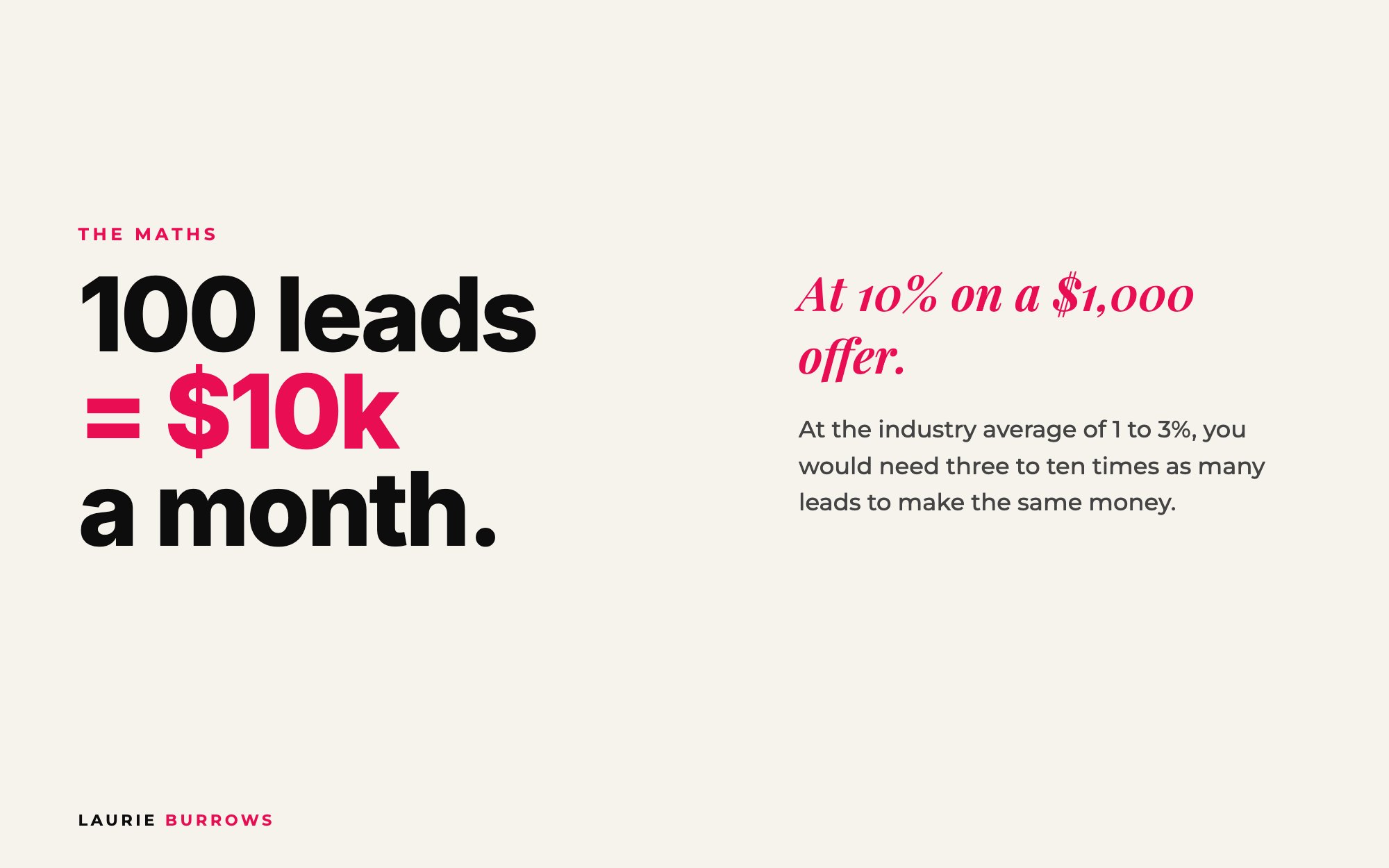
Say you generate 100 leads a month and 10% buy a $1,000 offer. That's $10,000 a month, or $120,000 a year, from just 100 leads a month. At $2,000 it's $20,000 a month. At 1 to 3%, you'd need three to ten times as many leads to make the same money.
Because it's built once, I can rinse and repeat it. Same recordings, same opt-in page, same emails, same content. After each round we look at what did well and tweak. Which means my team can run it, and I can grow the business without growing my hours.
The one thing pre-recorded doesn't fix
You still have to turn up. I've run the same pre-recorded launch three times. The third time I was away for my birthday, so I was less engaged in the community, posted less and didn't create the same excitement. The conversion rate dropped. Still good, but nowhere near the first two. The only thing that changed was me.
So pre-recorded doesn't mean absent. It means you get to spend your energy on the community, the conversations and the pitch, instead of on delivering live every day.
Worked example: rebuilding a launch that flopped
Example (illustrative numbers): a coach selling a $1,000 programme ran a five day live challenge. 400 people signed up, around 100 showed up on day one, around 40 were still watching on pitch day five, and she made 4 sales. That's 1% and $4,000.
- Step 1 diagnosis: the big drop was between day one and pitch day. A show up and length problem, not an offer problem.
- The rebuild: five pre-recorded 20 minute sessions, each with one aha moment and one action step, delivered by email and WhatsApp, with a community and a prize for the most engaged person. Pitch on day three with a 48 hour bonus, cart closes Monday, personal DMs to everyone who did a task.
- The maths if it lands at 10%: the same 400 sign-ups would be 40 sales, or $40,000. Even at 5% it's 20 sales and $20,000, five times the old result from the same audience.
Nothing about her offer changed. The launch just started matching how people buy now. If you want to check your numbers first, use the numbers behind a 6 figure launch, and if your sessions are long, read why live attendees buy 10 times more. For the whole process from start to finish, read the ultimate guide to a 6 figure course launch.
Launch benchmarks to aim for
| Number | Old style launch | What to aim for now |
|---|---|---|
| Conversion rate | Industry 1 to 3% | My launches convert at 10 to 12% |
| Session length | 45 to 90 minutes live | Around 20 minutes, pre-recorded |
| Show up by pitch day | Often 15% or less | Most of the room still there on day three |
| Pitch day | Day four or five | Day three, with a 48 hour bonus |
| Cart close | Sunday | Monday |
| Follow up | Emails only | Emails, WhatsApp, DMs and an encore |
Common launch mistakes (and the fix)
- Mistake: Blaming the offer when the launch flops. Fix: Find the biggest drop in your numbers first. It's usually length, pitch or follow up.
- Mistake: Teaching for an hour a day. Fix: Around 20 minutes, one aha moment, one action step.
- Mistake: Mentioning the offer in two sentences on the way out. Fix: Do a full pitch on day three with a reason to act now.
- Mistake: Relying on emails to do the selling. Fix: Personal DMs and WhatsApp to everyone who engaged.
- Mistake: Disappearing because it's pre-recorded. Fix: Show up in the community every day of the launch.
- Mistake: Treating non-buyers as a lost cause. Fix: Run an encore or a low priced down sell.
Your action plan
Today
- Pull the four numbers from your last launch and circle the biggest drop.
- Write one aha moment and one action step for each of your five days.
This week
- Record your five 20 minute sessions.
- Set up your community, welcome post and prize.
- Write your day three pitch, fast action bonus and Monday cart close emails.
Next 30 days
- Promote your start date for one to two weeks.
- Show up in the community every day and DM everyone who completes a task.
- Run an encore or down sell, then record your numbers and tweak one thing.
- Read the ultimate guide to a 6 figure course launch for the full launch calendar.
Want the day three pitch written with you?
The 5-Figure Webinar Formula is my 10-step webinar framework for $27, with the slide deck template, the pitch script and the objection handling slides, so you can build an event that sells without starting from a blank page.
Rather have it done for you?
Let Ascendia OS rebuild your launch and run it on repeat
The Launch Manager plans your 5 day experience from first email to cart close, the Email Marketer writes the reminders and follow up, and it all gets set up to run again next time. 14 days free, no tech skills needed.
Frequently asked questions
Why don't launches work like they used to?
Buyers have changed. There's more competition, people are tired of courses and information, they take longer to decide and they want conversations before they buy. A launch that relied on announcing an offer and sending people to a sales page doesn't build enough trust anymore.
Are 5 day challenges dead?
No, but long live challenges with hour-long sessions lose most people before the pitch. A shorter, pre-recorded experience with a start date, a community and daily action steps keeps the benefits of a challenge without the drop off.
Should my launch be live or pre-recorded?
Both can work. Pre-recorded lets you rinse and repeat and lets people watch at a time that suits them. When I asked my community, around 80% preferred pre-recorded. Just stay present in the community during the launch.
What day should I pitch in a launch?
Day three of a five day experience, or day two of a three day one. Trust is built by then and attention is still high, and you have time to pitch again before the fast action bonus ends.
What conversion rate should I expect from a launch?
The industry average is around 1 to 3%. With a short try before you buy experience, a strong pitch and personal follow up, my own launches convert at 10 to 12%.
Laurie Burrows is a UK-based marketing and sales strategist who has built a business that's generated multi-seven figures in sales through social media and digital marketing. Today, Laurie helps business owners use social media, content and digital marketing to get seen, attract more clients and make more sales. She's also the founder of Ascendia OS.
Do you want to scale your business to 10K months in the next 90 days? I am looking for 10 people for my new case study program. DM me the word CASE STUDY on Instagram (@_laurieburrows) to learn more.