Why Live Attendees Buy 10 Times More (25% vs 2.5%)
Short answer: people who attend your event live buy far more than people who only sign up, because they actually spend time with you, experience your teaching, get their questions answered and hear your full pitch. On one of my masterclass launches, around 2.5% of everyone who signed up bought, but around 25% of the people who showed up live bought. That's ten times more. So increasing your show up rate, and following up with everyone who didn't come, is one of the fastest ways to grow your sales.
When a launch doesn't hit the number, most people look at the offer or the price. I always look at the numbers first. And very often the problem isn't the offer at all. It's that not enough people were in the room. In this post I'll show you the numbers, then the five steps I use to get more people to show up live and to sell to the ones who don't, with the messages to copy and an action plan.
This is part of my ultimate guide to a 6 figure course launch, where getting people in the room is one of the biggest levers you have.
The launch that showed me where the money is
A while ago I ran a masterclass launch for a high ticket offer. Here's what happened:
- 500 people signed up.
- 50 people showed up live, around 10%.
- 12 to 13 people bought.
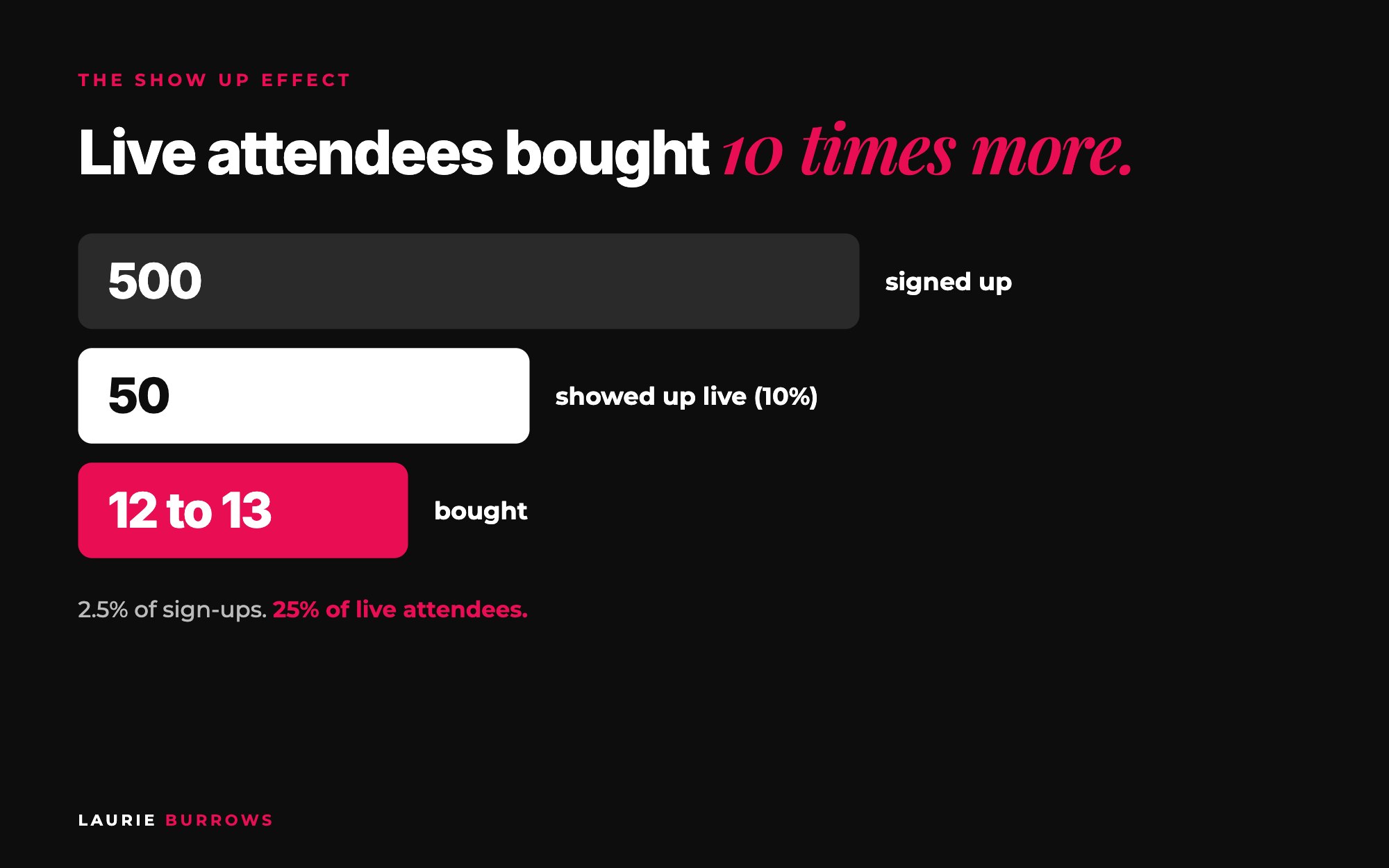
That's around 2.5% of everyone who opted in. But it's around 25% of the people who were there live. Same offer, same pitch, same price. The only difference was whether they turned up.
I was happy with that conversion for a high ticket offer. But I was disappointed with the show up rate, because I could see exactly how much money was sitting in the 450 people who signed up and never came.
Why do live attendees buy so much more?
- They spend real time with you. Trust is built through time. Someone who sits with you for an hour knows you far better than someone who just read an email.
- They experience the value. They get the aha moment, see how you think and get a small win. Your event is a try before you buy, and they actually tried.
- Their questions get answered in the moment. Objections get handled before they turn into "I'll think about it".
- They hear the full pitch. Not a summary in an email. The whole thing, with the energy of everyone else there.
- They feel the momentum. When other people in the chat are saying yes, it's easier to say yes too.
Why the price matters here
The higher the price, the more someone needs to be nurtured before they buy. Think about how you bought something for $25 compared to something for $2,500 or $25,000. A $25 purchase can be quick, even from someone you barely know. A five figure investment takes time, trust and usually a few touch points.
That's why for that high ticket launch I deliberately targeted my warm audience rather than bringing in lots of cold leads. Fewer sign-ups, but people who already knew why I was the expert. And it's why getting those people to actually show up mattered so much.
Step 1: Measure your two conversion rates
Every strategy has three stages: Attract Nurture Convert. Look at the numbers for each one.
- Attract: how many leads did you generate?
- Nurture: how many showed up, watched or had a conversation with you?
- Convert: how many bought?
Then work out your conversion rate twice: sales divided by sign-ups, and sales divided by live attendees. If the second number is much higher than the first, you don't have an offer problem. You have a show up problem. For each stage, write down what went well, what didn't and what you'll improve.
Copy and paste: show up scorecard
Sign-ups: [number]
Live attendees: [number] = [attendees ÷ sign-ups]% show up
Sales: [number]
Conversion from sign-ups: [sales ÷ sign-ups]%
Conversion from live attendees: [sales ÷ attendees]%
Money in the gap: if [extra people] more had shown up and bought at my live rate, that's [extra sales] × $[price] = $[amount].
Time: 20 minutes. Done when: you know both conversion rates and the dollar value of the people who didn't show up.
Step 2: Build your show up plan
When I reviewed that launch, this is the list I made, and it's what I'd look at for yours:
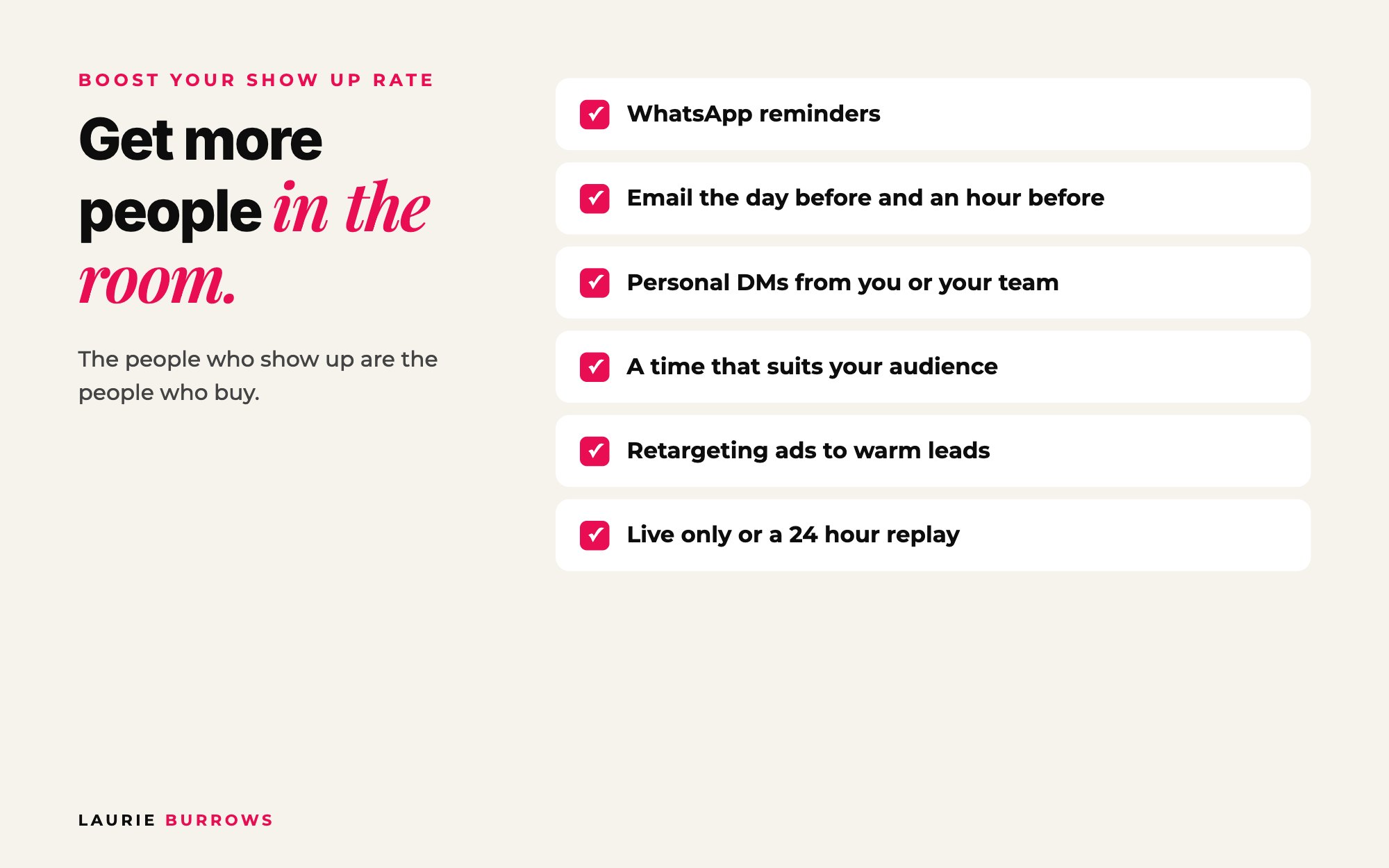
- WhatsApp marketing. I'm far more likely to open a WhatsApp than an email, and so are most people. Reminders there get seen.
- More reminders, at the right times. The day before, the morning of, an hour before and when you go live.
- Personal follow up. Have you or your team DM people who signed up: "Are you coming tonight?" People show up for a person, not an automation.
- Check your time zone. Look at where your audience actually is and pick a time that suits them.
- Retargeting ads. Especially with a warm audience, ads reminding people the event is happening can lift attendance.
- Make it live only. Some of my events have had no replay, or just a 24 hour replay, with a paid VIP pass for lifetime access. People are more likely to turn up when the replay isn't guaranteed.
- Keep it short and give them a community. More on that in kickoff parties and community and why 20 minute trainings sell better.
Copy and paste: reminder schedule
Day before (email + WhatsApp): "Tomorrow at [time] I'm showing you [the one thing they'll learn]. Pop it in your diary now: [link]."
Morning of (WhatsApp): "Today's the day! [Event] is at [time]. Bring [a pen / your offer / a question]."
One hour before (email + WhatsApp): "One hour to go. Stay to the end because there's a gift for everyone who does."
Going live (WhatsApp + community): "We're live! Jump in: [link]."
If you'd rather not write and schedule these yourself, the Email Marketer inside Ascendia OS writes your reminder emails and follow up in your voice and sends them on time, so your energy goes into the event itself.
Time: 1 hour to write and schedule. Done when: four reminders are scheduled on at least two channels, and the time suits where your audience lives.
Step 3: DM your sign-ups before the event
We always ask for people's Instagram handle on the opt-in, or get them into a Facebook group, so we can reach out personally before the event. Not to sell. Just to nurture and remind. People show up for a person.
Copy and paste: pre-event DM
Hi [name], so excited to see you've joined [event name]!
Just a quick reminder that it's on [day] at [time]. Will you be joining us live?
If there's one thing you want to get out of it, tell me and I'll make sure I cover it.
Time: 20 to 30 minutes a day in the run up, or hand it to your team. Done when: every sign-up you can reach has had a personal message, and you've noted who said they're coming.
Step 4: Give people a reason to stay to the end
Getting people in the room is one thing. Keeping them there for the pitch is another. I use a stay until the end gift: something genuinely useful that you only find out how to get after the pitch. To get it, they DM me a word like GIFT. Now they're in my DMs, and I can ask if they'll be joining.
Copy and paste: stay until the end gift DM
Here's your gift: [link]. Thank you so much for staying to the end!
Quick question: will you be joining us inside [offer]?
If it's a yes, here's the link. If it's a "yes, but", tell me the but. If it's a no, can I ask why? It's really helpful feedback for me.
Time: 30 minutes to create the gift. Done when: you mention the gift at the start and it's only revealed after the pitch.
Step 5: Follow up with everyone who didn't come
Even with a great show up rate, most of your sign-ups won't be there live. They're still leads. Around 80% of conversions happen on the fifth follow up, so how much money are you leaving on the table by not following up?
- Personalised follow up: DMs, emails and voice notes, not just automation.
- Success stories: share testimonials that match the struggles your prospects have.
- Objection handling: prepare for the common ones and reframe cost against value.
- Assume the close: instead of asking if they want to buy, ask how they'd like to get started.
- Another chance to watch: an encore or a second masterclass gives non-attendees another way in.
For more on what to say after the event, read how to follow up after a masterclass.
Time: Up to five follow ups over the cart open period. Done when: every sign-up who didn't attend has had the replay or encore and at least one personal message.
Worked example: the value of 10% more show up
Example (illustrative), using my masterclass numbers: 500 sign-ups, 50 live (10%), and around 25% of live attendees buy, so 12 to 13 sales.
- Raise show up to 20% with WhatsApp reminders and pre-event DMs: 100 live attendees. At around 25%, that's around 25 sales.
- On a $2,000 offer that's the difference between around $25,000 and around $50,000, from the same 500 sign-ups.
- Then follow up the 400 who didn't come. Even a few extra sales from the replay, DMs and an encore is money you'd otherwise leave on the table.
Show up benchmarks
| Number | What to aim for |
|---|---|
| Typical live show up | 10 to 15% of sign-ups |
| Live attendees who buy | Around 25% on a good masterclass |
| All sign-ups who buy | Around 2.5% on the same masterclass |
| Reminders | Day before, morning of, one hour before, going live |
| Follow up | Around 80% of conversions happen on the fifth follow up |
Common mistakes
- Mistake: Judging the offer on sign-up conversion alone. Fix: Work out conversion from live attendees too.
- Mistake: Email only reminders. Fix: Add WhatsApp and your community.
- Mistake: An unlimited replay. Fix: Use a 24 hour replay or a paid VIP pass.
- Mistake: Pitching to whoever is left. Fix: Use a stay until the end gift.
- Mistake: One follow up email and done. Fix: Follow up personally, up to five times.
Your action plan
Today
- Fill in the show up scorecard for your last event.
This week
- Write and schedule the four reminders.
- Add an Instagram handle field to your opt-in.
- Create a stay until the end gift.
Next event
- DM every sign-up before the event.
- Pitch fully, then send the gift DM.
- Follow up everyone who didn't come, then compare your two conversion rates with last time.
- Read the ultimate guide to a 6 figure course launch to plan the rest of the launch around your show up plan.
Once they're in the room, the pitch has to land. The 5-Figure Webinar Formula gives you my 10-step webinar framework, the pitch script and objection handling slides for $27.
Want the pitch that turns live attendees into buyers?
The 5-Figure Webinar Formula is my 10-step webinar framework for $27, with the slide deck template, the pitch script and the objection handling slides, so you can build an event that sells without starting from a blank page.
Rather have it done for you?
Let Ascendia OS get more people in the room
The Email Marketer writes and schedules your reminders and follow up, and the Launch Manager plans the event from first email to cart close. On Pro, the Appointment Setter replies to DMs 24/7 too. 14 days free, no tech skills needed.
Frequently asked questions
Do webinar attendees really buy more than people who watch the replay?
In my experience, yes, by a long way. On one masterclass, around 25% of live attendees bought, compared with around 2.5% of all sign-ups. Live attendees spend more time with you, get their questions answered and hear the full pitch.
What is a good show up rate for a masterclass?
It's common to see around 10 to 15% of sign-ups attend live. Reminders on several channels, personal follow up, the right time zone and a limited replay can all push that higher.
Should I offer a replay?
Consider limiting it. A 24 hour replay or a paid VIP pass for lifetime access gives people a reason to turn up live, and the VIP pass makes you money straight away.
How do I sell to people who didn't attend?
Follow up personally with DMs, emails and voice notes, share relevant success stories, handle objections and give them another chance to watch through an encore or a second event.
Why do higher ticket offers need more nurture?
The more something costs, the longer and more careful the buying decision. People need more time with you and more trust before investing at a higher price, which is why warm audiences and live time matter so much.
Laurie Burrows is a UK-based marketing and sales strategist who has built a business that's generated multi-seven figures in sales through social media and digital marketing. Today, Laurie helps business owners use social media, content and digital marketing to get seen, attract more clients and make more sales. She's also the founder of Ascendia OS.
Do you want to scale your business to 10K months in the next 90 days? I am looking for 10 people for my new case study program. DM me the word CASE STUDY on Instagram (@_laurieburrows) to learn more.