How to Have a 6 Figure Launch (The Numbers Behind It)
Short answer: a 6 figure launch is a numbers game before it's a sales game. Divide $100,000 by your price to get your sales target, then divide that by your conversion rate to find how many sign-ups you need. At $997 and an average 3% conversion rate, that's around 100 sales and roughly 3,300 leads. Then you map out exactly where every one of those leads will come from before you launch, and you plan a second route to the sale for everyone who doesn't buy from the first event.
Most people plan a launch backwards. They pick a goal, say $100k, work out they need to sell 100 spots of a $1,000 programme, and then they promote the free event to their email list and their social media and hope for the best.
Then the launch "flops", and they decide the offer doesn't work or launching doesn't work for them. Nine times out of ten, the launch didn't flop. The maths just never added up in the first place. Guessing and hoping isn't a strategy.
In 2021 I hit my first six figure month in my business with one programme I rinsed and repeated. These days my launch strategies make six figures per launch. Below is the exact seven step process I use, with the numbers, a worked example, a Lead Map you can copy, and an action plan so you can start planning yours today.
This is part of my ultimate guide to a 6 figure course launch. If you're still working towards your first 6 figure year overall, my guide to your first 6 figures is the place to start.
The 6 figure launch in seven steps
- Set your sales target (revenue goal ÷ price).
- Set your leads goal (sales target ÷ conversion rate).
- Lead Map every source until the numbers add up.
- Fill the gap with other people's audiences.
- Choose your promotion window.
- Lift your conversion rate before you spend a penny on leads.
- Plan your second route to the sale, then analyse your numbers.
Step 1: Set your sales target
Start with the simplest sum in your business: revenue goal divided by price.
- $100,000 at $997 = around 100 sales
- $100,000 at $1,200 = 83 sales
- $100,000 at $2,000 = 50 sales
This is where most people stop. "I need to sell 100 spots." Great. But how many people do you need to get in front of to sell 100 spots? That's the number that actually decides whether your launch works.
Time: 5 minutes. Done when: you have one number written down: how many sales you need.
Free 5 day event · 12th to 16th October
The 6 Figure Game Plan
Want your launch numbers mapped for you? Join my free 5 day event (12th to 16th October). You'll map your strategy to 6 figures and get the plan, content and pages created for you.
Step 2: Set your leads goal
When you launch, you need two goals. Your sales goal, and your leads goal. A lead is anyone who opts in to your free event, whether that's a challenge, a bootcamp, a workshop or a masterclass. It's the people who sign up, not the people who show up.
The average conversion rate for a live virtual event, like a 3 to 5 day challenge, is around 3%. For every 100 people who opt in, about three buy.
Leads needed = sales target ÷ conversion rate
For a $100,000 launch at $997:
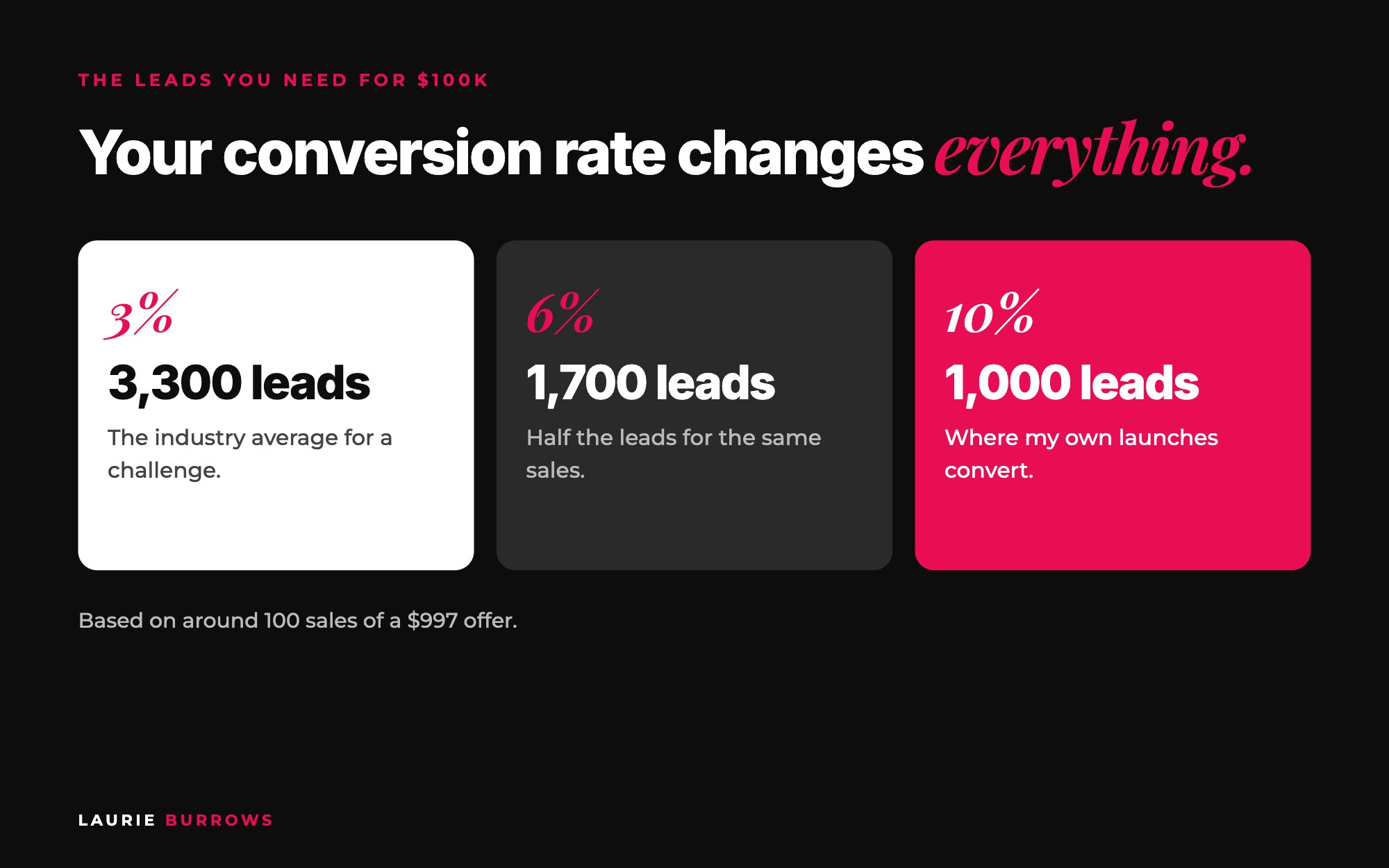
- At 3%: around 3,300 leads
- At 6%: around 1,700 leads
- At 10%: 1,000 leads
That's the biggest lever in your whole launch. Double your conversion rate and you halve the number of leads you need. My own launches convert at 10 to 12%, which is why I can hit big numbers without needing an enormous list. If you've never launched before, use 3% so you're planning from reality. I always put a slightly lower number into my calculator than I expect, because I like the wiggle room.
If maths isn't your happy place, the Strategist inside Ascendia OS does this part for you: it learns your business, sets the goal and tells you how many sales and leads you need, so you start with numbers instead of a hunch.
Time: 10 minutes. Done when: you know your leads goal and you used 3% (or your real past conversion rate), not a hopeful guess.
Step 3: Lead Map every source
Lead Mapping is where you take your leads goal and map out exactly where every lead is coming from, with a realistic number next to each source. It's the step almost everyone skips.
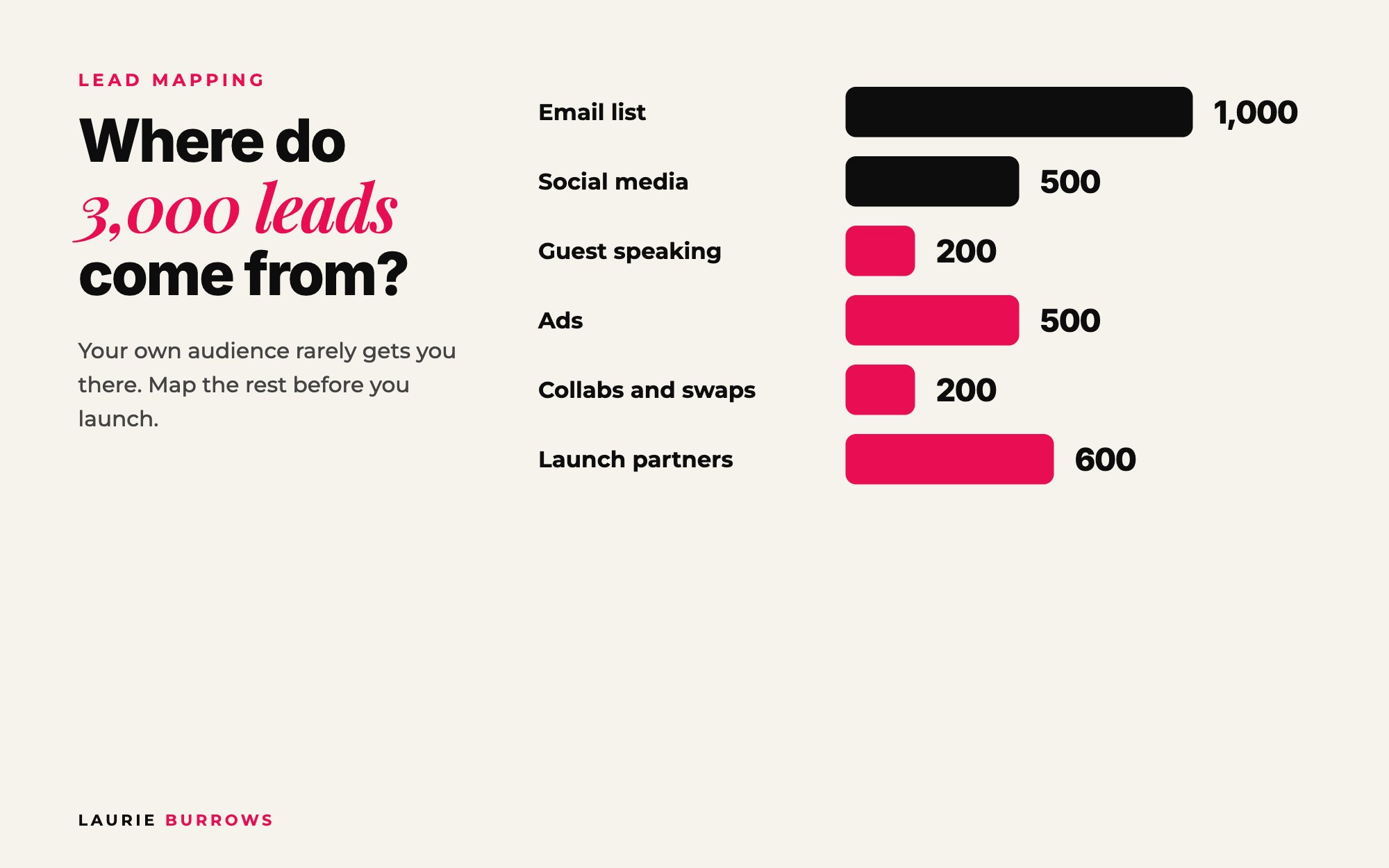
Here's an example I've used with my own audience for a 3,000 lead launch:
- Email list: 1,000
- Social media (comment below reels, stories, posts with a call to action): 500
That's 1,500. I've pretty much used my whole audience and I'm still 1,500 short. This is the point where most people would launch anyway and hope. Instead, you keep mapping:
- Guest speaking: five spots in other people's memberships, groups, summits and podcasts, maybe 200
- Ads: depending on budget, maybe 500
- Collaborations and exchanges: you promote my event, I promote yours, a couple of hundred
- Launch partners (affiliates): 10 people each bringing in 60 sign-ups, 600
Now you have a plan for weeks one and two of your launch. Every day you know exactly what you're doing to generate leads, instead of posting and praying. During those two weeks, my head isn't on the $100k. It's on the leads.
Copy and paste: Lead Map
Launch: [event name] for [offer] at $[price]
Revenue goal: $[goal] ÷ $[price] = [sales target] sales
Leads goal: [sales target] ÷ [conversion rate] = [leads goal] sign-ups
1. Email list: [list size] × [your usual opt-in rate] = [number]
2. Social media (comment below posts, stories, reels): [number]
3. Guest spots: [how many] × [sign-ups per spot] = [number]
4. Collaborations and swaps: [how many] × [sign-ups each] = [number]
5. Launch partners: [how many] × [sign-ups each] = [number]
6. Ads: $[budget] ÷ $[cost per sign-up] = [number]
Total mapped: [total]. Gap: [leads goal minus total]. Keep adding sources until the gap is zero.
Time: 45 minutes. Done when: every source has a number next to it and the total is equal to or higher than your leads goal.
Step 4: Fill the gap with other people's audiences
When you're trying to sell 100 spots, most of those leads won't come from your own list. That's normal. Here's how to fill the gap.
Launch partners
This is one of my favourites. Your launch partners don't promote anything paid. They just promote your free event to their audience. You give them the copy, the graphics and the emails. If anyone they bring in buys your offer, they earn a commission. I've offered 20 to 25% commission, and on one launch a flat $250 for every person who converted. They make money from promoting a freebie, and you get in front of audiences you'd never reach alone. If 50 partners each bring in 10 people, that's 500 leads.
Copy and paste: launch partner invite
Hey [name], I'm running a free [3 day challenge] for [who it's for] on [dates] and I immediately thought of your audience.
Would you be up for sharing it? I'll give you the emails, posts and graphics so it takes you five minutes, and you'll earn [20 to 25%] commission on anyone you bring in who joins [offer] after the event.
No pressure at all. If it's a yes, I'll send your link and the swipe copy today.
Guest speaking and collaborations
Look for memberships, programmes, summits and podcasts that need speakers. Give real value, then promote your free event as the next step. Do lives, interviews and swaps with people who serve the same audience. If you can find ten guest spots and 50 people sign up from each, that's another 500.
Ads (and a cheaper trick)
Ads work, but they're expensive and they need testing. In our testing, the cost per opt-in for a live virtual event has always been several times higher than for a free guide. And paying for a sign-up doesn't guarantee they'll show up.
So here's what we do instead. We put our best performing reels into nurture ads to get cheap reach. Then we post lead generation reels: a short video with text over it and a call to action like "comment GIFT below". When one takes off, we boost it. People comment, an automation sends them the link in their DMs, and we're not paying a cost per opt-in at all.
Time: 2 to 3 weeks before launch, 30 minutes a day of outreach. Done when: every partner, guest spot and collaboration on your Lead Map has a confirmed date.
Step 5: Choose your promotion window
I've tested one, two, three and four weeks of promotion in my own business. Here's what I found.
- One week is enough if you only need a few hundred leads (I often promote masterclasses for a week). It's not enough for a big launch, and people may already have plans.
- Four weeks gives you more time, but people who sign up on day one have to wait 28 days. They forget.
- Two weeks has been the sweet spot for big launches.
The more leads you need and the smaller your audience, the longer you'll want. If you need 500 leads, five to seven days might be plenty. If you need 3,000, give yourself the full two weeks. Then divide your leads goal by your promotion days so you have a daily target. 3,000 leads over 14 days is around 215 a day, and you check it every single evening.
Time: 10 minutes. Done when: your promotion start date, event dates, cart open and cart close are in your calendar, with a daily leads target.
Step 6: Lift your conversion rate
Because conversion rate is the biggest lever, it's worth working on before you spend money chasing more leads. In my experience these make the biggest difference:
- Get more people to show up. On one masterclass, around 2.5% of sign-ups bought, but around 25% of the people who showed up live bought. Reminders by email and WhatsApp matter. I explain why in why live attendees buy 10 times more.
- Keep the daily sessions short. Around 20 to 30 minutes stops people dropping off before you pitch. More on that in why 20 minute trainings sell better.
- Make it a try before you buy. Give people a taste of working with you, with an aha moment and an action step each day.
- Pitch on day three, with a fast action bonus, while people are at their most engaged.
- Follow up personally. DMs, voice notes, WhatsApp. People want conversations before they buy now.
If you want the pitch itself mapped out for you, The 5-Figure Webinar Formula gives you my 10-step webinar framework, the slide template and the pitch script for $27.
Time: 1 to 2 hours of prep. Done when: your reminders are scheduled, your sessions are under 30 minutes, and your pitch and fast action bonus are written.
Step 7: Plan your second route, then analyse
You don't have to hit 6 figures from one event, and this takes a ton of pressure off. If you only get 1,500 leads into your challenge instead of 3,000, that's not a failure. You can run a masterclass a week or two later for everyone who didn't buy. You can offer free audits and pitch from those. You can sell a low priced offer and upsell from it.
When I sell something big, I often use more than one route because people buy differently. Some love a 5 day challenge. Some will only watch a masterclass. Some (like me, honestly) never watch free events and would rather buy something low priced. If your only way of selling is a challenge, you're missing every buyer who doesn't do challenges.
Then, when the cart closes, write down four numbers: leads, live attendees, sales, and revenue. That's how launches grow. My first launch was a flop. The next sold 15 spots, then 25, then 50, then 75, just by looking at the data each time and improving.
Time: 1 hour after cart close. Done when: you know your real conversion rate and you have one thing to improve next time.
Worked example: a business coach selling a $997 programme
Example (illustrative numbers): a business coach wants $50,000 from a 3 day challenge launch, selling a $997 programme.
- Sales target: $50,000 ÷ $997 = 50 sales.
- Leads goal at 3%: 50 ÷ 0.03 = around 1,670 sign-ups.
- Her own audience: 2,000 email subscribers (she expects around 500 of them to sign up) plus social media (300). Total 800.
- The gap: 870 leads.
- Filling it: six guest spots at 50 each (300), two collaborations at 100 each (200), eight launch partners at 30 each (240), comment-to-get reels boosted for a small budget (130). Total 870. Gap closed.
- Promotion: two weeks, so around 120 sign-ups a day.
- Backup route: if she ends on 1,200 leads and 36 sales, a masterclass the following week to non-buyers plus 15 free audits is how she goes after the remaining 14 sales.
Now look at what happens if she lifts her conversion rate to 6% with better reminders and personal follow up. She only needs around 830 leads, which her own audience almost covers. That's why Step 6 matters so much.
6 figure launch benchmarks
| Number | What to aim for |
|---|---|
| Conversion rate (sign-ups to sales) | Plan with 3%. Industry 1 to 3%. My launches 10 to 12%. |
| Live attendees who buy | Around 25% on a good masterclass, vs around 2.5% of all sign-ups |
| Promotion window | 5 to 7 days for a few hundred leads, 2 weeks for big launches |
| Session length | 20 to 30 minutes a day |
| Pitch | Day three, with a fast action bonus |
| Launch partner commission | 20 to 25%, or a flat amount per sale |
Do this now: grab a piece of paper. Write your revenue goal, your price and your conversion rate (3% if you don't know it). Work out your leads goal. Then list every source you'll use with a number next to each one. If the total falls short, keep adding sources until it doesn't.
Common 6 figure launch mistakes
- Mistake: Setting a sales goal with no leads goal. Fix: Always work out leads needed = sales ÷ conversion rate before you announce anything.
- Mistake: Planning at 10% because a big name said so. Fix: Plan at 3% until you have your own data.
- Mistake: Relying on your own audience only. Fix: Lead Map other people's audiences: partners, guest spots, collaborations.
- Mistake: Promoting for four weeks. Fix: Two weeks is the sweet spot for big launches. People forget after that.
- Mistake: Calling it a flop when one event falls short. Fix: Run a second route: masterclass, audits or a low priced offer.
- Mistake: Never looking at the numbers. Fix: Record leads, live attendees, sales and revenue every launch, and improve one thing.
Your action plan
Today
- Work out your sales target and leads goal at 3%.
- Draft your Lead Map using the template above.
This week
- Message ten potential launch partners and five places you could guest speak.
- Book your promotion dates, event dates and cart close in your calendar.
- Write your reminder emails and WhatsApp messages.
Next 30 days
- Run the launch and track sign-ups every evening against your daily target.
- Pitch on day three with a fast action bonus, then follow up personally.
- Plan your second route (masterclass, audits or a low priced offer) and record your four numbers when the cart closes.
For the full launch process from start to finish, read the ultimate guide to a 6 figure course launch, and if you'd rather plan the timings first, start with how to plan a launch.
Want the pitch that turns those leads into sales?
The 5-Figure Webinar Formula is my 10-step webinar framework for $27, with the slide deck template, the pitch script and the objection handling slides, so you can build an event that sells without starting from a blank page.
Rather have it done for you?
Let Ascendia OS map your launch numbers and plan the launch
The Strategist works out your sales and leads goals, and the Launch Manager plans your challenge or masterclass from first email to cart close, then sets it up to run again on repeat. 14 days free, no tech skills needed.
Frequently asked questions
How many leads do I need to make $100k from a launch?
At $997 and a 3% conversion rate, you need about 100 sales and roughly 3,300 leads. At 6% you'd need around 1,700, and at 10% around 1,000. Your conversion rate changes everything.
What is a good conversion rate for a launch?
The industry average for a challenge or live virtual event is around 1 to 3% of sign-ups. A masterclass to a warm audience can convert much higher. My own launches convert at 10 to 12%.
Is a lead someone who signs up or someone who shows up?
Someone who signs up. Anyone who opts in to your free event is a lead. Show up rate is a separate number, and improving it is one of the fastest ways to lift your sales.
Can I have a 6 figure launch with a small audience?
Yes, but most of your leads will need to come from other people's audiences. Launch partners, guest speaking, collaborations and ads fill the gap, and a higher conversion rate means you need fewer leads in the first place.
What if I don't hit my leads goal?
Don't panic and don't call it a flop. Work on your conversion rate, then run a second event, a masterclass or a low priced offer to bring in more leads over the following weeks. You don't have to hit your goal from one event.
Laurie Burrows is a UK-based marketing and sales strategist who has built a business that's generated multi-seven figures in sales through social media and digital marketing. Today, Laurie helps business owners use social media, content and digital marketing to get seen, attract more clients and make more sales. She's also the founder of Ascendia OS.
Do you want to scale your business to 10K months in the next 90 days? I am looking for 10 people for my new case study program. DM me the word CASE STUDY on Instagram (@_laurieburrows) to learn more.