How to Build a Product Suite: Low, Mid and High Ticket
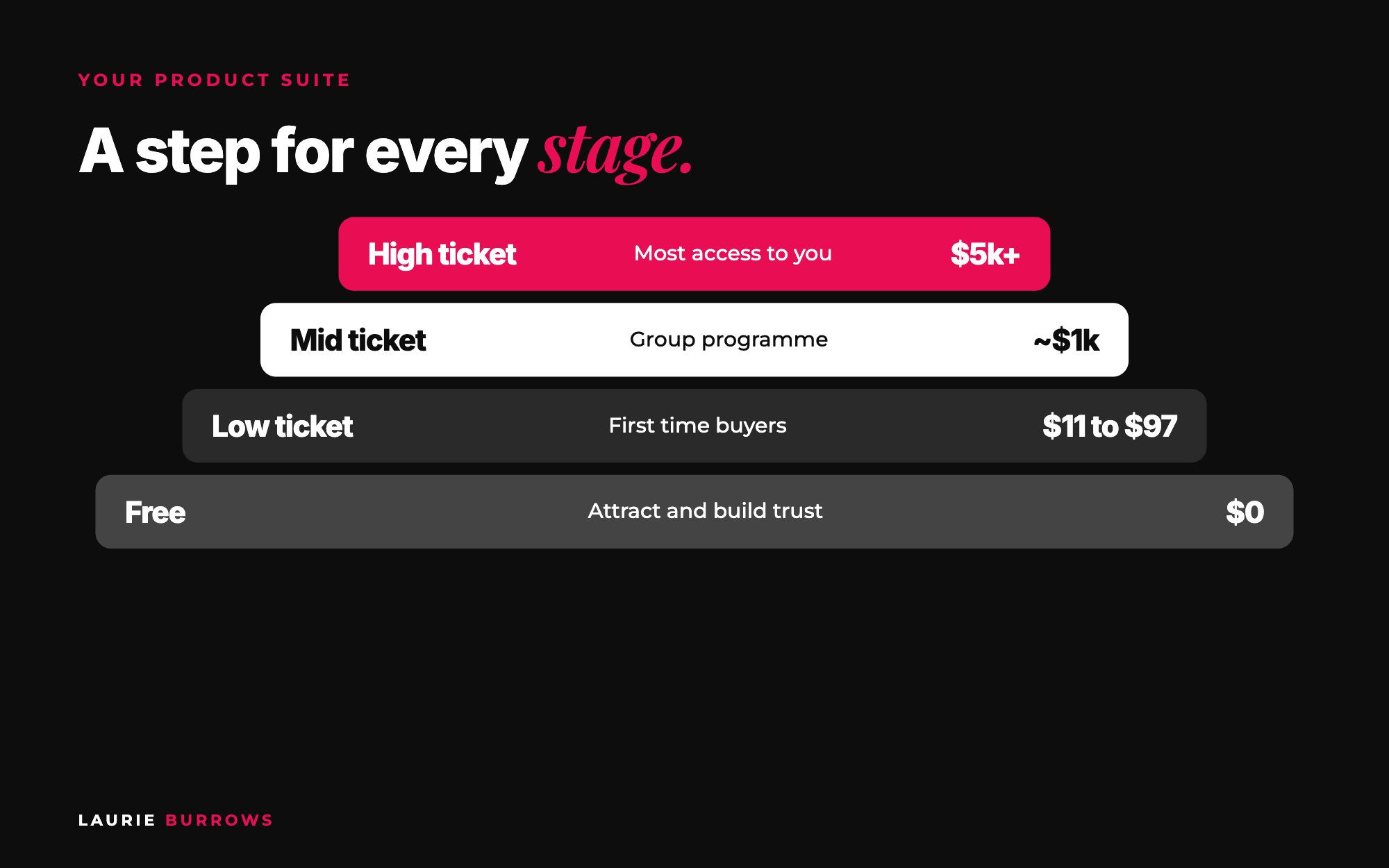
Short answer: a product suite is the set of offers in your business at different price points, arranged so people can step from one to the next. Free offers attract and build trust. Low ticket entry offers (usually $11 to $97) convert people for the first time. Mid ticket offers (around $1,000, often a group programme) give real value with less access to you. High ticket offers ($5,000 to $10,000 or more) give the most access to you and create recurring revenue. Build it one level at a time, and perfect one offer before adding the next.
"Should I focus on low ticket or high ticket?" I get asked this constantly, usually by someone who's been told one thing by one mentor and the opposite by another. Here's the honest answer: it all works. Low ticket works. High ticket works. Mid ticket works. What matters is the strategy behind it and whether it fits the time you have.
A good product suite means that wherever someone is in their journey with you, and whatever they can invest, you have something to sell them, and a natural next step after it.
This is part of my ultimate guide to creating an offer that sells, where your product suite is built around one core offer.
The four levels of a product suite
Free offers: attract and build trust
Your free content, challenges, masterclasses, podcasts, guides and social media. Their job is to attract your ideal clients and give them something to read, watch or listen to that builds trust and shows why you're the expert.
Low ticket entry offers: convert people for the first time
Two figure offers like $27 or $47, often a 60 minute masterclass, a short mini course or a guide. At this price, people will buy even if they don't know you well, because they're buying the content rather than you. It's a try before you buy. I often use three of them: one around $11 to $14, one at $27 and one at $47. You can usually pull them straight out of your core offer, so there's nothing new to create.
Mid ticket offers: the core group offer
Usually around $1,000, and typically a group environment: an online curriculum, a few months of support in a private group, and group calls (sometimes with a co-coach). Less access to you, but lots of value, which justifies the price.
High ticket offers: the most access to you
Five figure offers like one to one coaching, a high level mastermind or a done for you service. These give people the most access to you or your team. They're also brilliant for recurring revenue, because most people choose a monthly payment plan.
How people buy at each level
How someone buys a $50 offer is completely different to how they buy a $5,000 offer. Think about your own purchases. A $27 offer is an impulse buy. It's low risk, so you don't need much trust. A four or five figure investment is a considered decision: you want to know the person, see proof and get your questions answered first.
That changes your focus:
- If you mostly sell low ticket, you need volume, so focus on audience growth and visibility.
- If you mostly sell high ticket, you need fewer sales but more trust, so focus on authority and being seen as the go to expert.
Here's the maths with a $10,000 a month goal. At $50 you need 200 sales a month. At $5,000 you need two. If your audience is 200 people, the first means converting all of them. The second means converting 1%.
Why stepping stones work
Not everyone who loves your free content is ready to go straight into your high ticket offer. It might be affordability. It might be mindset. Most often, they just don't trust you enough yet. Stepping stones fix that.
I've had someone come into one of my freebies, buy my $47 offer, then a one month intensive with me, and from there invest in a five figure package. They told me they'd never have gone straight into the high ticket offer. The stepping stones let them test the water first.
That's also how I built my own suite in my first year: a $47 masterclass, then a $555 intensive, then a signature programme that started at $997 and grew to around $1,500, then a mastermind. I tell that whole story in how I went from a $47 masterclass to a $1,500 signature programme.
One core offer with tiers
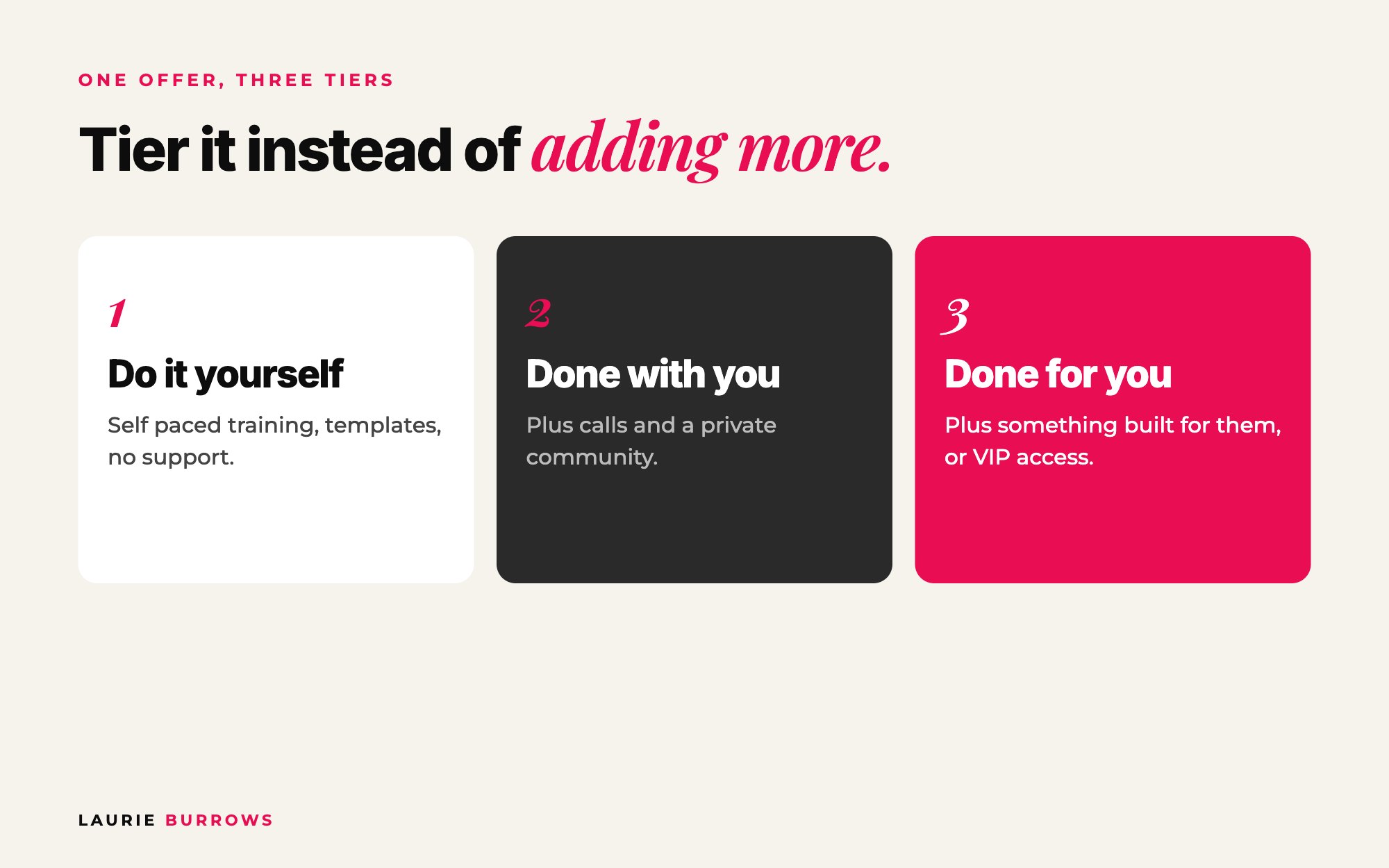
If you don't want to run lots of separate offers, tier your core offer: do it yourself, done with you, and done for you or VIP. You only run one offer, people can upgrade or downsell, and each tier simply costs more and includes more.
Whatever you choose, perfect selling one offer before adding the next. I go into why in perfect one offer before you launch the next.
Don't forget recurring revenue and retention
When you see people hitting their biggest months, the secret is usually two things: recurring revenue and retaining clients. If 10 people pay you $1,000 a month on a 12 month programme, you start every month with $10,000 already coming in, and anything you launch stacks on top. And it's around 10 times easier to sell to a current client than to win a new one, so a great experience in one offer is the best marketing for the next.
For how to set the price of each level, read how to price a coaching programme. And if you're unsure whether to give something away or charge for it, the free resources on my free resources page are a good example of where free fits in.
How to build your product suite, step by step
Here's the order I'd build a suite in if I was starting again. Notice it doesn't start at the bottom. It starts with your core offer, because everything else exists to lead people to it.
Step 1: Start with your time and your goal
Write your monthly revenue goal and the hours you genuinely have each week. Those two numbers decide how many offers you can run. Part time or doing it all yourself? Start with one core offer (tiered if you like), one entry offer and your free content.
Time: 10 minutes. Done when: you have a revenue goal and a weekly hours number written down.
Step 2: Do the maths for each price point
Divide your goal by each price. At $10,000 a month, a $50 offer needs 200 sales, a $1,000 offer needs 10 and a $5,000 offer needs 2. Now compare that with your audience. With an audience of 200, the $50 route means converting all of them. Your maths tells you which level has to carry most of the revenue.
Time: 15 minutes. Done when: you know which price point your goal mainly depends on.
If you'd rather not do the sums alone, the Strategist inside Ascendia OS sets the goal and maps what to sell, when, and how many sales you need at each level.
Step 3: Build or tighten your core offer first
Your mid ticket core offer (usually around $1,000) is the heart of the suite. Make sure the end result is clear and worth more than the price before you add anything around it. If you want low, mid and high without running lots of offers, tier this one: do it yourself, done with you and VIP or done for you.
Time: 1 to 2 weeks if you are building, a few hours if you are tightening. Done when: your core offer has a clear end result, a price and, if you want them, tiers.
Step 4: Add one entry offer that leads to the core
Create one low ticket offer (around $27 or $47) that solves the first problem on the way to your core offer's end result. A short masterclass or mini course is perfect. Add an order bump at checkout, for example a $27 offer plus an $11 bump, so the average order becomes $38.
Time: 1 to 2 weeks. Done when: every buyer of your entry offer has an obvious next step into the core offer.
This is usually where the tech slows people down. The Funnel Builder in Ascendia OS builds your opt-in page, thank you page offer and checkout inside your account, with order bumps and upsells, ready to go live.
Step 5: Point your free offers at the entry offer
Make sure your free resource, free training or challenge teaches something that makes the entry offer the natural next step. Put the entry offer on the thank you page after someone opts in.
Time: 2 to 3 hours. Done when: someone can go from free to low ticket to core without you having to sell to them one to one.
Step 6: Add high ticket last, for the clients you already have
Only once the core offer sells consistently, add the high ticket level: a mastermind, VIP upgrade or done for you service. Offer it to your current clients first. It's around 10 times easier to sell to a current client than a new one.
Time: When the core is predictable. Done when: some of your current clients have asked for more support or upgraded.
Copy and paste: product suite map
Goal: $[monthly goal] | Hours a week: [hours]
Free (attract and build trust): [free resource / training / challenge] teaching [first step]
Low ticket (first purchase): [name] at $[27 to 47] + order bump [name] at $[x] | Shown on: [thank you page / content]
Mid ticket core offer: [name] at $[around 1,000] | End result: [result] in [timeframe] | Tiers: DIY $[x] / done with you $[x] / VIP $[x]
High ticket (add last): [mastermind / VIP / done for you] at $[x] | Offered first to: current clients
Next step from each level: free → [ ] → [ ] → [ ]
Example: a simple three level suite
This is an illustrative example with round numbers. A business coach with a $10,000 monthly goal and 15 hours a week builds:
| Level | Offer | Monthly target |
|---|---|---|
| Free | A 3 day free challenge every month | 300 new leads |
| Low ticket | $27 masterclass replay + $11 bump on the thank you page | 30 buyers, around $1,100 |
| Core | $997 group programme (DIY and done with you tiers) | 8 sales, around $8,000 |
| High ticket | VIP upgrade at $3,000, offered to current clients only | 1 upgrade a month when ready |
Benchmarks to aim for
| What you measure | Benchmark |
|---|---|
| Leads to sales (core offer) | Around 3% on average. My own launches convert at 10 to 12%. |
| Thank you page offer | 8 to 10% of opt-ins buying |
| Order bump | 70 to 80% of buyers adding it |
| Low ticket order value | $27 offer + $11 bump = $38 |
Common mistakes (and the fix)
- Building the free and low ticket levels first. Fix: start with the core offer so everything else has somewhere to lead.
- Entry offers that do not lead anywhere. Fix: make the low ticket offer solve the first step towards the core end result.
- Launching high ticket to strangers. Fix: offer it to current clients first.
If you want the full sales system that moves people from free content to your core offer every day, it's inside Content To Clients®.
Your action plan
Today
- Write your monthly goal and weekly hours.
- Do the maths for each price point.
This week
- Tighten your core offer's end result and price.
- Fill in the product suite map.
- Outline one entry offer that leads to the core.
Next 30 days
- Launch the entry offer with an order bump.
- Add it to your thank you page.
- Track how many entry buyers move into the core offer.
- Go back to the ultimate guide to creating an offer that sells if your core offer needs tightening.
Free 5 day event · 12th to 16th October
The 6 Figure Game Plan
Want your product suite mapped into a plan to 6 figures? In my free 5 day event you'll map your strategy and get the plan, content and pages created for you.
Want help designing your product suite?
In the 90 Day Revenue Growth Accelerator I help you choose your offers, set the prices and build the plan to move people from free to paid every month.
Rather have it done for you?
Let Ascendia OS build your suite's funnel
The Strategist maps how many sales you need at each level, and the Funnel Builder builds the opt-in, thank you page offer, order bump and checkout that move people from free to paid. 14 days free, no tech skills needed.
Frequently asked questions
What is a product suite?
It's the full set of offers in your business at different price points, from free content through low, mid and high ticket offers, arranged so people can move from one to the next as their trust and needs grow.
What should my low ticket offer be?
Something quick and focused that solves one specific problem, like a 60 minute masterclass, a short mini course or a guide, priced in two figures. Ideally pull it from your core offer so there's little new to create.
Should I start with low ticket or high ticket?
Both work. Low ticket needs volume, so your focus is audience growth. High ticket needs trust, so your focus is authority and proof. Many people start with a low priced offer while trust is still building, then add higher priced offers.
How many offers should I have?
As many as you can sell and deliver well with the time you have. For most coaches that's one core offer, possibly tiered, plus a few low ticket entry offers. Add more once the first one sells predictably.
What's the difference between mid and high ticket?
Mid ticket offers are usually group based with less access to you, often around $1,000. High ticket offers give the most access to you or your team, such as one to one, a mastermind or done for you, and are often five figures.
Laurie Burrows is a UK-based marketing and sales strategist who has built a business that's generated multi-seven figures in sales through social media and digital marketing. Today, Laurie helps business owners use social media, content and digital marketing to get seen, attract more clients and make more sales. She's also the founder of Ascendia OS.
Do you want to scale your business to 10K months in the next 90 days? I am looking for 10 people for my new case study program. DM me the word CASE STUDY on Instagram (@_laurieburrows) to learn more.