Why You Shouldn't Build Your Business on a Custom GPT
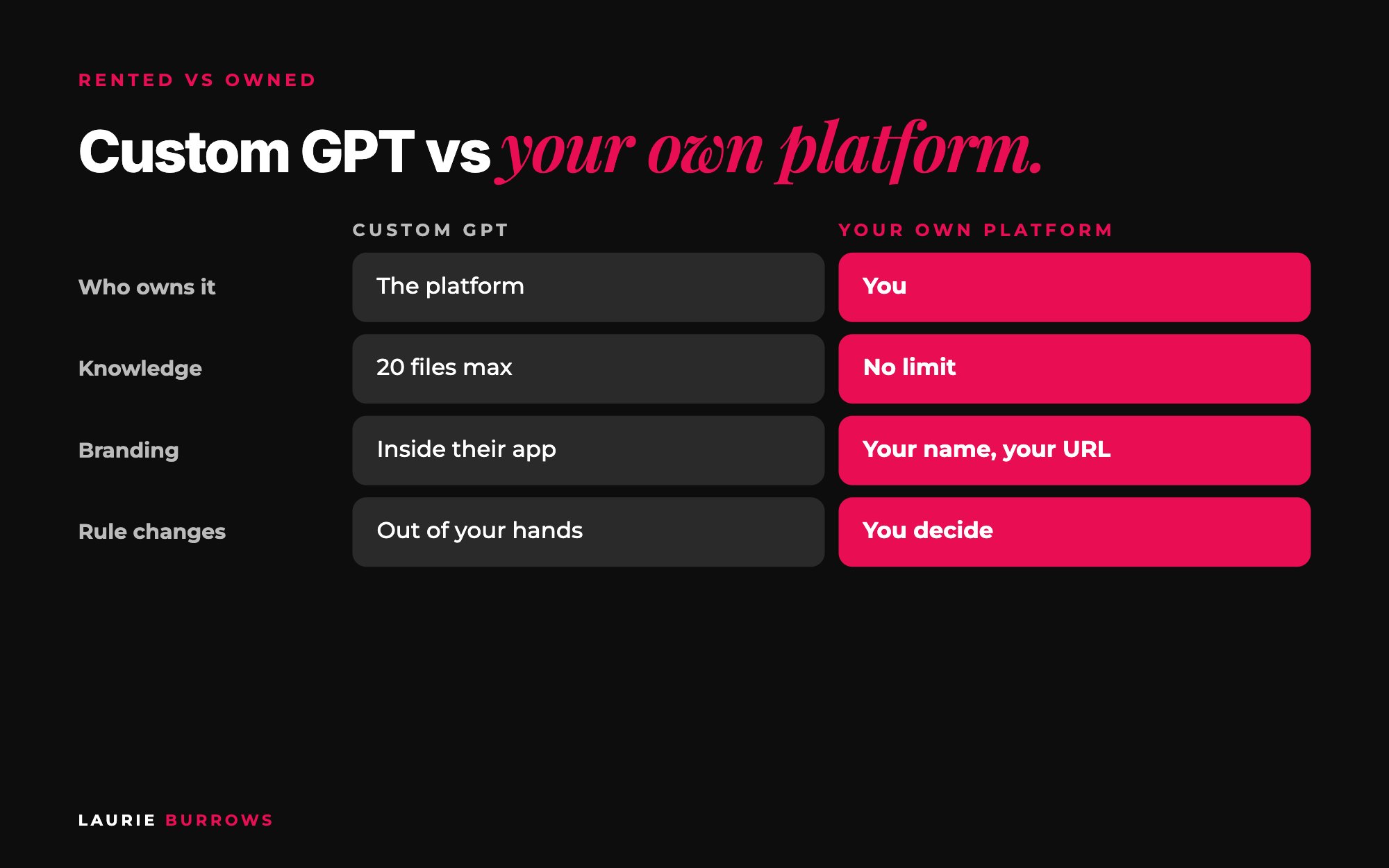
Short answer: you shouldn't build your business on a custom GPT because you don't own it. The platform can change the rules, change the tiers or remove the feature altogether, and your product goes with it. You're also capped at 20 knowledge files, your buyers need an account with someone else's company, and your brand sits inside theirs. A custom GPT is a brilliant way to test an idea in an afternoon. To keep a product people pay you for, move it onto its own platform: back up your instructions and files, plan it in Claude, build it in Lovable, store it in Supabase, power it through an API, then move your clients across with a clear email.
I say this as someone who did it. When I first launched my custom AI, an AI version of me trained on all of my frameworks, it was a custom GPT. It sold. Over 100 people signed up in around 30 days. And then something happened that I had absolutely no control over.
In March, there was a huge wave of people cancelling their ChatGPT subscriptions. Millions of them, in a matter of weeks. My clients were divided: some wanted to stay, some didn't want to touch it. And it landed right in the middle of one of my launches. That launch converted nowhere near as well as the others, and I'm convinced a big part of it was simply where the product lived. So I moved my AI onto its own platform. Best decision I made all year. Below is why, and exactly how to do the same.
This is part of my ultimate guide to building a custom AI for your business. If you haven't built your AI yet, start there. If you have, and it lives in a custom GPT, read on.
What's the problem with selling a custom GPT?
A custom GPT feels like your product. It has your name, your instructions and your content. But it lives inside someone else's platform, on someone else's terms. That creates five problems.
1. They can change the rules overnight
Platforms change features, tiers and pricing whenever it suits them. That's their right. But if your product depends on a feature they move, restrict or remove, your product changes too, and you find out at the same time as everyone else. The news that custom GPTs are being removed sent a lot of business owners into a panic, because they'd sold products that suddenly had an end date. Guessing and hoping isn't a strategy, and building on rented land is guessing and hoping nothing changes.
2. Your buyers' feelings about the platform become your problem
Everything people think about that platform rubs off on you. A controversy, a price rise or a mass cancellation, and some buyers won't buy while some existing ones ask for another option. I had both. Not because of anything my AI did, but because of where it lived.
3. You're limited on how much you can teach it
A custom GPT lets you upload 20 knowledge files. If you've been in business a while, you have hundreds of hours of courses, masterclasses and Q and As. So you squash everything into a few huge documents or leave half your best material out. On your own platform there's no cap. Mine is trained on hundreds of transcripts, organised by theme, and I keep adding to it.
4. Your buyers need someone else's subscription
Your client needs an account on that platform, and for some features a paid one. That's an extra step between "yes, I'll buy" and actually using it. Every extra step loses people.
5. It's harder to charge premium prices
Sitting in a list of GPTs inside someone else's app, it looks like one of many. With its own website, login, branding and URL, it looks like a real product, because it is one. That makes a four figure price far easier to justify, and "why don't I just use ChatGPT?" far easier to answer.
It's the same reason my software, Ascendia OS, lives on its own platform. Its AI marketing team (the Strategist, Launch Manager, Content Creator, Copywriter, Email Marketer and Funnel Builder) sits inside a product I own, with its own login and branding. Nobody else can switch it off, rename it or change who's allowed to use it. That's what a custom AI product looks like when you own it.
Is a custom GPT ever a good idea?
Yes. A custom GPT is fast (you can genuinely build one in an afternoon), cheap (around $20 a month for the subscription, the same whether ten people use it or a thousand) and great for testing whether people want your AI before you build a platform. That's how I started, and it proved the concept. Use it to validate the idea and get your first buyers. Just don't make it the long term home for a product your business depends on.
Your two options if you already have one: a plugin or app inside the same ecosystem (familiar, but you're still under their rules, and if they change which tier allows plugins, you're back where you started), or rebuild it on its own platform. That's what I did. People log in through my website, with my branding and my domain. Behind the scenes it's powered by one of the big AI models through an API, so if one provider changes something, I can switch the engine without my clients noticing.
How to move your custom GPT to your own platform, step by step
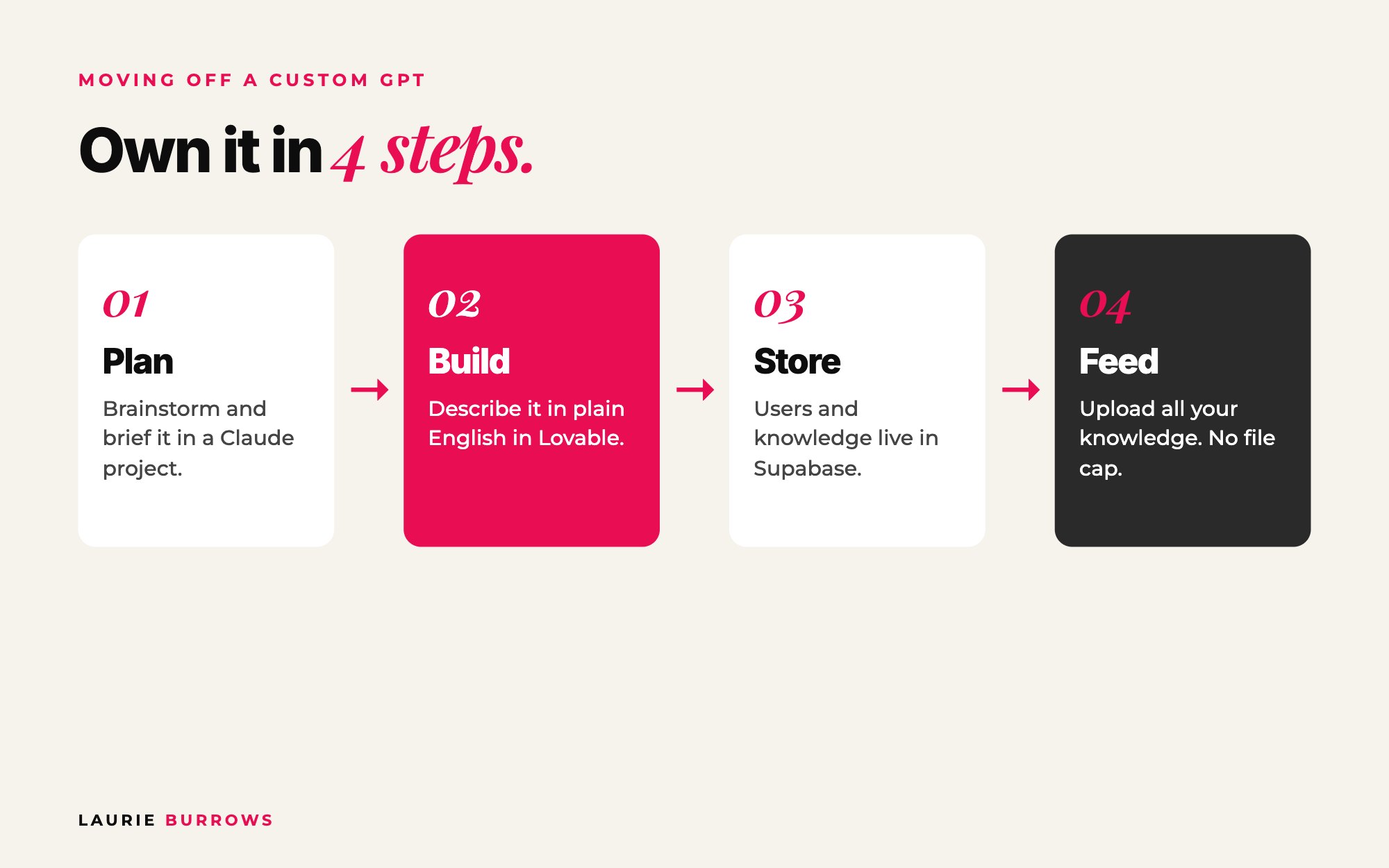
I'm not a developer. I can't code. This is the process I use, and it's the one I teach because it works for people who aren't tech savvy.
Step 1: Back up everything today
Copy your GPT's instructions into a Google Doc. Download every knowledge file into a Google Drive folder. Then make a second list: everything you wanted to give it but couldn't fit. That list is exactly why you're moving.
Time: 30 minutes. Done when: your instructions, files and "couldn't fit" list are saved in your own Drive.
Step 2: Plan it in a Claude project, starting with the customer journey
Use Claude for the planning and brainstorming, not your build tool. The build tool works on credits and will build whatever you tell it, including the wrong thing. It has no opinion. Claude will push back and tell you what belongs in version two. Map the journey from the customer's side: they find it, create an account, get onboarded, ask their first question, come back next week. Every step a customer takes needs something built.
Copy and paste: customer journey prompt
I'm moving my custom GPT, [name], onto its own platform. It helps [ideal client] to [result]. I've uploaded my current instructions.
Walk me through the customer journey one step at a time, from finding the product to using it every week: sign up, onboarding, asking questions, saving answers, coming back.
Then turn it into a component list in build order, and mark what can wait for version two. Ask me questions where you need more detail.
Time: one to two hours. Done when: you have a component list in build order, with version two items parked.
Step 3: Build the visual shell in Lovable
Lovable builds by talking to it in plain English and puts it live on a real URL. Ask Claude to write the first prompt for you, so you spend Lovable credits on building, not thinking.
Copy and paste: ask Claude for the build prompt
Using the component list we agreed, write me the first prompt to give Lovable. It should create the visual shell only: the login page, the main chat screen and the layout, with my branding ([colours, fonts, logo]). No features wired up yet.
Write it in plain English so I can paste it straight in, and tell me what to check once it's built.
Step 4: Connect Supabase and choose what powers the AI
Your AI runs on the server, not on the page, and all your users and knowledge need somewhere to live. Connect Supabase inside Lovable (if you're unsure how, ask Lovable to walk you through it). Then choose the API that powers the answers: OpenAI, Anthropic (Claude) or Google. Each question costs a tiny amount, pennies. Ask Lovable which option is most cost effective for what you're building.
Step 5: Feed it your instructions and knowledge, with no file limit
Give it the same instructions your GPT had, then everything from your "couldn't fit" list. I built an admin area into mine, which only I can access, where I paste a transcript or upload a file, give it a title, a category and a source, and it's in. Ask for one in your build. The full method for organising your knowledge is in how to turn your Otter transcripts into an AI knowledge base, and the five instruction blocks are in the 5 identity blocks that make an AI sound like you.
Step 6: Build one component at a time, and test each one
The mistake I made on one build was jumping straight in with everything at once. Nothing worked properly and I lost track of what I'd done. Build one component, test it, then move to the next. It saves credits and it means the free trial or first login is brilliant, which is what keeps people.
Time: a few weeks of evenings for a simple AI, depending on how much you add. Done when: a new user can sign up, ask a question and get an answer in your voice, start to finish.
Step 7: Move your existing clients across
Don't panic, and don't leave them hanging. When I moved mine, I kept the original running for people who wanted to stay where they were, and built the new platform for everyone else. If you've made a promise to clients, you keep it. Most people are really understanding when you're open with them.
Copy and paste: client move email
Subject: Your [AI name] is getting its own home
Hi [first name],
Quick update on [AI name]. It's moving onto its own platform at [URL]. That means no separate subscription, no file limits (so it now knows far more of my training), and it's protected from changes on other platforms.
What this means for you: your access carries over. Log in here: [link]. If you'd rather keep using the original version, that's fine too. It stays available [for as long as you promised].
Any questions, just hit reply.
[Your name]
Do this now: open your custom GPT now, copy the instructions into a Google Doc and download every knowledge file. Even if you never move it, you can't lose it.
Worked example: what changes when you move
Example (illustrative): a coach selling an AI trained on her signature programme as a four figure offer.
| As a custom GPT | On her own platform | |
|---|---|---|
| Knowledge | 20 files: 6 modules merged into 6 docs, Q and As left out | Every module, every Q and A, top 20 questions, filed by theme |
| Buyer access | Needs an account with the AI company | Logs in on her website |
| Running cost | Around $20 a month, flat | Build credits (higher during the build, much lower after), database, pennies per question |
| Risk | Feature, tier or reputation changes hit her product | Can switch the AI engine without clients noticing |
| Positioning | One GPT among many | A branded product, easier to sell at four figures |
Benchmarks
- Custom GPT: 20 knowledge files, around $20 a month, buildable in an afternoon.
- Own platform: no file limit, pennies per question through the API.
- Proof it sells: my custom AI launched with over 100 sign-ups in around 30 days, and has gone on to generate six figures in new sales.
- Build rhythm: one component, one test, then the next.
Common mistakes (and the fix)
- No backup. Fix: Step 1 today, whatever you decide.
- Brainstorming inside the build tool. Expensive, and it won't say no. Fix: plan in Claude.
- Building everything at once. Fix: one component at a time.
- Moving clients without telling them. Fix: the email above, and keep your promises.
- Forgetting the marketing. A platform nobody hears about sells nothing. Fix: plan the launch while you build.
Your action plan
- Today: Back up your instructions and files and write your "couldn't fit" list.
- This week: Set up a Claude project, run the customer journey prompt and agree your component list.
- Next 30 days: Build the shell, connect Supabase and the API, feed your knowledge, test every component, then send the client move email.
The whole point of an AI product is that you build it once and sell it again and again: on its own, as a downsell, as a bonus, inside your funnels or through affiliates. I explain the revenue side in can AI turn your expertise into passive income? and the full build in the ultimate guide to building a custom AI. None of it works if the product can disappear because someone else changed their mind. Build it where you hold the keys.
And once it lives on your own platform, you need somewhere to sell it from. The Funnel Builder inside Ascendia OS builds your sales page and checkout on your own domain, and the Launch Manager plans the launch and sets it up to run again on repeat.
Want help turning your AI into a product you own?
If you want help deciding what your AI should do, where it should live, and how to price and launch it, have a look at working with me. Prefer a free first step? Grab the 30 Claude Content Prompts and my other free resources.
Rather have it done for you?
Sell the AI you own from a platform you own
The Funnel Builder builds your sales page, checkout and upsells on your own domain, the Copywriter writes the launch emails and sales page, and the Launch Manager sets the launch up to run on repeat. 14 days free, no tech skills needed.
Frequently asked questions
Can I still sell a custom GPT?
You can, and it's a fast way to test whether people want your AI. Just know you're relying on another company's features, pricing and reputation. If it's going to be a core offer, plan to move it onto your own platform.
What happens to my custom GPT if the platform removes the feature?
Your product stops working in its current form, and you'll need to rebuild it somewhere else. That's why it's worth keeping your instructions and knowledge files saved in your own Google Drive, so you can move quickly.
How many files can you upload to a custom GPT?
Custom GPTs are limited to 20 knowledge files. People with lots of content end up combining transcripts into large documents or leaving material out. Your own platform has no limit.
Is it expensive to run my own AI platform?
Not as expensive as people expect. You pay for the build tool's credits (higher during the build, much lower afterwards), your database, and a small cost per question through the AI provider's API, usually pennies. For most coaches it's a fraction of what the product sells for.
Do I need a developer to move my custom GPT?
No. You plan it in Claude, build it in Lovable by describing what you want in plain English, and ask the AI to walk you through anything you're stuck on. I'm not a developer and I've built my own AI platform and my own software this way.
Laurie Burrows is a UK-based marketing and sales strategist who has built a business that's generated multi-seven figures in sales through social media and digital marketing. Today, Laurie helps business owners use social media, content and digital marketing to get seen, attract more clients and make more sales. She's also the founder of Ascendia OS.
Do you want to scale your business to 10K months in the next 90 days? I am looking for 10 people for my new case study program. DM me the word CASE STUDY on Instagram (@_laurieburrows) to learn more.