Why Traditional Courses and Programmes Stopped Selling
Short answer: traditional courses and programmes stopped selling the way they used to because buyers have changed. Most of your ideal clients have already bought courses they never finished, they're overloaded with information (especially now AI makes it free), the market is more crowded than ever, and they want implementation and faster results rather than another 100 hours of training and calls. Courses still sell, but only when they're restructured around speed, support and implementation, and marketed with a clear point of difference.
If you sell a course or programme and it used to fly, and now the same launch with the same offer brings in a fraction of what it did, you're not imagining it. Lots of businesses are seeing exactly the same thing right now.
It happened to me too. When I hit my first six figure month, honestly, it felt easy. I was selling a 12 month programme: pre-recorded training, live Q&As and a private community where people could ask me questions and get feedback. It grew to hundreds of members very quickly. If I launched that same programme with that same strategy today, it wouldn't work, even with a bigger audience and a bigger reputation than I had back then.
This is part of my ultimate guide to creating an offer that sells, which walks you through rebuilding an offer from research to relaunch.
So what changed, and what do you do about it?
Which of these sounds like you?
Most course creators and coaches I speak to right now fall into one of three camps:
- You've had success, but you're exhausted. You moved from one to one to a one to many model because everyone told you to, and you're still burnt out, because the programme still needs you: every live call, every question, every onboarding, every chase to get people to turn up.
- Your offer used to sell, and now it doesn't. Same offer, same strategy, completely different results.
- Nothing you put out there lands. You know you're good at what you do. You show up every day. It just doesn't turn into sales.
All three have the same root cause: what people used to invest in, they're not investing in the same way anymore.
Free 5 day event · 12th to 16th October
The 6 Figure Game Plan
If your course used to carry your revenue and doesn't now, you need a new plan, not just a new launch. In my free 5 day event you'll map your strategy to 6 figures and get the plan, content and pages created for you.
Why traditional courses stopped selling
1. Your ideal client has already bought the course
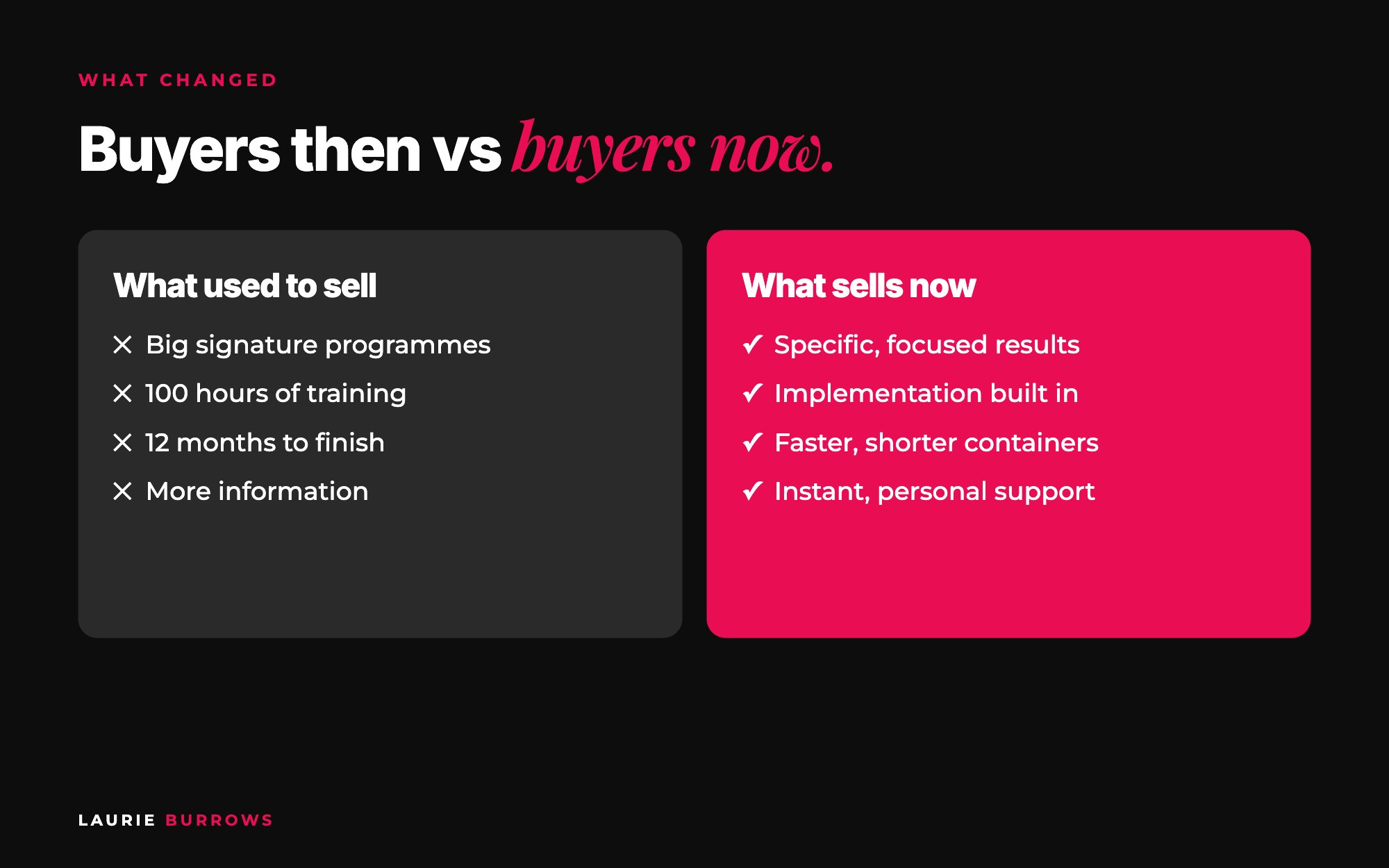
Your ideal clients have been there and done it. They've bought the courses, the programmes, the memberships. They started with the best intentions, dropped off part way through and still haven't got the result. I've been guilty of it myself. I don't want to think about how much money I've spent on things I signed up to and never finished or implemented. When your offer looks like another one of those, it gets filed with the rest of them.
2. Information is everywhere, and now it's instant
People don't need more information. They need implementation. And in a world where they can ask AI almost any question and get an answer in seconds, "a course that teaches you X" is competing with free. The value has moved from knowing what to do to actually getting it done.
3. There's more competition than ever
More competition means more choice. Your ideal client has hundreds of options that look similar to yours, which means "good" isn't enough to stand out. If your offer looks the same as everyone else's, buyers default to price, or to doing nothing.
4. Nobody has time for 100 hours of content
When we asked people why they weren't buying, time came up constantly. Your ideal client doesn't want another 30 hours of material to work through. They want the result faster, with less to consume.
5. Long, broad programmes feel risky
A broad signature programme that covers everything used to feel like great value. Now it often feels like a big commitment to something they might not finish. When we looked at our own data and research, our audience wanted subject specific offers that got straight to the point, like a course just on selling on Instagram or just on funnels, rather than one programme with everything in it.
What I did when our course sales dipped
In 2025 we saw a dip in sales of our courses and programmes. Instead of guessing, I went and asked people why they weren't buying. The objections were really clear:
- "I don't have time."
- "I've bought courses and programmes before and didn't get results."
- "I'm overloaded with information. I need implementation."
- "I need support that's personalised to me."
So I asked a different question: what offer would answer every one of those objections? The answer was a passive AI product trained on my frameworks and methods. Instead of watching hours of training and waiting for the next call, people could ask a question and get an instant answer specific to them, then implement in minutes. We launched it at four figures and had over 100 sign-ups, at a time when lots of businesses were struggling to sell anything.
I'm not saying everyone needs to build an AI product. I'm saying the offer worked because it was built from the objections, not from what I wanted to make. That's the lesson.
Do courses and programmes still sell?
Yes. Do not panic. Courses and programmes still sell when they're structured right and marketed right. They just don't sell the way they did in 2020 or 2021. Here's what I'd change.
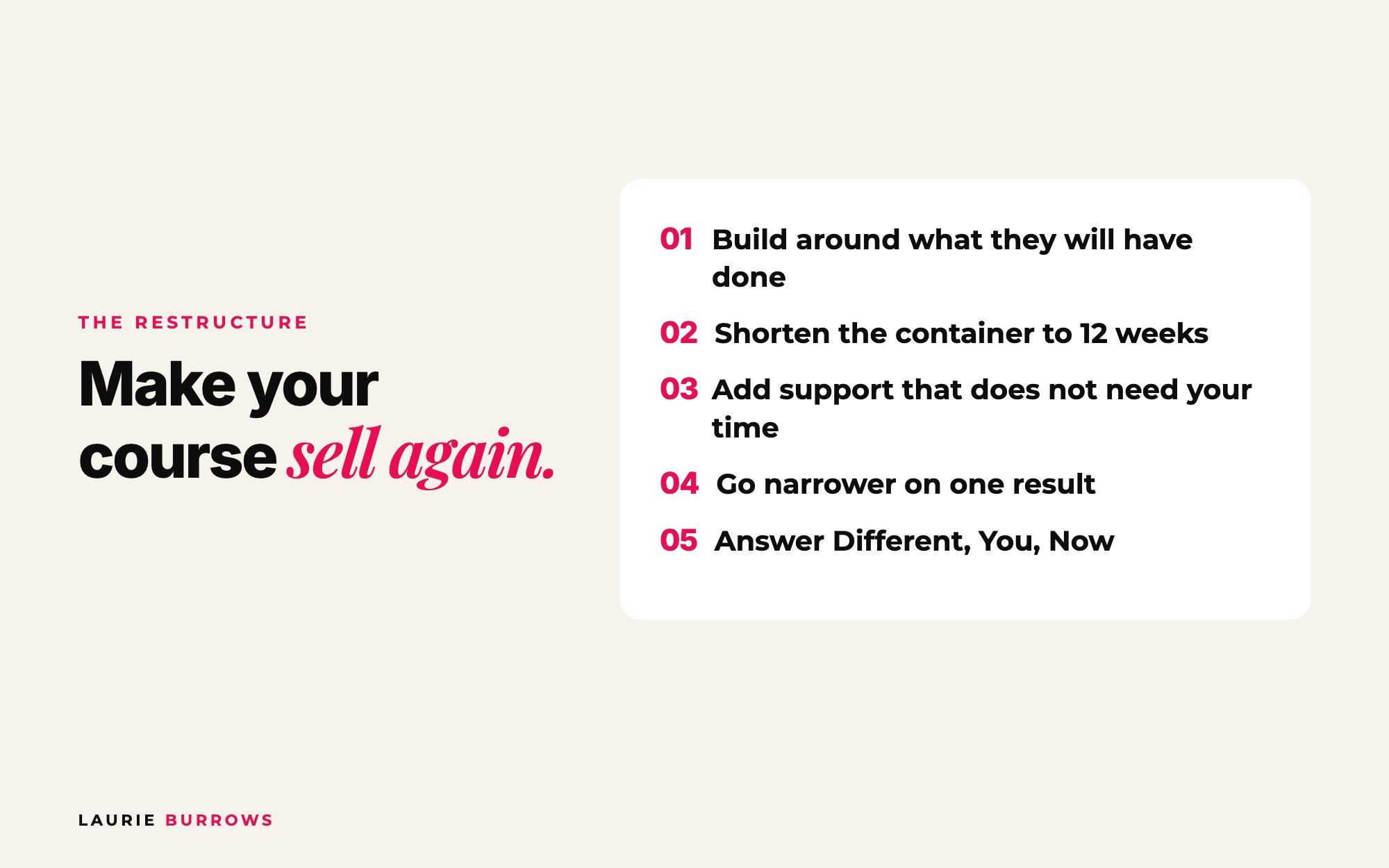
Build around implementation, not information
Ask what someone will have done (not learned) by the end. In our academy, we introduced a three day implementation so people leave with a full sales system actually in place. That one change answers the "I've bought courses and never finished them" objection head on.
Shorten the container
When you give someone 12 months, it takes them 12 months. When you give them 12 weeks, they get it done in 12 weeks, which means faster results, more testimonials and a natural point to sell them into your next offer.
Add support that doesn't need more of your time
Templates, swipe files, group Q&As delivered by your team, a community, and AI trained on your method so people get answers instantly. These make the offer faster and more personal without making you the bottleneck.
Go narrower
One specific result, sold clearly, will usually beat one big programme that promises everything. You can always offer several focused offers later.
Use a hybrid structure
Pre-recorded curriculum so people can join any time, plus live elements so they still get support and you still build a relationship with them. I break down the pros and cons in live vs pre-recorded programmes.
Answer Different, You, Now
What makes it different to everything they've bought before? Why you? Why now? If you can't answer those in a sentence each, buyers can't either. I go through these properly in why is no one buying my offer.
Do this now: ask ten people in your audience who didn't buy your last course one question: "What stopped you?" Write every objection down, then go through your offer and mark which ones it actually solves. The gaps are your next version.
What about the burnout?
If you're in the first camp (successful but exhausted), the restructure matters even more. A one to many model that still needs you for every call and every question isn't freedom, it's a glorified nine to five with more people in it. Look at each part of your delivery and ask whether it could be pre-recorded, delivered by a team member, handled by a template or answered by AI. The aim is an offer you create once and sell again and again without it costing you more time.
Your expertise isn't the problem
The thing I want you to hear is this: your knowledge is still valuable. The packaging is what's out of date. When you rebuild the offer around the objections your buyers actually have, it starts selling again.
If you want the full process for rebuilding an offer from the ground up, read the ultimate guide to creating an offer that sells. And if you'd rather have someone look at your offer with you, here's how we can work together.
How to restructure your course so it sells again, step by step
This is the process I'd follow if I had a course or programme that used to sell and has gone quiet. It's the same thing I did when our own sales dipped: stop guessing, ask, then rebuild the packaging around what people told me.
Step 1: Ask ten people why they didn't buy
Message people who showed interest and didn't buy: people who opted in, came to your free training, clicked the sales page or asked a question. Use the script below. You want ten honest answers. Don't argue with them, don't sell to them, just listen and write their words down.
Time: 30 minutes to send, 2 to 5 days to collect. Done when: you have ten answers saved word for word.
Copy and paste: why didn't you buy DM
Hey [name], thank you so much for coming along to [free training / checking out the programme]. I'm reworking [offer name] at the moment and I'd love your honest opinion.
What stopped it being a yes for you? Time, money, timing, or something about the programme itself? There's no wrong answer and I promise I'm not going to try and sell to you. It would really help me make it better.
Step 2: Group the objections and write one answer for each
Sort the answers into piles. You'll usually see the same ones I saw: no time, bought courses before and didn't get results, overwhelmed with information, it isn't the right time. Next to each pile, write the change to the offer that answers it. Not a sales line, a real change.
Time: 45 minutes. Done when: every objection has a matching change to the offer.
Step 3: Define what they will have DONE by the end
Rewrite your end result as an action they'll have completed, not something they'll have learned. "Understand email marketing" becomes "a 5 email welcome sequence written, loaded and sending". This becomes the headline of the new offer.
Time: 30 minutes. Done when: your end result starts with a verb and someone could tick it off.
Step 4: Cut the content and shorten the container
List every module and lesson. Keep only what someone needs to reach the end result in step 3. Move everything else into a bonus library or delete it. Then set a timeframe: weeks, not months. Add one implementation sprint (a three day or one week block where people build it with support) so they finish with the thing done.
Time: 2 to 3 hours. Done when: the core curriculum fits in the timeframe and every lesson leads to the end result.
Step 5: Add support that does not need more of your time
Pick two or three: templates and swipe files, a weekly group Q&A (which your team can run), a community, office hours, an AI trained on your method. Each one should make the result faster or easier. None of them should add hours to your week.
Time: 1 hour to plan. Done when: you can describe the support in one sentence and it does not depend on you doing one to one.
If your course, community and emails currently live in three different tools, it's worth simplifying here too. Ascendia OS hosts your courses and community in the same place as your funnels, email and calendars, with one login and one bill.
Step 6: Relaunch to your warmest people first
Take the new version to your email list, past buyers and the people who answered your DM in step 1. Lead with the new end result and show them you listened: "You told me you didn't have time, so I made it 6 weeks with a 3 day implementation sprint." Then look at your numbers.
Time: 1 to 2 weeks. Done when: you've made at least one offer to your list and your warm audience and tracked the results.
Want the relaunch planned for you? The Launch Manager in Ascendia OS plans your challenge, webinar or launch from first email to cart close, then sets it up to run again on repeat, and the Email Marketer writes the emails to your list and past buyers.
Example: a $997 course with 40 hours of video
This is an illustrative example. A marketing coach sells a $997 self-paced course with 12 modules and around 40 hours of video. It sold well in 2021 and barely sells now. Her ten DMs come back with: "no time" (5), "I bought something similar and never finished it" (3), "not the right time" (2).
- New end result: "Your 30 day content plan built, your first freebie live and your welcome emails sending, in 6 weeks."
- Content: 12 modules cut to 4 core modules, everything else moved to a bonus library.
- Implementation: a 3 day build sprint in week 5 with live support.
- Support: weekly group Q&A, templates for every step, private community.
- Price: still $997. Now it answers "no time" and "I never finish" right in the offer.
Benchmarks to aim for
| What you measure | Aim for |
|---|---|
| Non-buyer answers collected | 10 before you change anything |
| Container length | Weeks, not months. 12 weeks or less for most offers. |
| Leads to sales after the relaunch | Around 3% on average. My own launches convert at 10 to 12%. |
| Live attendees on your sales event | Around 25% of live attendees buy vs 2.5% overall, so get people live |
Common mistakes (and the fix)
- Adding more content to make it feel more valuable. Fix: take content away and add implementation and support.
- Guessing why people did not buy. Fix: ask ten of them. Their words become your new sales page.
- Lifetime access with no deadline. Fix: keep the curriculum, but give support a clear start and end so people take action.
- Relaunching to cold audiences first. Fix: start with your list and past buyers, then take it wider once it converts.
Your action plan
Today
- Send the why didn't you buy DM to ten people.
- List every module and lesson in your current offer.
This week
- Group the objections and write the change that answers each one.
- Rewrite your end result as something they will have done.
- Cut the curriculum and set a shorter container with an implementation sprint.
Next 30 days
- Add two or three support elements that do not need more of your time.
- Relaunch to your list, past buyers and the people who answered.
- Measure leads, show up and sales, then improve one thing.
- Rebuild the rest of your offer with the ultimate guide to creating an offer that sells.
Want help rebuilding your offer so it sells now?
In the 90 Day Revenue Growth Accelerator I help you restructure your offer around what buyers want today and build the plan to relaunch it.
Rather have it done for you?
Let Ascendia OS run your relaunch
The Launch Manager plans your relaunch from first email to cart close, the Email Marketer writes the emails to your list and past buyers, and your course and community sit on the same platform as your funnels. 14 days free, no tech skills needed.
Frequently asked questions
Are online courses dead?
No. Courses that are mostly information, with no support and no clear implementation, are struggling. Courses built around a specific result, with implementation built in and support that gets people there faster, still sell well.
Why did my course sell before but not now?
Buyers have changed. Most have bought courses they never finished, they're overloaded with information, AI has made answers instant, and there's far more competition. An offer that worked in 2020 usually needs a clearer point of difference and a faster route to the result.
Should I turn my course into a membership?
Not automatically. A membership solves recurring revenue, not the underlying objections. First fix the end result, implementation and support, then decide the model based on your goal and how many you need to sell.
How long should an online programme be?
Long enough to get the result and no longer. I recommend 12 weeks for many programmes: people act within the deadline, get results faster, and you have a natural point to offer them the next step.
What do buyers want instead of courses?
Implementation, speed and support that feels personal. That might be done with you elements, implementation days, templates, a community, or AI trained on your method that answers questions instantly.
Laurie Burrows is a UK-based marketing and sales strategist who has built a business that's generated multi-seven figures in sales through social media and digital marketing. Today, Laurie helps business owners use social media, content and digital marketing to get seen, attract more clients and make more sales. She's also the founder of Ascendia OS.
Do you want to scale your business to 10K months in the next 90 days? I am looking for 10 people for my new case study program. DM me the word CASE STUDY on Instagram (@_laurieburrows) to learn more.