What to Teach on Each Day of a Challenge

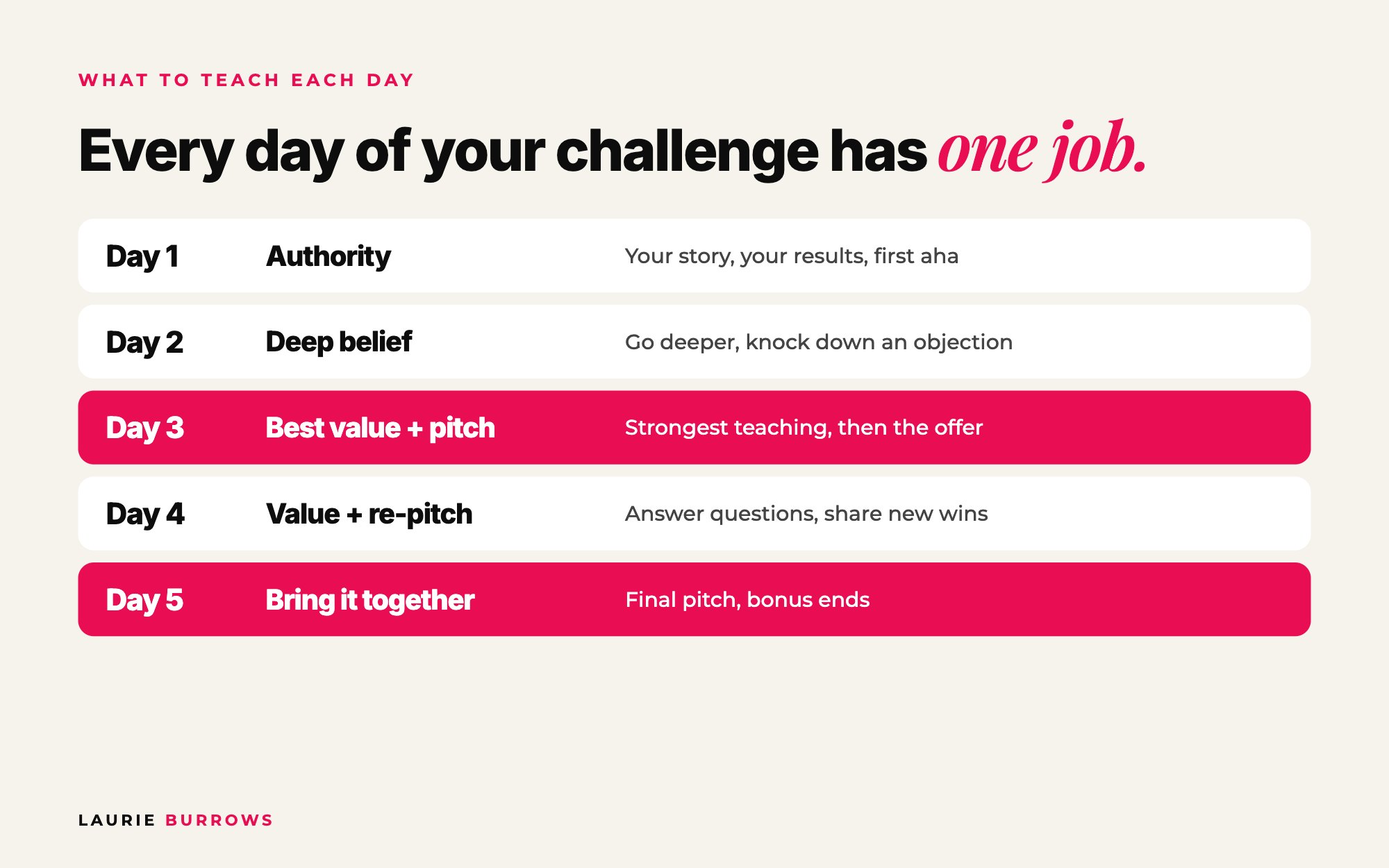
Short answer: each day of a challenge has a job. Day one builds authority and gives the first aha moment. Day two deepens belief in your method. Day three delivers your most valuable teaching and then your pitch. Day four adds more value and re-pitches. Day five brings everything together with a final pitch and fast action bonus. Every day needs one aha moment and one action step, all pointing at the same end result your paid offer delivers.
Most people plan their challenge content by brain dumping everything they know into five days. Then they're surprised when people feel overwhelmed, drop off and don't buy.
A challenge isn't a free course. It's a customer journey. Each day is there to move your ideal client one step closer from cold (they've just found you) to hot (they want to work with you). When you plan it that way, the pitch on day three feels like the natural next step, not a hard sell. Here's how to plan it, day by day, with a planner you can copy, an example, the numbers to aim for and an action plan.
This is part of my ultimate guide to a 6 figure course launch, so once your five days are planned, head there for the promotion, pitch and follow up.
Step 1: Write one promise for the whole challenge
Your whole challenge should deliver a smaller version of your paid offer's end result. Same promise, smaller scope, smaller milestones. If your programme helps people add $10k a month through Instagram, your five days help them take the first steps towards that, not something loosely related.
Then plan every day around two things:
- One aha moment: the moment they realise what's actually been missing and why they need your solution.
- One action step: something they do today that gets them a small result. Results build trust, and trust creates the sale.
Teach the what, not every how. Show them what's missing and give them enough to take one step. The full how is what they get when they buy.
Time: 20 minutes. Done when: you can finish the sentence "By day five you'll have..." and it's a smaller version of your paid offer's result.
Copy and paste: 5 day challenge planner
Promise: By day five you'll [small result] so you can [paid offer end result].
Day 1, authority: Aha: [what's really missing]. Action: [task]. Proof: [your story or result].
Day 2, belief: Aha: [next part of your method]. Objection to knock down: [objection]. Action: [task that builds on day 1].
Day 3, best value + pitch: Aha: [the piece that makes it all click]. Pitch: [offer], [price], [fast action bonus, 24 to 48 hours]. Action: [task].
Day 4, value + re-pitch: Aha: [answer the biggest question from day 3]. Win to share: [someone who joined]. Action: [task].
Day 5, bring it together: Plan: [how it all fits]. Final pitch: bonus ends [day and time]. Action: [task].
Step 2: Plan day one (authority and foundations)
Many of the people joining don't know you yet. So day one has to answer: why should I listen to you?
- Share your story: who you are, what you've been through, why you do this.
- Share results, yours and (with permission) your clients'. If you don't have client results yet, use your own journey and become your own evidence. When I started, I documented growing my business in real time so people could see it working.
- Teach the foundation of your method and give the first aha moment.
- Set the first action step and ask them to post it in the community.
Time: 45 minutes to plan. Done when: someone who has never heard of you would know why to listen to you within the first three minutes.
Step 3: Plan day two (build deep belief)
Day two goes deeper into your method. The goal is for them to believe two things: that this approach works, and that it can work for them.
- Recap day one and celebrate the action steps people posted.
- Teach the next part of your method and give another aha moment.
- Weave in a story or result that knocks down a common objection ("I don't have a big audience", "I'm not techy", "I've tried this before").
- Set another action step that builds on yesterday's.
Time: 45 minutes. Done when: you've named the one objection day two knocks down.
Step 4: Plan day three (your best value, then the pitch)
This is the day that matters most. Attention is at its highest and trust has been building for two days, so this is when you pitch.
Here's a trick I use: I put the most important part of the strategy on day three. That's usually where you see people start to drop off, so I tell everyone from day one that day three is where it all comes together. They want to be there.
- Teach your most valuable piece, the part that makes everything else click.
- Include client stories and results.
- Then pitch your offer properly: what it is, who it's for, the end result, what's included, the price and a fast action bonus for the next 24 to 48 hours.
- Finish with the day's action step.
If you're running a three day challenge, this happens on day two instead. If pitching makes you want to hide, read how to pitch without feeling icky, or grab The 5-Figure Webinar Formula, which includes my pitch script.
Copy and paste: day one teaser line for day three
"Make sure you're here on day three. That's where everything we do this week comes together, and it's the bit most people never get to. I'm telling you now so you can block it out."
Time: 1 to 2 hours, because this is the day that sells. Done when: day three has your strongest teaching, a full pitch and a bonus with a real deadline.
Step 5: Plan day four (more value and re-pitch)
Not everyone was there on day three, and plenty of people who were need to hear it again. Day four gives more value, answers the questions and objections that came up after the pitch, then pitches again with your face and your voice. Share any wins from people who've already joined, because nothing sells like other people saying yes.
Time: 30 minutes, after day three. Done when: you've listed the top three questions from day three and answered each one in the session.
Step 6: Plan day five (bring it all together)
Day five connects the dots. Show them how everything from the week fits into one plan, then make your final pitch and remind them the fast action bonus is about to end. In my own five day experiences, day five has often been "bring it together into a 90 day plan", which makes the paid offer the obvious way to carry that plan out.
Time: 45 minutes. Done when: day five ends with a plan they can follow and a clear deadline for the bonus.
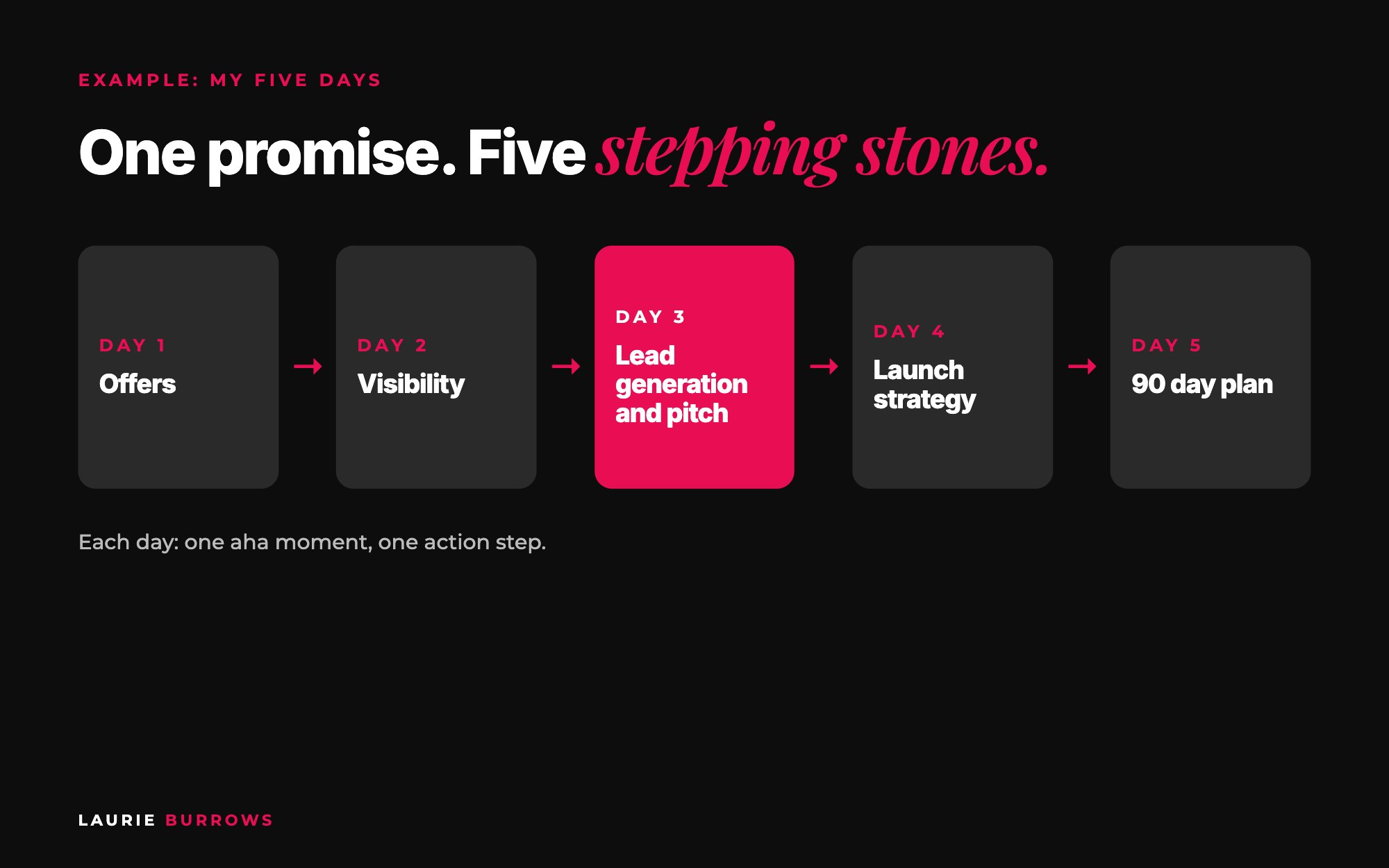
Worked example: my own five days
When I've run a five day experience for coaches, the days have looked something like this:
- Offers: what makes an offer actually sell, so they can see the gap in theirs. The action step: fix that gap.
- Visibility: why no one's seeing them, and three things to do today to get visible.
- Lead generation: the mistakes they're making and what to fix. Pitch day.
- Launch strategy: how to turn all of that into sales.
- A 90 day plan: bringing it all together.
Before one round, I polled the people who'd been through it and asked what they wanted more of. They asked for more lead generation, more visibility and more on handling objections, which was different to what I'd originally planned. Ask your audience. They'll tell you.
Step 7: Test your plan with your audience
Before you record anything, run a quick poll in your stories or community: "Which of these do you most want help with?" with your five themes as options. Move the most popular topic to day three, because that's the day you most need people to turn up for.
Time: 10 minutes, then 48 hours of votes. Done when: your day three topic is the one your audience voted for most.
Once your five themes are set, the rest is logistics: emails, reminders, the pitch day and cart close. If you'd rather not build that around your plan yourself, the Launch Manager inside Ascendia OS plans the whole challenge from first email to cart close, then sets it up to run again on repeat.
Another structure that works well is building one finished thing across the week, where each day's task creates one piece of it. A storytelling challenge, for example, could have people work out their ideal client's story on day one, choose a moment and write an opening line on day two, write the story on day three, make it relevant to their audience on day four, and add a call to action and publish it on day five. By Friday they have something real they made, which is a brilliant result to build trust on.
How long should each day be?
Around 20 minutes. Long sessions lead to big drop off, and by pitch day hardly anyone is watching. Twenty minutes is enough for one aha moment and one action step. I explain why in why 20 minute trainings sell better. For the full set up, from promotion to down sell, read how to run a 5 day challenge that sells.
Benchmarks for each day
| Number | What to aim for |
|---|---|
| Session length | Around 20 minutes |
| Aha moments | One per day |
| Action steps | One per day, posted in the community |
| Pitch | Day three (day two on a three day challenge), then again on days four and five |
| Fast action bonus | 24 to 48 hours |
| Conversion rate | Industry 1 to 3%. My launches 10 to 12%. |
Common mistakes
- Mistake: Brain dumping everything you know. Fix: One promise, one aha and one action step per day.
- Mistake: Saving the best teaching for day five. Fix: Put it on day three, the day you pitch.
- Mistake: Skipping your story on day one. Fix: Spend the first few minutes on why they should listen to you.
- Mistake: Pitching once. Fix: Pitch on day three, then again on days four and five.
- Mistake: Guessing the topics. Fix: Poll your audience before you record.
Your action plan
Day 1
- Write your one promise.
- Copy the planner above and fill in the five themes.
Day 2
- Poll your audience on the themes and move the favourite to day three.
Day 3
- Write one aha and one action step per day.
Day 4
- Script your day three pitch and fast action bonus.
Day 5 to 7
- Record or plan each session at around 20 minutes.
- Schedule reminders and the day one teaser for day three.
- Read the ultimate guide to a 6 figure course launch to plan everything around your five days.
Want the day three pitch done with you?
The 5-Figure Webinar Formula is my 10-step webinar framework for $27, with the slide deck template, the pitch script and the objection handling slides, so you can build an event that sells without starting from a blank page.
Rather have it done for you?
Let Ascendia OS turn your five days into a full launch
The Launch Manager plans each day of your challenge, the pitch day and cart close, and the Email Marketer writes the reminders and follow up in your voice. 14 days free, no tech skills needed.
Frequently asked questions
What should I teach on day one of a challenge?
Build authority first. Share your story and results so people know why to listen to you, teach the foundation of your method, and give one aha moment and one action step.
Which day should I pitch in a 5 day challenge?
Day three. Trust has been built over days one and two and attention is still high. You then have days four and five to re-pitch and handle objections before the fast action bonus ends.
How much should I give away for free in a challenge?
Teach the what and enough of the how for people to take one step and get a small result. Your challenge is a snippet of your paid offer, not the whole thing.
Should every day have homework?
Yes, one clear action step per day. When people take action and get a result, they trust you more and they're more likely to buy.
How do I stop people dropping off before day three?
Keep sessions short, send email and WhatsApp reminders, run an active community with prizes for engagement, and tell people from day one that day three is where it all comes together.
Laurie Burrows is a UK-based marketing and sales strategist who has built a business that's generated multi-seven figures in sales through social media and digital marketing. Today, Laurie helps business owners use social media, content and digital marketing to get seen, attract more clients and make more sales. She's also the founder of Ascendia OS.
Do you want to scale your business to 10K months in the next 90 days? I am looking for 10 people for my new case study program. DM me the word CASE STUDY on Instagram (@_laurieburrows) to learn more.