How to Pitch Without Feeling Icky

Short answer: pitching feels icky when you rush it, apologise for it or treat it as separate from the value you've given. It stops feeling icky when you see it as the next step for people who already want the result, and when you follow a clear structure: invite them to the shortcut, name the solution, show proof, explain what's included and why, stack the value, reveal the price with confidence, ask a belief question and answer objections. Clear isn't pushy.
I've watched so many pitches lately that are, honestly, weak. Someone delivers a brilliant challenge or masterclass, gets to the moment where they should talk about their offer, and suddenly backs down. "For those of you who want to work with me further, I have this offer... here's a bit about it... the link's below. Okay, bye!"
How many times have you done that? You go in feeling confident, then it comes to the pitch and you panic, take a step back and lightly mention your offer on the way out. And then you wonder why nobody bought.
Here's what I want you to know: the people still watching at the end of your training are interested. They stayed. If you don't tell them clearly how to get the result, you're leaving them to figure it out on their own. That isn't kind. That's abandoning them right when they're ready. Below I'll show you why pitching feels icky, the ten part structure I use, then exactly how to write and deliver yours step by step, with a full pitch script to copy and an action plan.
This is part of my ultimate guide to webinars that sell, where the pitch is step 10 of the structure.
Why does pitching feel so icky?
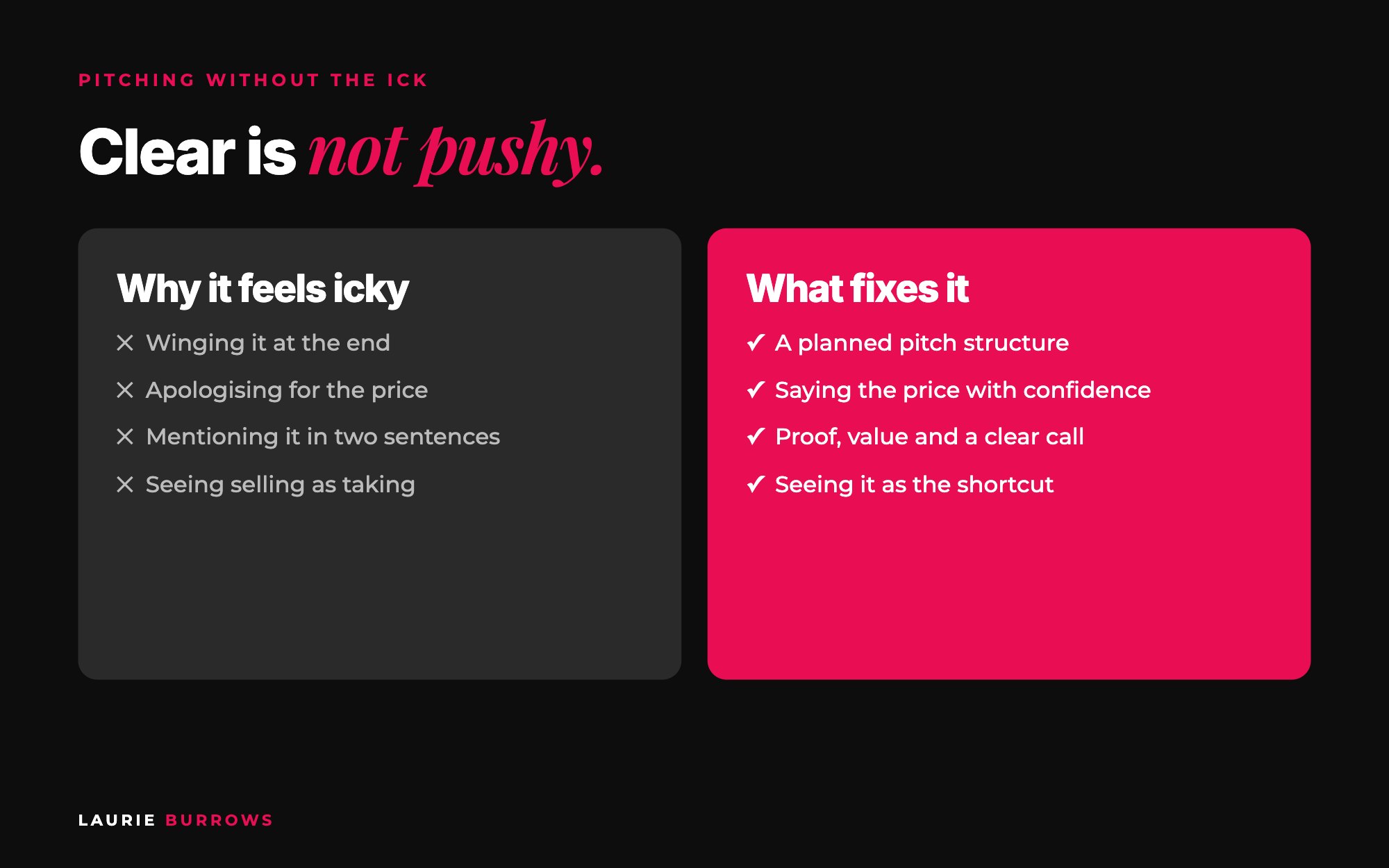
In my experience, it comes down to three things:
- You're winging it. You've planned 45 minutes of teaching and 30 seconds of offer. No wonder it feels awkward.
- You're apologising. Hesitation in your voice tells people you're not sure it's worth it. If you're not sure, why would they be?
- You've separated selling from serving. You think the value is the training and the pitch is the bit where you take something. It isn't. The pitch is where you show people how to actually get the result.
Fix those three and the ick goes with them.
Reframe the pitch: it's the shortcut
In my webinars, I don't "transition to selling". I offer a shortcut.
"I've shown you what's missing today. What I haven't given you is the how. For those of you who want this set up in your business and generating sales in the next 90 days, I have an invitation for you. This is for those of you who want a shortcut."
Then I give people permission to leave: "If you don't want the shortcut, you're welcome to go." It takes the pressure off everyone, including me. The people who stay have chosen to hear about the offer. You're not pushing anything on anyone.
The 10 part pitch structure
Having a structure is the biggest cure for pitch nerves. You're not improvising, you're following steps.
- Name the solution. "This is what will help you finally achieve [their result]. It's called [offer name]." Simple and grounded.
- Remind them why they're here. "You're here because you want X. You're done with Y." Use their words.
- Show proof. One to three stories of people who were where they are and are now where they want to be. If you don't have client results yet, use your own journey.
- Explain what's included, and why it matters. Not "eight modules". What it is, why they need it and how it gets them closer to the result. People buy outcomes, not features.
- Stack the value. Recap everything with a value next to each part, so they see it's worth far more than the price. See how to build a value stack.
- Add real bonuses. A fast action bonus for the next 24 to 48 hours. Real deadline, real bonus.
- Reveal the price with confidence. "The total value is X. You're not going to pay that. Your investment today is Y." Then stop talking.
- Ask the belief question. More on this below.
- Answer the common objections. Time, money, "will it work for me".
- Give a clear final call. Two choices: keep doing what isn't working, or take the shortcut. Exactly what to click and by when.
The belief close
This is one of my favourite parts of any pitch, because it lets the buyer justify the decision themselves.
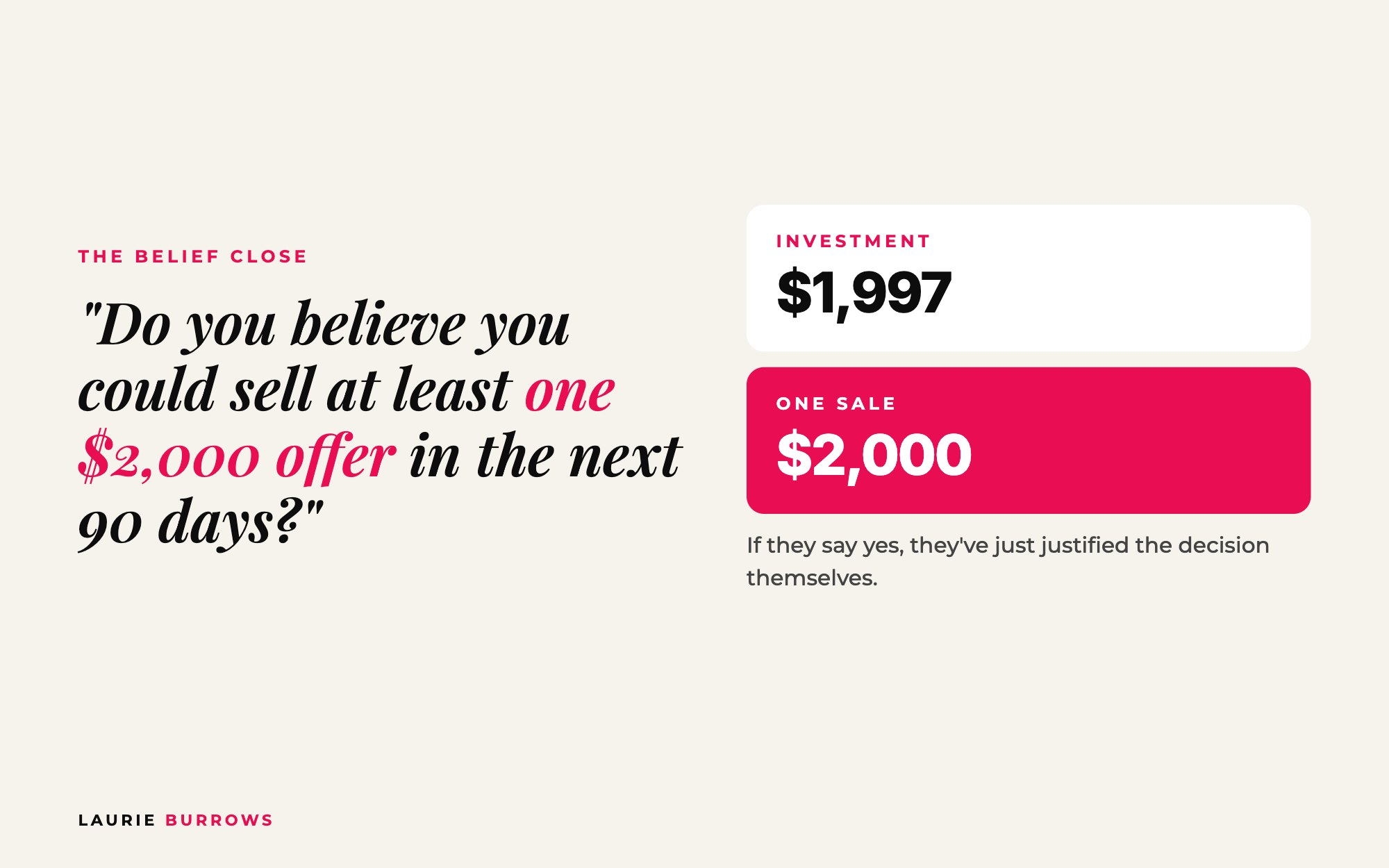
After I reveal the price, I ask a question that shows the result is worth more than the investment. For a $1,997 programme that helps people build a sales system, it's: "Do you believe that with this system you could sell at least one $2,000 offer in the next 90 days?"
If they've stayed to this point, the answer is yes. And in saying yes, they've just realised they only need to sell one offer to make their money back. Then I remind them we're not aiming for one sale. We're building something that sells every week.
Your question will be different depending on what you sell. The point is the same: if the result is worth more to them than the price, they'll buy. Help them see it.
Bonuses, not discounts
Discounting can make a pitch feel desperate and reduces the perceived value of what you sell. It's also unfair on people who paid full price. Bonuses do the opposite: they add value and reward people who decide quickly.
If you do want to offer money off for fast action, the wording matters. I don't say "I'll discount it by $500." I say "if you join in the next 48 hours, I'm going to give you $500 towards your tuition." Same maths, very different feeling. More on doing this honestly in ethical urgency and scarcity.
How to write and deliver your pitch, step by step
Step 1: List every objection you've ever heard
Before you write a word of the pitch, write down every question and objection people have raised about your offer. "I don't have time." "I can't afford it right now." "I've tried something like this before." "Will it work in my niche?" Each one needs an answer, either woven into the pitch or answered one by one at the end. When you know you have an answer for everything, you stop dreading the pitch.
Time: 20 minutes. Done when: you have at least five objections, each with a one or two sentence answer.
Step 2: Write the pitch as its own script
Write it as a separate document from your training, using the ten parts above. If you want the full framework with slides, The 5-Figure Webinar Formula includes my 10-step webinar structure, pitch script and objection handling slides for $27.
Copy and paste: pitch script
Shortcut: "I've shown you what's missing today. What I haven't given you is the how. For those of you who want [result] in the next [timeframe], I have an invitation. If you don't want the shortcut, you're welcome to go."
Name it: "This is what will help you finally [result]. It's called [offer name]."
Why they're here: "You're here because you want [desire]. You're done with [pain]."
Proof: "When I [your story or result], [what changed]."
What's included and why: "You get [part one]. That matters because [how it gets them closer to the result]." (Repeat for each part.)
Value: "Let's recap: [part one] ($[value]), [part two] ($[value]), [bonus] ($[value]). That's $[total]."
Price: "You're not going to pay $[total]. Your investment today is $[price]." (Pause.)
Belief question: "Do you believe that with [offer] you could [result worth more than the price] in the next [timeframe]?"
Bonus: "Join in the next [48] hours and you'll also get [fast action bonus]."
Final call: "You have two choices. Keep [what isn't working], or take the shortcut. Click [button] before [deadline]. Any questions, DM me."
Time: 1 to 2 hours. Done when: the pitch is written word for word and takes as long to say as it needs, not 30 seconds.
Step 3: Write your belief question
Find a result your offer can realistically help someone get that's worth more than the price. Then turn it into a yes question. For a $997 programme for coaches, it might be "Do you believe that with this you could sign one new client in the next 90 days?" If one client is worth more than $997, the maths does the selling.
Time: 15 minutes. Done when: your belief question has an obvious yes, and that yes covers the price.
Step 4: Choose a bonus, not a discount
Pick something that speeds up the result, like an extra call or a review of their work, as covered above.
Time: 15 minutes. Done when: you have one fast action bonus that speeds up the result, with a real end date and time.
Step 5: Say the price out loud until it's boring
Read the price section out loud ten times. Record yourself once and listen back. If your voice goes up or you add "only" or "just", go again. The aim is for the price to sound as normal as saying your name.
Time: 10 minutes a day for three days. Done when: you can say the price and then stop talking.
Step 6: Put the pitch in the right place
In a five day challenge, pitch on day three, while attention and trust are both high. In a masterclass, mention halfway through that there's a way to work with you, then do the full pitch at the end. Don't save it for the very last minute of the very last day, when most people have gone.
Time: 5 minutes. Done when: the pitch is in your run sheet with its own time slot.
Step 7: Follow up, then review
The pitch isn't the end. Message everyone who was there and use their answers to improve the pitch next time. I explain how in how to follow up after a masterclass.
Your pitch doesn't stop when the live ends. The sales page and cart emails carry it for the next few days. If you'd rather not write those from scratch, the Copywriter inside Ascendia OS writes your sales page and launch emails in your voice, using the same structure, so the pitch sounds like you everywhere.
Time: 30 minutes a day during cart open. Done when: you know the top three objections from this round and you've added the answers to your script.
Worked example: the maths behind a confident pitch
Example (illustrative): a consultant sells a $997 group programme from a masterclass.
- Value stack: 8 week programme ($2,000), weekly group calls ($1,200), templates ($500), fast action bonus: a one to one strategy call ($500). Total value $4,200.
- Price reveal: "You're not going to pay $4,200. Your investment today is $997."
- Belief question: "Do you believe that with this you could win one $1,500 client in the next 90 days?" Yes means the programme has paid for itself.
- Bonus: the strategy call for anyone who joins in the next 48 hours.
- Result: if 50 people stay for the pitch and around a quarter of them buy, that's around 12 sales and roughly $12,000, before follow up.
Pitch benchmarks
| Number | What to aim for |
|---|---|
| Pitch day in a challenge | Day three |
| Masterclass | Mention halfway, full pitch at the end |
| Fast action bonus | 24 to 48 hours |
| Live attendees who buy | Around 25%, vs around 2.5% of all sign-ups |
| Conversion rate | Industry 1 to 3%. My launches 10 to 12%. |
Common pitch mistakes
- Mistake: A 30 second pitch on the way out. Fix: Script all ten parts and give it proper time.
- Mistake: Listing features. Fix: Say why each part matters and how it gets them to the result.
- Mistake: Apologising for the price. Fix: Say it, then stop talking.
- Mistake: Discounting to make it easier. Fix: Add a fast action bonus instead.
- Mistake: Ignoring objections. Fix: Answer them in the pitch and at the end.
Your action plan
Day 1
- List every objection and your answer.
Day 2
- Write your pitch using the script above.
Day 3
- Build your value stack and write your belief question.
Day 4
- Choose your fast action bonus and deadline.
Day 5 to 6
- Practise the price out loud and record yourself once.
Day 7
- Pitch it, then follow up and add any new objections to your script.
- Read the ultimate guide to webinars that sell to build the nine steps that lead into your pitch.
Want the pitch script and objection slides done for you?
The 5-Figure Webinar Formula is my 10-step webinar framework for $27, with the slide deck template, the pitch script and the objection handling slides, so you can build an event that sells without starting from a blank page.
Rather have it done for you?
Let Ascendia OS write the pages and emails that carry your pitch
The Copywriter writes your sales page and launch emails in your voice, the Email Marketer handles the follow up, and the Funnel Builder builds the checkout ready to take payments. 14 days free, no tech skills needed.
Frequently asked questions
How do I pitch my offer without sounding salesy?
Position it as the shortcut for people who want the result, give them permission to leave if it's not for them, and follow a clear structure. Speak about outcomes, back it up with proof and say the price confidently. Clear and confident isn't salesy.
What is a belief close?
A question after the price that helps the buyer see the result is worth more than the investment, such as "Do you believe you could sell at least one $2,000 offer in the next 90 days?" for a programme that costs less than that.
Should I offer a discount when I pitch?
Bonuses usually work better because they add value instead of reducing it. If you offer money off for fast action, frame it as a contribution towards their place rather than a discount.
What if nobody buys after my pitch?
Look at the numbers first: how many people were there, and did you follow up? Most sales happen after the pitch through personal follow up. Then review whether the pitch named the result clearly, had proof and handled objections.
Laurie Burrows is a UK-based marketing and sales strategist who has built a business that's generated multi-seven figures in sales through social media and digital marketing. Today, Laurie helps business owners use social media, content and digital marketing to get seen, attract more clients and make more sales. She's also the founder of Ascendia OS.
Do you want to scale your business to 10K months in the next 90 days? I am looking for 10 people for my new case study program. DM me the word CASE STUDY on Instagram (@_laurieburrows) to learn more.