Webinar Hooks That Stop People Leaving
Short answer: the best webinar hooks open with a bold question, statement or insight about the result your audience wants, never with "Hi everyone, welcome". Follow it with a clear promise of what they'll walk away with ("even if they've tried before"), then keep people watching with a reason to stay until the end, open loops, small interactive tasks and an emotional rhythm that moves between where they are and where they want to be.
Most people leave a webinar in the first few minutes, and it's rarely because the content is bad. It's because the opening gave them no reason to stay.
Think about how people arrive. They're scrolling on their phone, thinking about their to-do list, wondering what to have for tea. Then the webinar starts with housekeeping, a slow introduction and a long story about the presenter's background. By the time anything interesting happens, half of them have gone.
Your opening isn't a greeting. It's your moment to break their default scroll mode and position yourself as someone worth listening to. Here's how I hook people at the start and keep them hooked all the way to the pitch, then a six step process to write your own, with fill-in-the-blank formulas, a hook map, an example opening and an action plan.
This is part of my ultimate guide to webinars that sell, which takes you through all ten steps, from the hook to the pitch.
What makes a good webinar hook?
A good hook does three things in a few seconds: it interrupts what they were thinking about, it speaks to what they want, and it makes them curious about what comes next. You do that with something bold, surprising or emotional.
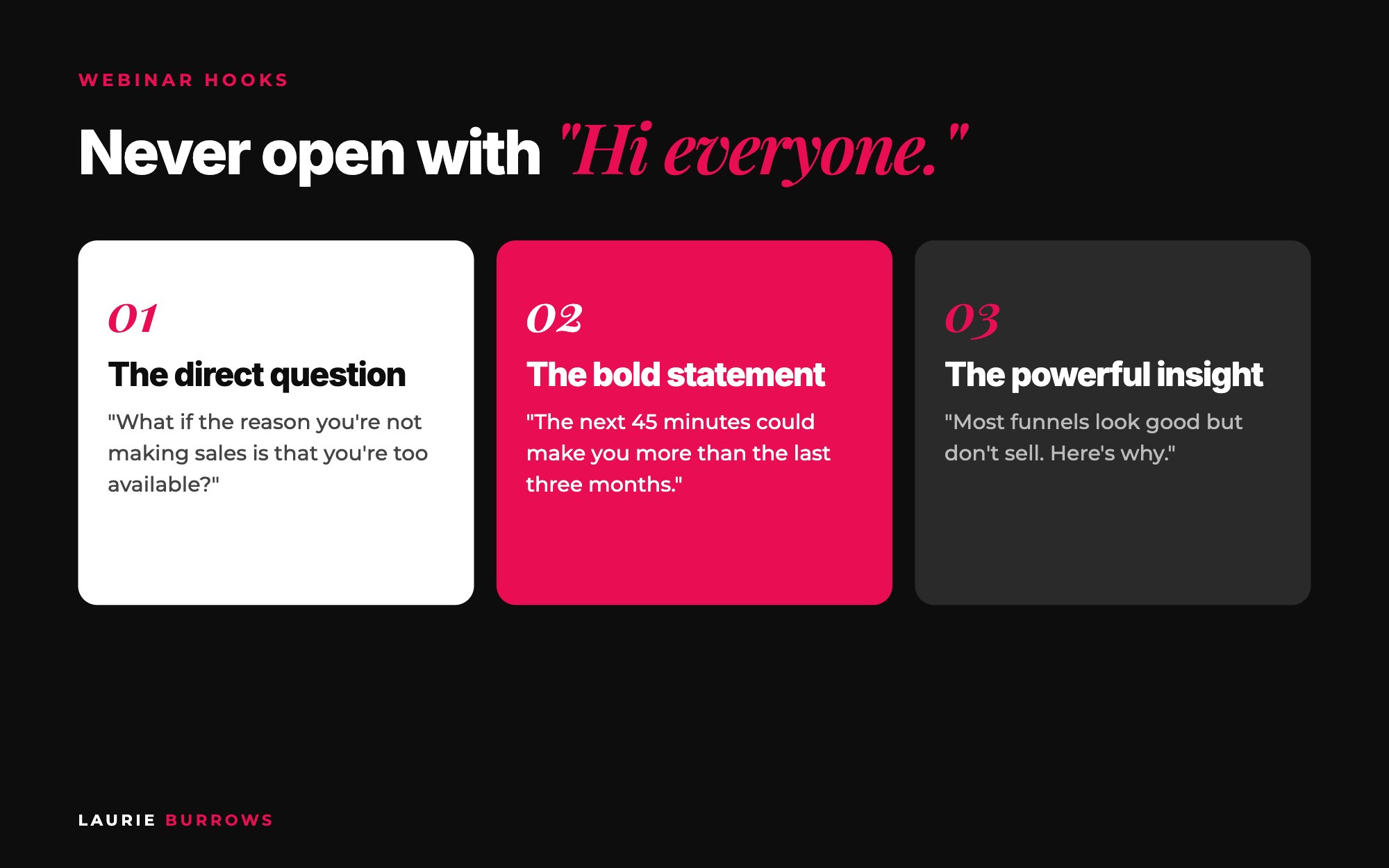
1. The direct question
"What if I told you the reason you're not making more sales is because your audience thinks you're too available?"
A question they can't help answering in their head. The more it challenges what they believe, the better.
2. The bold statement
"The next 45 minutes could make you more money than the last three months combined, if you're willing to see things differently."
A big claim with a condition attached. It raises the stakes of leaving early.
3. The powerful insight
"Most people build funnels that look good but don't sell. I'm going to show you why that happens, and exactly how to fix it."
Name a truth they've felt but never heard said, then promise the fix.
Notice none of these start with "Hi everyone, welcome to my webinar, today I'm going to teach you..." That opening is one of the most common mistakes I see. It tells people this is just another webinar. Your hook should tell them it isn't.
Follow the hook with a promise
Once you've got their attention, tell them why staying to the end is worth it. Preview the transformation:
"By the end of this session, you'll know exactly how to turn scattered content into a sales machine, even if you've tried this before and nothing has worked."
That "even if" matters. It handles the objection that's already forming ("I've tried this, it didn't work") before they've even said it.
Make it about them straight away
Your story matters, but not yet. After the hook, turn the spotlight onto them. I often ask: "Why did you sign up to this training today? You're here for a reason."
Then I describe that reason. Three pain points painted so clearly they're remembering the time it happened to them last month. You posted every day and sales stayed stuck. You launched the offer you could feel in your bones was the one, and heard crickets. A hundred people signed up to your challenge and ten showed up.
When people hear their own situation described better than they could describe it themselves, they don't leave. They lean in.
Hooks that keep people watching through the middle
The opening hook gets them in. These keep them there.
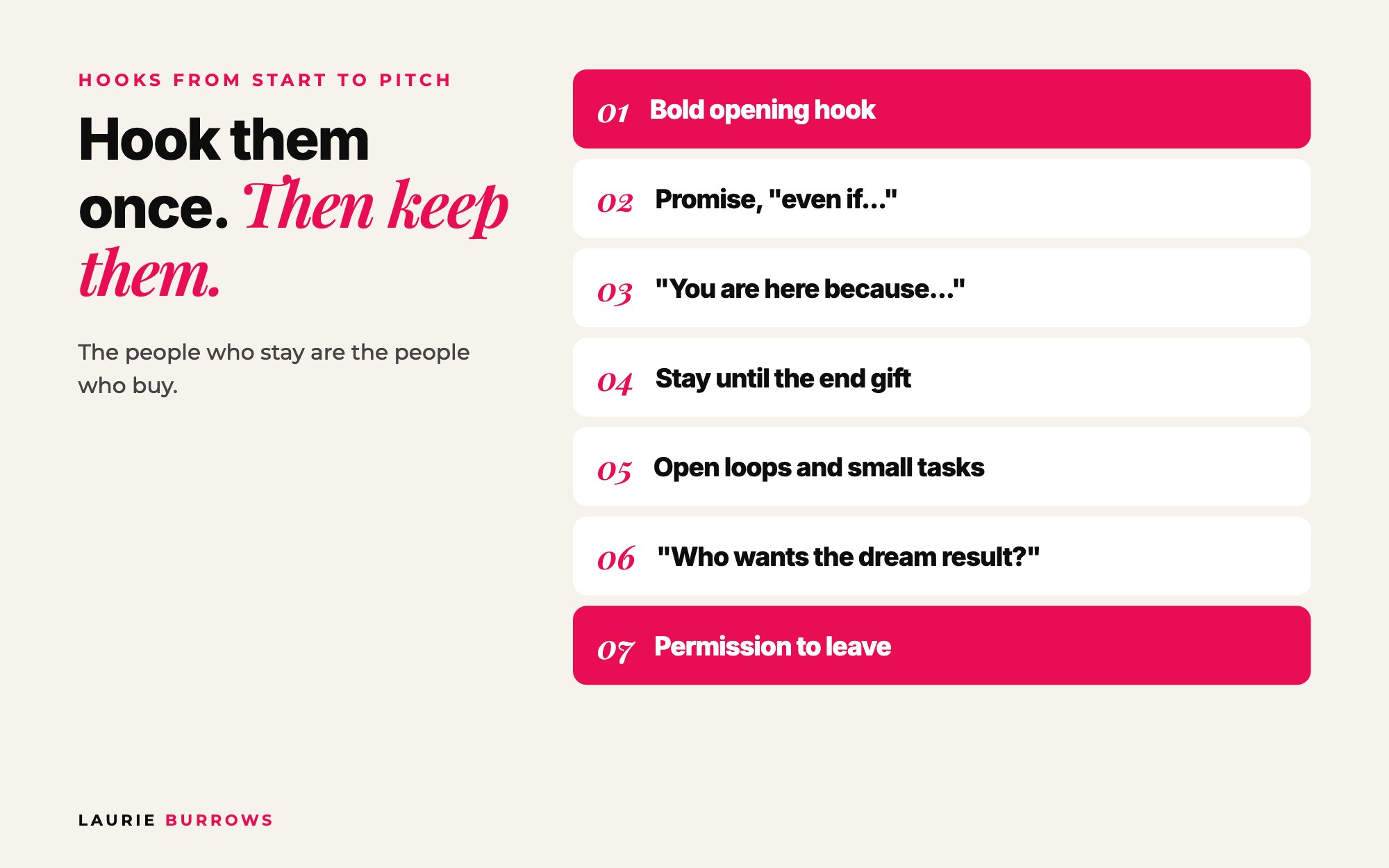
A stay until the end gift
Tell people at the start there's a gift for everyone who stays to the end. After the pitch, tell them how to claim it: DM me the word GIFT. They stay longer, and they end up in your inbox, which is where conversations and sales happen.
Open loops
"In a moment I'm going to show you the one thing that changed my launches completely." Then teach something else first. People stay to close the loop. Use them sparingly and always pay them off.
Small tasks
Ask them to do something. "Write down your goal for the next 12 months." "Get your phone out and work out your number per week." When people are writing and calculating, they're engaged, and they're building their own belief in what's possible.
An emotional rhythm
Flat webinars lose people. I deliberately move people between where they are now (the frustration) and where they want to be (the dream result), more than once. Remind them of the pain, lift them with the vision, teach, then lift them again with "who here wants to wake up to sales notifications every morning?" That rhythm keeps energy up through the long middle section, where most webinars sag.
Proof at every step
Every teaching point gets a result or story behind it. Each one is a mini hook: "this worked for someone just like you" keeps them watching for the next one.
Tease the offer halfway
On a 90 minute masterclass, I mention halfway through that there's a way to work with me, share a few details that get people excited, and tell them I'll share the rest at the end. Now they've got a reason to stay.
The hook right before the pitch
This one surprises people. Just before I pitch, I give everyone permission to leave: "This next part is for those of you who want the shortcut. If you don't want it, you're welcome to leave now."
It sounds risky, but it does the opposite of what you'd expect. It makes the pitch feel exclusive and creates curiosity, because nobody wants to miss the shortcut. And anyone who leaves wasn't your ideal client anyway.
How to write your webinar hooks, step by step
Step 1: Write three openers, one of each type
Copy and paste: opening hook formulas
Direct question: "What if I told you the reason you're not [result they want] is [surprising cause]?"
Bold statement: "The next [length] could [big outcome], if you're willing to [see things differently / do one thing]."
Powerful insight: "Most [ideal clients] [common approach] that [looks good] but [doesn't work]. I'm going to show you why that happens, and exactly how to fix it."
Time: 15 minutes. Done when: you have three openers and you've read them out loud.
Step 2: Add a promise with an "even if"
Copy and paste: promise line
"By the end of this session, you'll know exactly how to [result], even if [the objection they're already thinking]."
Time: 5 minutes. Done when: the "even if" names the thing your audience has tried before.
Your opener and promise line shouldn't only live in the webinar. Use them as the headline on your registration page and the subject lines of your promo emails, so the hook starts working before anyone arrives. If writing those isn't your thing, the Copywriter inside Ascendia OS writes registration pages, emails and ad copy that sound like you.
Step 3: Write the "why you're here" section
List three moments your ideal client has lived through recently, in their words. Not "you struggle with visibility" but "you posted every day for a month and got three likes from your mum."
Copy and paste: why you're here
"Why did you sign up today? You're here for a reason. Maybe [pain moment one]. Maybe [pain moment two]. Or maybe [pain moment three]. If that's you, you're in the right place."
Time: 20 minutes. Done when: each pain point is a specific moment, not a category.
Step 4: Plant your keep-watching hooks on a timeline
| When | Hook |
|---|---|
| First 60 seconds | Opening hook, promise, mention the stay until the end gift |
| Minutes 2 to 5 | "Why you're here" pain points, then your story |
| Before each teaching point | An open loop ("in a moment I'll show you...") |
| After each teaching point | Proof, then a small task |
| Halfway | Tease that there's a way to work with you |
| Just before the pitch | Permission to leave |
| After the pitch | How to claim the gift (DM me GIFT) |
Time: 20 minutes. Done when: every section of your webinar has at least one reason to keep watching.
Step 5: Write your permission-to-leave line
Copy and paste: permission to leave
"This next part is for those of you who want the shortcut to [result]. If you don't, you're welcome to leave now. And if you're staying, remember the gift is at the very end."
Time: 5 minutes. Done when: it's in your slides, word for word.
Step 6: Test and keep the winner
Run your best opener, then look at when people left. If the drop happens in the first few minutes, try a different opener next time. If it happens in the middle, add an open loop or a task there. Change one thing at a time so you know what worked.
Time: 30 minutes after each webinar. Done when: you know where people dropped off and what you'll change.
Common webinar hook mistakes
- Mistake: Starting with "Hi everyone, welcome to my webinar." Fix: Open with a question, statement or insight.
- Mistake: Housekeeping and tech checks first. Fix: Hook first, housekeeping in one line later (or not at all).
- Mistake: Your full life story in the first five minutes. Fix: Make it about them, then tell your story.
- Mistake: Talking about the topic. Fix: Talk about the result they want.
- Mistake: No promise. Fix: Tell them what they'll walk away with, "even if..."
- Mistake: Open loops you never close. Fix: Use a few and always pay them off.
For the full ten step structure, from the hook to the pitch, read the ultimate guide to webinars that sell. And because the people who stay are the people who buy, see why live attendees buy 10 times more and why 20 minute trainings sell better.
Worked example: a full 60 second opening
Example (illustrative): a business coach running a webinar on getting clients from content.
Copy and paste: example opening script
"What if I told you the reason you're not getting clients from your content has nothing to do with how often you post?"
"By the end of the next 40 minutes, you'll know exactly how to turn the content you already make into client conversations, even if you've posted every day for a year and heard nothing back."
"And stay to the very end, because there's a gift for everyone who does."
"So why are you here? Maybe you posted every day last month and got a handful of likes. Maybe you launched the offer you knew was the one and heard crickets. Or maybe a hundred people signed up for your last challenge and ten showed up. If that's you, you're in exactly the right place."
Notice there's no welcome, no housekeeping and no life story yet. The story comes next, once they're leaning in.
Webinar hook benchmarks
| Number | What to aim for |
|---|---|
| Time to first hook | The first sentence |
| Live attendees who buy | Around 25%, vs around 2.5% of all sign-ups, so every person you keep matters |
| Session length | Around 20 minutes per session for multi-day events, up to 90 for a warm masterclass |
| Halfway tease | Halfway through a 90 minute masterclass |
| Gift claim | After the pitch, by DM |
Your action plan
Day 1
- Write three openers using the formulas.
Day 2
- Write your promise line and "why you're here" section.
Day 3
- Map your keep-watching hooks onto the timeline.
Day 4
- Create your stay until the end gift.
Day 5
- Rehearse the first two minutes out loud until they sound like you.
Day 6 to 7
- Run the webinar, note where people left and change one thing next time.
- Read the ultimate guide to webinars that sell to plan everything after the hook.
The hook gets them in the room. The 5-Figure Webinar Formula gives you the whole 10-step structure, the slide deck template and the pitch script for $27, so the rest of the webinar converts too.
Want the full webinar structure, not just the hook?
The 5-Figure Webinar Formula is my 10-step webinar framework for $27, with the slide deck template, the pitch script and the objection handling slides, so you can build an event that sells without starting from a blank page.
Rather have it done for you?
Let Ascendia OS carry your hook into every page and email
The Copywriter turns your hook into a registration page, promo emails and ad copy in your voice, and the Launch Manager plans the webinar from first email to cart close. 14 days free, no tech skills needed.
Frequently asked questions
How should I start a webinar?
With a bold hook, not a welcome. Open with a direct question, a bold statement or a powerful insight about the result your audience wants, then promise what they'll walk away with.
How do I stop people leaving my webinar early?
Give them reasons to stay: a stay until the end gift, open loops, small tasks, proof at every teaching point and a mention halfway through that there's a way to work with you. Keep the energy moving between their current reality and their dream result.
When should I introduce myself in a webinar?
After the hook and after you've shown them you understand where they are. Your story builds trust, but it lands better once they're already engaged.
Should I give people permission to leave before the pitch?
Yes. It makes the pitch feel exclusive and creates curiosity, so most people stay. Those who leave weren't going to buy.
What is an open loop in a webinar?
A promise to reveal something later ("in a moment I'll show you..."). People stay to find out. Use a few, and always deliver on them.
Laurie Burrows is a UK-based marketing and sales strategist who has built a business that's generated multi-seven figures in sales through social media and digital marketing. Today, Laurie helps business owners use social media, content and digital marketing to get seen, attract more clients and make more sales. She's also the founder of Ascendia OS.
Do you want to scale your business to 10K months in the next 90 days? I am looking for 10 people for my new case study program. DM me the word CASE STUDY on Instagram (@_laurieburrows) to learn more.