How to Create Your Signature Framework (The A to B Method)
Short answer: to create your signature framework, write where your ideal client is now (point A) and the end result they want (point B). Brain dump everything you'd take them through to get there, put it in chronological order, group the similar pieces into clear steps, then give the framework a memorable name, ideally with each step named to match. That's the A to B Method, and it becomes the backbone of your offer, your content and your point of difference.
Every coach, consultant and course creator already has a method. You get clients results in a particular way, in a particular order, whether you've written it down or not. The problem is that when it lives in your head, buyers can't see it. And if they can't see a clear path from where they are to where they want to be, they don't buy.
A signature framework fixes that. It turns "trust me, I know what I'm doing" into a clear, named path people can see themselves walking.
This is part of my ultimate guide to creating an offer that sells, where your A to B Method is the backbone of the offer.
What is the A to B Method?
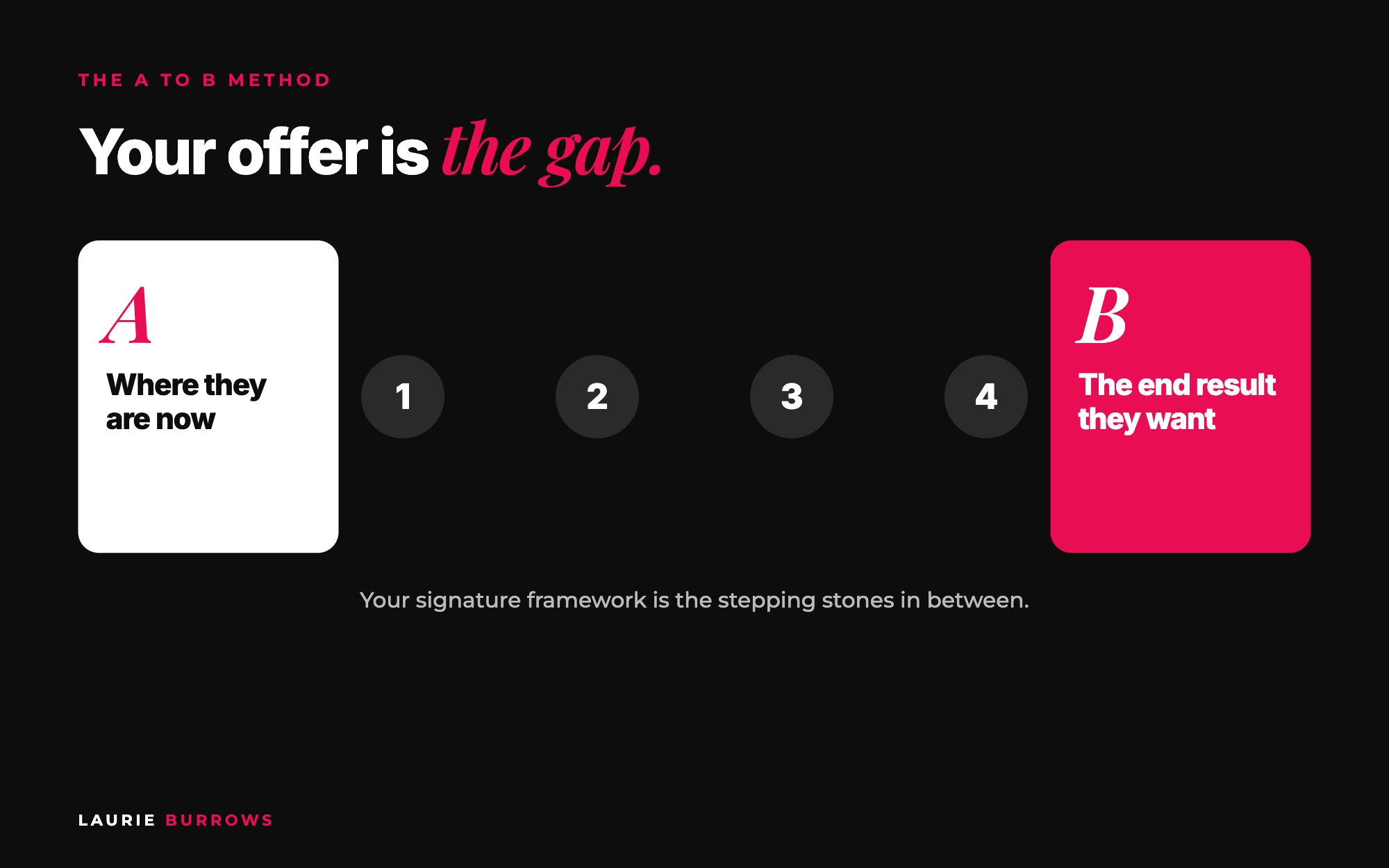
Your ideal client is at point A. That's where they are right now, and it's why they're looking for help. They want to get to point B: the end result, the transformation, the problem solved.
Your offer is the gap. Your signature framework is the stepping stones that close it. Mine is the Freedom Funnel. It's the framework that takes people from where they are now to the end result of generating daily sales, and I've trademarked it.
Why you need a signature framework
- It shows a clear path from A to B. That's one of the biggest buying triggers there is. People buy when they can see how they'll get there.
- It makes your offer different. A named method is yours. "Another course on marketing" isn't.
- It makes you look like the expert. A clear process signals you've done this many times.
- It structures everything else. Your modules, your content pillars, your free trainings and your pitch can all hang off it.
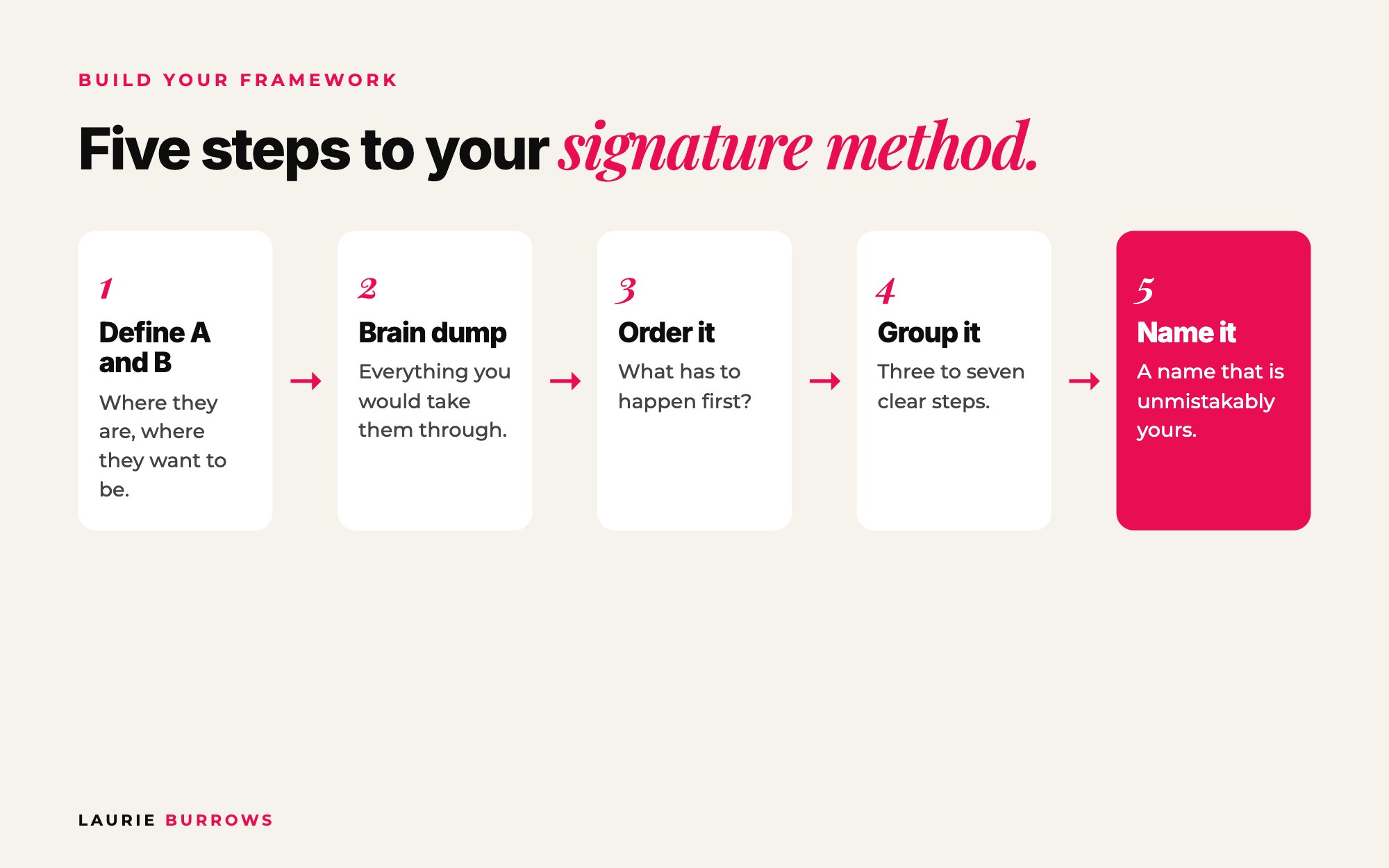
How to create your signature framework in 5 steps
Step 1: Define point A and point B
Grab a sheet of paper or a whiteboard. On the left, write where your ideal client is right now: their situation, their frustrations, what they've tried. On the right, write point B: the specific end result they want. Be as concrete as you can. If point B is vague, your framework will be too.
Time: 15 minutes. Done when: point B has a number, a timeframe or something they could see change.
Step 2: Brain dump everything in between
Now write down everything you would take someone through to get them from A to B. Every topic, every task, every mindset shift, every tool. Don't filter or organise yet. For me, that list would include things like core offer creation, low priced offers, free resources, webinars, email sequences and so on. Get it all out of your head.
Time: 20 minutes, on a timer. Done when: you have at least 20 items on the page and nothing left in your head.
Step 3: Put it in chronological order
What has to happen first? What can't happen until something else is in place? Number everything in the order you'd take a client through it. For me, it's the offer first, then the free resource, then the low priced offer, because each one depends on the one before.
Time: 20 minutes. Done when: every item has a number and nothing depends on something that comes later.
Step 4: Group the similar pieces into steps
You'll find some items naturally belong together. In my list, core offer creation and low priced offers fit in one step. A free resource and a webinar are really similar, so they could sit together too. Aim for somewhere between three and seven clear steps. Fewer is easier to remember.
Time: 30 minutes. Done when: you have three to seven groups, each with a short working title.
Step 5: Name it
Give the framework a name that reflects the end result or the feeling (the Freedom Framework, the Freedom Method). Then, to make it even more memorable, try naming each step so the first letters spell out the name of the framework. It's not essential, but it makes your method stick and look unmistakably yours.
Time: 30 minutes to an hour (or a few days of saying it out loud). Done when: you can say the framework name and every step in one breath.
Do this now: set a timer for 20 minutes. Write point A on the left of a page and point B on the right, then brain dump everything in between. Don't stop until the timer goes. Tomorrow, put it in order and group it into steps. Naming can wait until the structure is right.
Stuck on naming it? Use AI
Naming is where most people get stuck for weeks. Don't. Give AI your point A, your point B and your grouped steps, and ask it something like: "This is how I get my clients from A to B. Help me turn this into a named signature framework, and suggest names for each step that spell out the framework name." You'll get dozens of options in seconds. Pick the one that sounds like you, and say it out loud a few times before you commit.
Check it against your end result
Before you build anything on it, test the framework:
- Does every step move them closer to point B? If a step doesn't, cut it or fold it in somewhere else.
- Is anything missing that would stop someone getting the result?
- Could someone explain your framework back to you after hearing it once?
- Does it overcome the reason people haven't got results before (for example, never implementing)?
Example: a career coach builds her framework
This is an illustrative example. A career coach helps mid level managers move into their first leadership role.
- Point A: passed over for promotion twice, doing the job without the title, not sure how to make the case.
- Point B: promoted into a leadership role (or a new job offer) within 6 months.
- Brain dump (shortened): CV rewrite, wins log, LinkedIn profile, internal visibility, conversation with the manager, salary research, interview prep, mindset, networking, personal brand, negotiation.
- Grouped and ordered: 1. Know your value (wins log, salary research, mindset). 2. Get seen (LinkedIn, internal visibility, networking). 3. Make the case (manager conversation, CV, interview prep). 4. Close it (negotiation, first 90 days plan).
- Named: The RISE Method: Recognise your value, Increase your visibility, Sell your case, Embed your win.
That's four modules, four content pillars and a pitch that shows the whole path in one slide. Her free training now teaches step one properly and invites people into the rest.
Copy and paste: signature framework worksheet
Point A (where they are now, in their words): [situation], [frustration], [what they have tried].
Point B (the end result): [specific result] in [timeframe].
Brain dump: [everything you would take them through, no filtering].
Ordered and grouped: Step 1 [group name]: [items] | Step 2 [group name]: [items] | Step 3 [group name]: [items] | Step 4 [group name]: [items]
Framework name: The [NAME] Method / Framework. Step names that spell it out: [letter] [name], [letter] [name], [letter] [name], [letter] [name].
AI prompt: "Here is my point A, my point B and my grouped steps: [paste]. Suggest 10 names for this signature framework, and for each, names for the steps that spell out the framework name. Keep it simple and easy to say."
Benchmarks to aim for
| Check | Aim for |
|---|---|
| Number of steps | 3 to 7. Fewer is easier to remember. |
| Brain dump | 20 items or more before you organise anything |
| Explain back test | Someone can repeat your framework after hearing it once |
| Time to a first version | One focused afternoon. Refine it as you teach it. |
Common mistakes (and the fix)
- Naming it before the structure is right. Fix: order and group first, name last.
- Too many steps. Fix: merge anything that belongs together until you have seven or fewer.
- Steps that are topics, not progress. Fix: each step should move them closer to point B, not just cover a subject.
- Keeping it in your head. Fix: put it in a graphic, on your sales page and in your pitch so buyers can see the path.
How to use your framework once it's built
- Structure your offer: each step becomes a module or phase.
- Build your content: each step is a content pillar you can teach from again and again.
- Shape your free trainings: teach one step deeply so people see the whole path and want help with the rest.
- Strengthen your pitch: show the full framework so buyers can see a clear path from A to B.
And because each step is clearly defined, your framework is perfect for pre-recorded delivery, so people can join any time and move through the stepping stones at their own pace.
Once your steps have names, they make a ready-made content plan. The Content Creator inside Ascendia OS can plan your month around them, write the posts in your voice and schedule them, so every week teaches a step of your method.
Your framework is also a big part of your point of difference in the EVP Model. If you haven't worked through that yet, read the EVP Model explained, and for how it all fits into one offer, the ultimate guide to creating an offer that sells. You'll find more help in my free resources.
Your action plan
Today
- Write point A and point B on one page.
- Brain dump everything in between for 20 minutes.
This week
- Order and group the list into three to seven steps.
- Name the framework and the steps, using AI if you get stuck.
- Test it by explaining it to someone and asking them to repeat it back.
Next 30 days
- Rebuild your offer so each step becomes a module or phase.
- Plan your content pillars around the steps.
- Teach step one in your next free training and show the full path in your pitch.
- Build the rest of your offer around it with the ultimate guide to creating an offer that sells.
Want help turning your method into an offer that sells?
In the 90 Day Revenue Growth Accelerator I help you shape your framework, build your offer around it and create the plan to sell it.
Rather have it done for you?
Turn your framework into a month of content
The Content Creator plans your month around your framework steps and writes and schedules the posts in your voice, and the Copywriter shows the full A to B path on your sales page. 14 days free, no tech skills needed.
Frequently asked questions
What is a signature framework?
It's your named, step by step method for getting clients from where they are now to the end result they want. It makes your process visible, memorable and clearly yours.
How many steps should a signature framework have?
Usually between three and seven. Enough to show a real process, few enough that people can remember it after hearing it once.
Do I need to trademark my framework?
You don't need to in order to use it. I trademarked the Freedom Funnel because it's central to my business. If your framework becomes a big part of your brand, it's worth getting proper advice on protecting it.
What if my method changes over time?
That's normal. Your framework should evolve as you learn what gets clients results fastest. Keep the name and the overall path, and refine the steps inside it.
Can I have a framework if I offer a done for you service?
Yes. Your framework shows the stages you take clients through, even if you're doing the work for them. It still gives buyers a clear picture of the path from A to B.
Laurie Burrows is a UK-based marketing and sales strategist who has built a business that's generated multi-seven figures in sales through social media and digital marketing. Today, Laurie helps business owners use social media, content and digital marketing to get seen, attract more clients and make more sales. She's also the founder of Ascendia OS.
Do you want to scale your business to 10K months in the next 90 days? I am looking for 10 people for my new case study program. DM me the word CASE STUDY on Instagram (@_laurieburrows) to learn more.