How to Handle the 5 Most Common Sales Objections
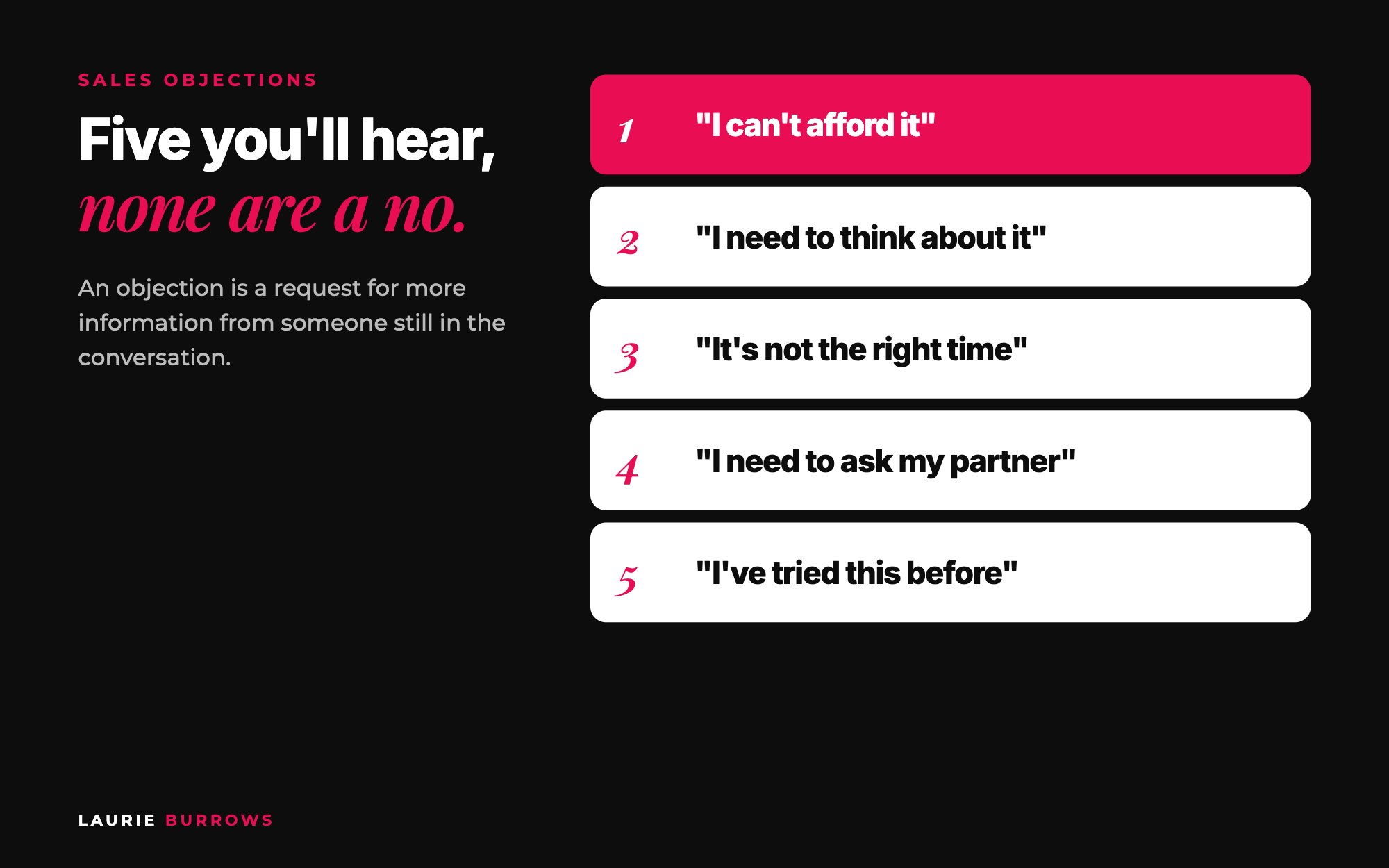
Short answer: the five most common sales objections are "I can't afford it", "I need to think about it", "it's not the right time", "I need to ask my partner" and "I've tried things like this before". An objection isn't a no. It's usually a request for more information, from someone who's still in the conversation and wants you to help them say yes. Handle it by asking a question first, then showing the value against the price, the cost of waiting and the proof it works. Better still, answer the objection in your content before it's ever raised. Below are word for word replies for all five.
You've had a great conversation. They love what you do. You share the details of your offer and then it comes: "I just can't afford it right now." Or "Let me have a think about it." And most coaches reply with "No worries at all!" and never hear from that person again.
That's money left on the table, and often it's a client who genuinely needed your help. Here's how I handle objections without being pushy, sleazy or awkward.
This is part of my ultimate guide to making sales every single day, because handling objections well is one of the quickest ways to turn the conversations you're already having into sales.
First: an objection is not a no
When someone gives you an objection, they're still talking to you. If they really weren't interested, they'd ignore your message or scroll on. Whenever I ask someone if they'll be joining, I get one of three answers:
- Yes: brilliant, send the link.
- Yes, but...: now they've told you exactly what's in the way, so you can help.
- No: always ask why. "Could I ask why? It's really helpful feedback for me and my team." Sometimes it turns into a yes, or a better fit offer.
Free 5 day event · 12th to 16th October
The 6 Figure Game Plan
Want a sales plan where the objections are answered before anyone raises them? Join my free 5 day event and map your strategy to 6 figures, then get the plan, content and pages created for you.
The 5 objections, and exactly what to say
1. "I can't afford it"
The biggest one by far. Usually they're not seeing enough value, or they're not sure whether they can afford it. Often they do have the money; you just haven't made the decision clear enough.
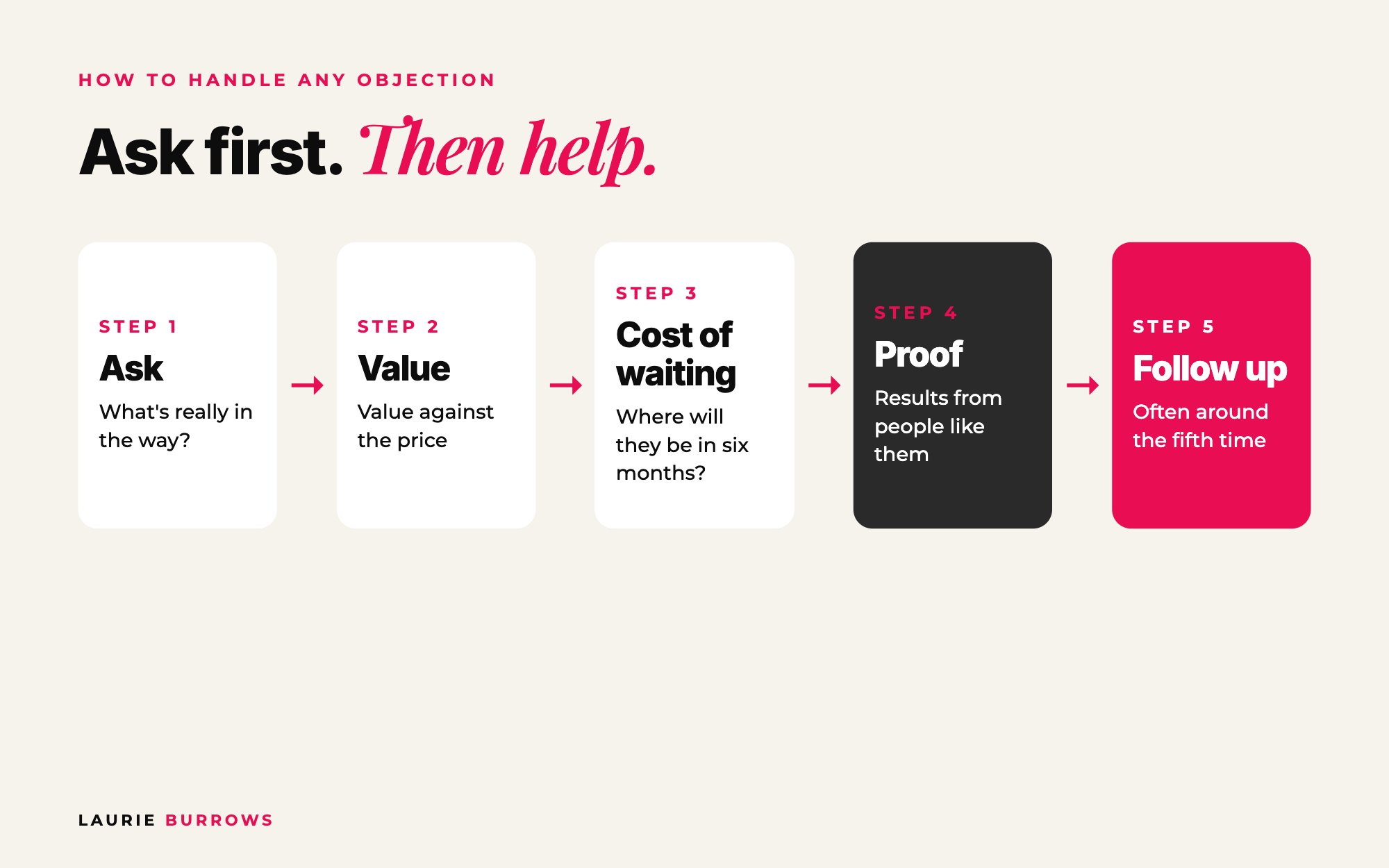
- Show the opportunity cost. Option one: keep piecing it together from free videos and risk being in the same place in six months. Option two: get help from someone who's done it, with a proven method.
- Show the value against the price. When the value clearly outweighs the price, it's a no brainer. Here's how to build a value stack.
- Break the number down. A $1,000 six month programme is less than $6 a day. That's a coffee, or a shop bought lunch.
If it's genuinely not affordable right now, a payment plan or a lower priced offer can help them start. Just don't drop your price on the spot; it undermines the value for everyone who paid in full.
Copy and paste: reply to 'I can't afford it'
Totally understand, and thank you for being honest. Can I ask, is it that it doesn't feel worth it yet, or that the number itself feels like a stretch right now?
If it's the number: it works out at less than $[daily amount] a day over [length]. And if nothing changes, where do you think you'll be in six months?
If it helps, there's also a payment plan of [amount] a month, or you could start with [lower priced offer] and move up when you're ready.
2. "I need to think about it"
"Think about it" is rarely about thinking. It's usually an unspoken question or worry. Ask kindly, and nine times out of ten the real objection comes out. Then give a genuine reason to decide (a fast action bonus for 24 to 48 hours) and follow up.
Copy and paste: reply to 'I need to think about it'
Of course. Can I ask what specifically you're weighing up? I might be able to help.
And just so you know, the [fast action bonus] is available until [day and time], so I'd hate for you to miss it while you're deciding.
3. "It's not the right time"
Sometimes that's true, and you should respect it. But often it really means "I'm too busy", which is exactly why they need help. When one of my three day events got the objection "I can't take that much time out of my business", my answer was simple: that's exactly why you need it. Yes, it's 21 hours. But what would those hours get you?
Copy and paste: reply to 'it's not the right time'
I hear you. Can I ask what would make it the right time?
The reason I ask is that most people who wait for the right time are in the same place a year later, telling themselves the same thing.
This is designed to [save you time / fit around a busy diary], so being busy is actually the reason it'll help.
4. "I need to ask my partner"
Completely fair, especially for a big investment. Don't fight it. Help them have a good conversation instead, and let them know when any bonus deadline ends so the conversation actually happens.
Copy and paste: reply to 'I need to ask my partner'
That makes total sense. What do you think they'll want to know?
Here's a quick summary you can show them: the result is [end result], it includes [what's included], the investment is [price, broken down], and here's what [proof] looks like.
The bonus is there until [day]. Shall I check in with you on [day] to see what you both think?
5. "I've tried things like this before"
This one is everywhere right now. Ask what happened last time. Often they didn't finish it, didn't have time, or didn't get the support to implement it. Then show how yours is different using my Different You Now questions: what makes your offer different, why you, and why now. Share evidence: results, case studies, real stories of people like them.
Copy and paste: reply to 'I've tried things like this before'
That's so common, and I'm sorry it didn't work out. Can I ask what happened last time? Was it time, support, or the method itself?
The reason I ask is that [offer] is built around [implementation / support / quick wins], so you're not just getting more training to watch. Here's an example of someone who felt exactly the same: [story].
How to build your objection playbook, step by step
Step 1: List the objections you actually hear
Look back through your DMs, emails and call notes. Write down the three objections you hear most, in the exact words people use.
Time: 20 minutes. Done when: you have your top three objections in their words.
Step 2: Write one question for each
Your first response to any objection is a question, never a defence. Use the scripts above as a starting point.
Time: 15 minutes. Done when: every objection has a kind, curious question to ask first.
Step 3: Write one answer for each
Value against price, opportunity cost, proof, or a way to start smaller. Save them somewhere you can copy from.
Time: 30 minutes. Done when: you have a saved reply for each of your top objections.
Step 4: Answer them before they're raised
People buy to solve a problem, achieve a desire, avoid pain or fear, and for emotional reasons they justify with logic afterwards. So in your sales emails, don't just pitch. Include an email on the opportunity cost, one breaking down the investment, a client story, and one that tackles time. By the time someone reaches a conversation with you, most of their objections have already been answered.
Time: Half a day. Done when: your sales sequence has one email per top objection. If writing those emails is the bit you keep putting off, the Copywriter inside Ascendia OS writes sales emails, sales pages and DMs that sound like you, so each objection gets answered without you starting from scratch.
Step 5: Follow up until you get a clear answer
Most sales don't happen on the first message. A large share come after several follow ups, often around the fifth. Following up isn't pushy. It's good service. Track your leads so you know who's waiting on a reply.
Copy and paste: follow up message
Just checking in. I sent you a message a few days ago and wanted to make sure you saw it. Any questions I can help with?
Time: 10 minutes a day. Done when: everyone with an open objection has a next follow up date.
Worked example: the objections after a webinar
Example (illustrative numbers): after a webinar pitching a $1,000 six month programme, a coach messages 30 engaged attendees asking "Will you be joining us?".
- 5 say yes straight away.
- 12 say "yes, but": 5 price, 4 "think about it", 2 partner, 1 tried before.
- 13 don't reply or say no. She asks the "no"s why.
- With the scripts above, a breakdown of under $6 a day, a 48 hour bonus and up to five follow ups, 5 of the 12 "yes, buts" join.
- Result: 10 sales instead of 5. $10,000 instead of $5,000, from the same webinar, just by not saying "no worries!".
Benchmarks
| What | Aim for |
|---|---|
| First response to an objection | A question, not a defence |
| Fast action bonus window | 24 to 48 hours |
| Follow ups | Keep going, many sales come around the fifth |
| Sales emails that pre-empt objections | At least one per top objection |
| Every 'no' | Ask why |
Common mistakes (and the fix)
- "No worries at all!" Fix: ask a question before you accept the objection.
- Discounting on the spot. Fix: show the value, offer a payment plan or a lower priced start.
- Arguing. Fix: curiosity, not debate. You're helping them decide.
- One follow up, then silence. Fix: track leads and follow up until you get a clear yes or no.
- Fake deadlines. Fix: real bonuses, real end dates.
Your action plan
Today
- Write down your three most common objections.
- Save a question and an answer for each, using the scripts above.
This week
- Message everyone who said "maybe" in the last month with a kind follow up.
- Ask every "no" why.
Next 30 days
- Add one sales email per objection to your sequence.
- Post one piece of evidence based content a week (a result, a story, a breakdown).
- Track how many "yes, buts" become yeses.
Objection handling works best inside a clear sales process: generate leads, start conversations before your event, message people afterwards, handle objections and follow up. The whole process is in the ultimate guide to making sales every single day. If you pitch on webinars, The 5-Figure Webinar Formula includes my objection handling slides so you answer the big ones before anyone asks. And for help with your sales process and messaging, find out how to work with me.
Want my objection handling slides and pitch script?
The 5-Figure Webinar Formula is my 10-step webinar framework with the slide deck template, the pitch script and the objection handling slides that answer price, time and trust before anyone raises them. $27.
Rather have it done for you?
Let Ascendia OS answer objections before they come up
The Copywriter writes your sales page and one email per objection in your voice, and the Email Marketer sends the follow-up sequence for you, so nobody slips through the cracks. 14 days free, no tech skills needed.
Frequently asked questions
What is the most common sales objection?
"I can't afford it". It usually means the value isn't clear enough yet, or they're unsure whether they can afford it. Show the opportunity cost, the value against the price, and break the investment down into a daily amount.
How do I respond to "I need to think about it"?
Ask what specifically they're weighing up, kindly. That usually reveals the real objection. Then give a genuine reason to decide, such as a fast action bonus, and follow up.
Should I offer a discount when someone objects to the price?
I'd avoid it. Discounting on the spot lowers the perceived value and isn't fair to people who paid in full. Show the value, offer a payment plan if appropriate, or suggest a lower priced starting point.
How many times should I follow up?
More than you think. Many sales happen after several follow ups, often around the fifth. Keep it kind and helpful, and track your leads so nobody slips through.
How can I stop getting objections?
Answer them before they're raised. Use your content, emails and sales page to address price, time and trust, and share evidence based content so people already believe it works before they talk to you.
Laurie Burrows is a UK-based marketing and sales strategist who has built a business that's generated multi-seven figures in sales through social media and digital marketing. Today, Laurie helps business owners use social media, content and digital marketing to get seen, attract more clients and make more sales. She's also the founder of Ascendia OS.
Do you want to scale your business to 10K months in the next 90 days? I am looking for 10 people for my new case study program. DM me the word CASE STUDY on Instagram (@_laurieburrows) to learn more.