How I Made $200k in My First Year as a New Mum
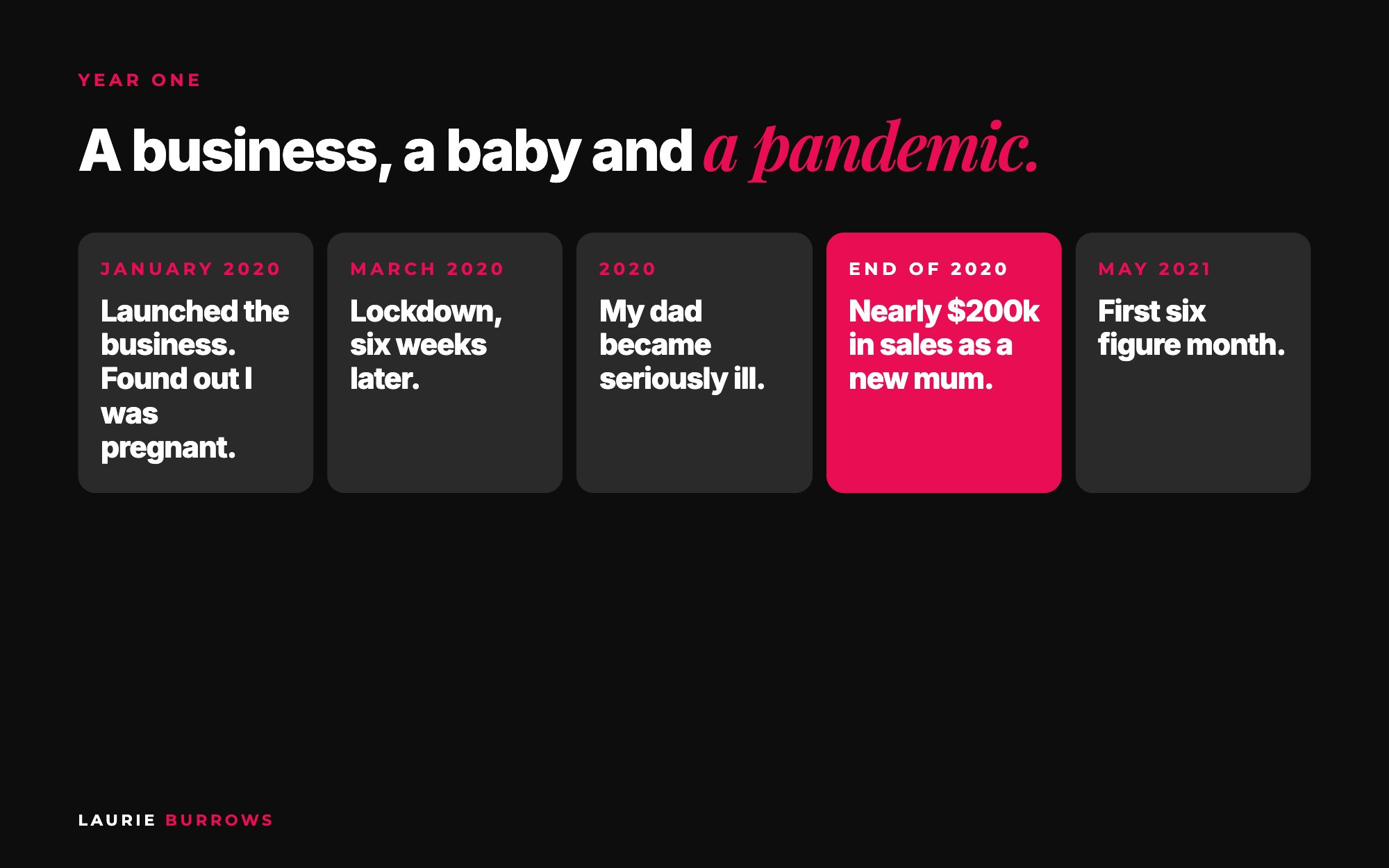
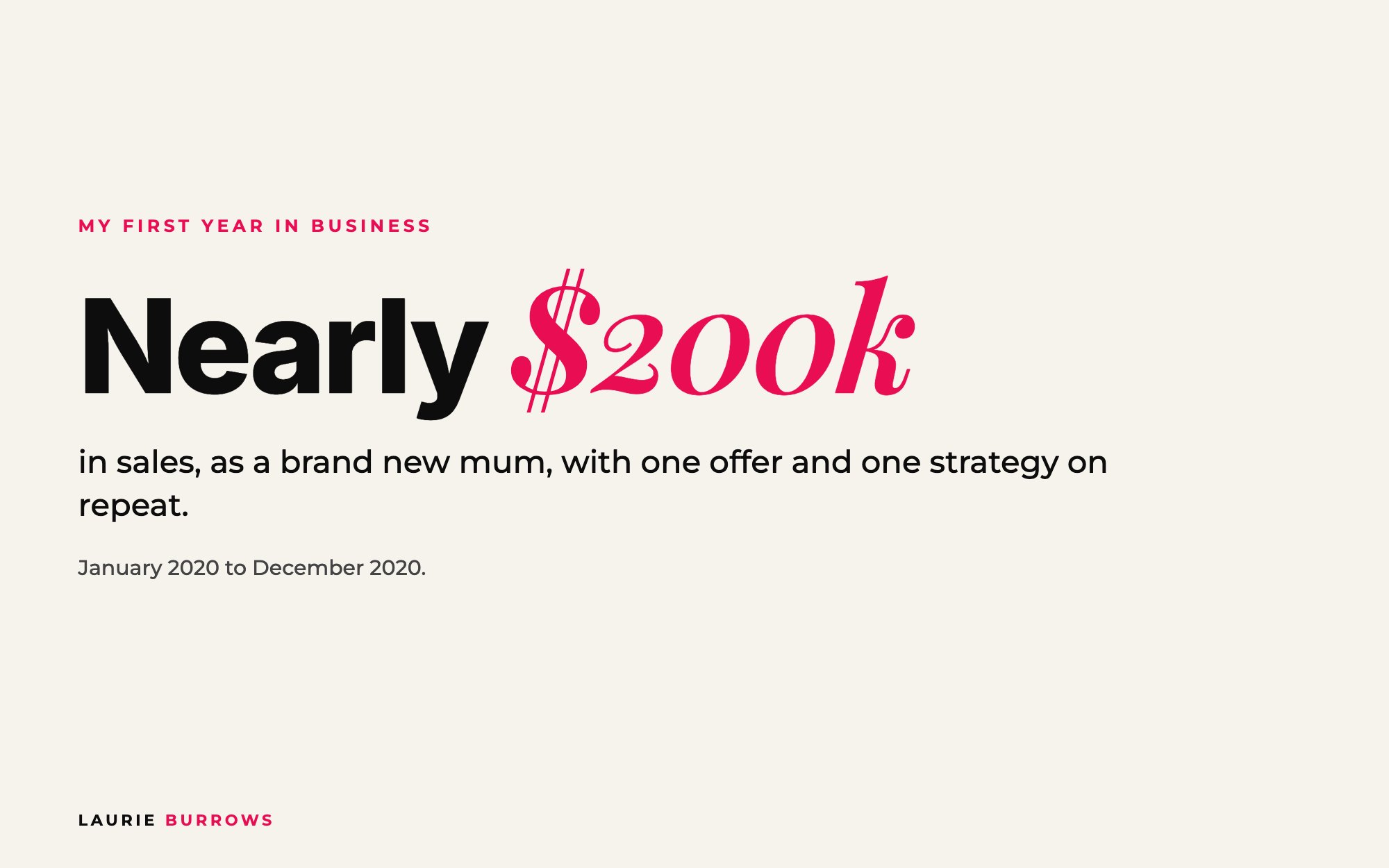
Short answer: I launched my business in January 2020, found out I was pregnant the same month, went into lockdown six weeks later, and watched my dad become seriously ill not long after. With very limited time, I had to work smart, not harder. I got visible, built trust by documenting my results in public, started with low priced offers, then put almost all my energy into one pre-recorded signature programme sold through free five day challenges. That year I made nearly $200,000 in sales as a brand new mum.
When people ask how I built my business, they usually expect a story about hustle. It isn't one. It's a story about having almost no time, and being forced to build something simple, focused and repeatable because there was no other option.
Here's what happened, and what I'd want you to take from it.
It's part of my ultimate guide to a 6 figure year, where I turn lessons like these into a plan you can follow.
Before the business
I've spent my whole career in marketing and sales, around 15 years now. In my early twenties I was a marketing trainer and assessor, teaching digital marketing qualifications to young people. I got that job at 22, and I believe I was one of the youngest in the UK doing it. At 24 I was promoted to lead my subject, which meant writing the course materials used across 36 colleges.
I loved it, mainly because I had freedom over how and when I worked. Then the whole organisation closed and I was made redundant. I'd already been headhunted for a Head of Marketing role, but it was the opposite of what I loved: clocking in at 8.30, making up time if I was late, asking permission for holidays and watching my ideas get presented as someone else's.
I'd always wanted my own business. I'd dabbled with freelancing for years but never fully committed, because I had the security of a well paid job. That role was the kick up the backside I needed. I quit and went all in.
January 2020: a business and a baby
I officially launched my first programme in January 2020. That same month, a little voice in my head said, "You're pregnant." I did seven pregnancy tests in 24 hours. Every single one was positive.
So I wasn't just birthing a business. I was about to birth a baby. Six weeks later, the country went into lockdown. And not long after that, my dad became very ill, and we were told he might only have months to live.
I knew straight away that my time was going to be incredibly limited. I couldn't build a business that needed me on calls all day. Whatever I built had to work around a pregnancy, a newborn and a family going through something really hard.
How I made nearly $200k in my first year
1. My first launch flopped, so I improved it
My very first launch did not go to plan. At all. But I looked at what worked and what didn't and went again. The next launch sold 15 spots. Then 25. Then 50. Then 75. Same offer, better every time.
2. I got visible and became my own evidence
Nobody online knew who I was, so visibility came first. I sent people to a free Facebook group and documented growing it in public. It grew to hundreds of people within weeks, and people wanted to know how I was doing it. That curiosity built trust before I had testimonials online.
3. I started with low priced offers
My first ever sale was a $47 masterclass on growing a Facebook group. Then a one month intensive at $555, which led to $10,000 in sales within the first couple of months. I knew one to one wouldn't be sustainable with a baby on the way, but it got cash in and proved people would pay.
4. I built one signature programme, mostly pre-recorded
I turned my experience into a signature programme: pre-recorded training, a weekly live Q&A and a Facebook group for support. Pre-recorded meant I could create it once and sell it again and again without needing more of my time. It started at $997 and grew to around $1,500, and for the rest of the year it was pretty much the only thing I sold.
5. I sold it with free five day challenges
Every quarter or so, I ran a free five day challenge, around 45 minutes a day, and sold the signature programme at the end. In between, I'd run a low priced pop up masterclass to bring new people in. Same strategy, rinse and repeat.
6. I swapped sales calls for messages
I didn't do sales calls. I was a new mum to a newborn, and I simply didn't have the time. Instead, I let people message me with any questions before they bought. They still got a personal conversation, and I could reply around feeds and naps.
7. I shared the good, the bad and the ugly
People followed my journey of growing a business while pregnant, then with a newborn, then while grieving. I showed what I was doing, but I also showed the hard days. Lots of people told me later that was why they chose to work with me: they could relate.
For how those offers fit together, see how to build a product suite, and for the full ladder, how I went from a $47 masterclass to a $1,500 signature programme.
2021: the best and worst year
I lost my dad on 20th March 2021. He was my absolute world, and he's the reason I'm where I am today. When everyone else was telling me not to leave my career, he was the one telling me to go for it.
Six weeks later, in May 2021, I celebrated my first six figure month. I've always called 2021 the best year and the worst year of my life. The business grew because I'd built it to run without me being switched on every minute, and that meant I could be there for my family when it mattered most.
What to copy from my first year, step by step
You don't need a pandemic and a newborn to use what I learned. You just need to build as if your time is limited, because it usually is. Here's the exact playbook, in order, that I'd hand to anyone starting now with a few hours a week.
Step 1: Count your real hours
Write down how many hours a week you genuinely have for your business. Not the hours you wish you had. The real ones, after family, work and rest. Then block them in your calendar as fixed appointments. In my first year, my working time fitted around feeds and naps, so everything I built had to work in small pockets.
Time: 15 minutes. Done when: your business hours are in your calendar and you know the number.
Step 2: Pick one place to be visible and one result to document
Choose one platform where your ideal clients already spend time and one home to nurture them (a free group, your email list or your Instagram). Then pick one result you can document in public over the next 30 days. That becomes your evidence, the way growing my Facebook group was mine.
Time: 30 minutes to decide, then 20 minutes a day. Done when: people are asking you how you are doing it.
Step 3: Sell something small to the people who are watching
Turn the questions into a low priced masterclass, somewhere around $27 to $47. Teach it live, record it and keep selling the replay. Then offer a small number of spots on a short, capped, higher priced next step to the people who bought.
Time: 2 hours to plan, 60 to 90 minutes live. Done when: you have your first buyers and a recording you can keep selling.
Step 4: Build one mostly pre-recorded signature programme
Take the steps you repeat with every client and record them once. Add one weekly live Q&A at the same time every week and a community for support. Launch at a founding price to the people who already trust you, then raise it every time you sell it.
Time: 2 to 4 weeks to record. Done when: the curriculum is recorded and your weekly Q&A slot is fixed.
Step 5: Sell it the same way every quarter
Pick one repeatable way to sell, like a free five day challenge of around 45 minutes a day with the offer on the final day. Write the content and emails once, then reuse them every round, improving one thing each time (I explain why in perfect one offer before you launch the next). Use the weekly rhythm below between launches.
Time: 1 week per round, then the weekly rhythm. Done when: you have the next three rounds in your diary.
If holding all of that together feels like a lot in limited hours, the Launch Manager inside Ascendia OS, my platform, plans your challenge from first email to cart close, then sets it up to run again on repeat.
Copy and paste: limited time weekly rhythm
Every day (20 minutes): one post documenting what you are doing or teaching one useful thing, then reply to comments and messages.
Once a week (60 minutes): your live Q&A for clients, same day and time every week.
Once a week (30 minutes): reply to everyone who is thinking about joining. Answer their questions by message, no sales calls needed.
Every quarter (1 week): run the five day challenge again using last round's content and emails, and change one thing.
In between: one low priced pop up masterclass to bring new people in.
Step 6: Swap sales calls for messages
Invite people to message you with questions before they buy. Reply when you can, in the gaps in your day. Use the script below. It keeps the personal conversation without needing you on a call at a set time.
Time: 10 minutes a day. Done when: every enquiry gets a reply within 24 hours.
Copy and paste: message instead of a sales call
Hey [name]! I saw you were checking out [programme]. Any questions at all, just pop them here and I'll answer personally.
If it helps, most people want to know three things: how much time it takes each week ([answer]), what support you get ([answer]) and what happens if you fall behind ([answer]).
What would make this a yes for you?
Example: a coach with 6 hours a week
This is an illustrative example with round numbers. A coach working a part time job has 6 hours a week. She blocks two mornings and three evenings. She documents rebuilding her own routine for 30 days, then runs a $37 masterclass and sells 20 spots ($740). At the end, she offers 5 spots on a $397 four week intensive and fills 4 ($1,588). Those four clients show her the steps for a pre-recorded programme with a weekly Q&A, which she launches through a five day challenge at a founding price of $697 and sells to 8 people ($5,576). Same 6 hours a week. One offer, one way of selling it, rinse and repeat.
Benchmarks to aim for
| What you measure | Aim for |
|---|---|
| Daily visibility | 20 minutes a day |
| Launches of the same offer | Improve every round. Mine went from a flop to 15, 25, 50 and then 75 spots. |
| Leads to sales | Around 3% on average. My own launches convert at 10 to 12%. |
| Live attendees vs everyone registered | Around 25% of live attendees buy vs 2.5% overall |
Common mistakes (and the fix)
- Planning for the hours you wish you had. Fix: build around the hours you genuinely have, and protect them.
- Launching a new offer every month. Fix: sell one offer the same way, and improve one thing each round.
- Doing everything live. Fix: pre-record the curriculum and keep one weekly live slot.
- Hiding the hard days. Fix: share the real journey. It is often why people choose you.
Your action plan
Today
- Count your real hours and block them in your calendar.
- Choose one platform, one place to nurture people and one result to document.
This week
- Post about your result every day for 20 minutes.
- Write down every question people ask.
- Plan your low priced masterclass from the most common question.
Next 30 days
- Run the masterclass and offer a capped next step.
- Outline your pre-recorded signature programme from what you repeat with every client.
- Book your first five day challenge and the next two rounds.
- Map the rest of your year with the ultimate guide to a 6 figure year.
Free 5 day event · 12th to 16th October
The 6 Figure Game Plan
Want to map your own route to 6 figures around the hours you really have? In my free 5 day event you'll map your strategy and get the plan, content and pages created for you.
Want the system that makes one offer sell on repeat?
Content To Clients® is my course for turning your content into repeat sales, with every tool and template I use, built for people who need their business to work in limited hours.
Frequently asked questions
How much did Laurie Burrows make in her first year of business?
Nearly $200,000 in sales in 2020, her first year, while pregnant and then with a newborn.
How do you grow a business as a new mum?
Simplify. Focus on one offer, one strategy you can repeat, and delivery that doesn't need you live all the time, like pre-recorded training with a weekly Q&A. Swap time heavy tasks like sales calls for options that fit around your day, such as answering questions by message.
What offer did Laurie start with?
A $47 masterclass, then a one month intensive at $555, then a signature programme that launched at $997 and grew to around $1,500.
Do you need sales calls to sell a coaching programme?
No. In my first year I didn't do sales calls at all. People could message me with questions before buying, which gave them a personal conversation without me needing to be on calls.
When did Laurie hit her first six figure month?
In May 2021, around 18 months after launching her business.
Laurie Burrows is a UK-based marketing and sales strategist who has built a business that's generated multi-seven figures in sales through social media and digital marketing. Today, Laurie helps business owners use social media, content and digital marketing to get seen, attract more clients and make more sales. She's also the founder of Ascendia OS.
Do you want to scale your business to 10K months in the next 90 days? I am looking for 10 people for my new case study program. DM me the word CASE STUDY on Instagram (@_laurieburrows) to learn more.