The Trust Economy: Why Talking Head Videos Sell
Short answer: we're in a trust economy. With AI, anyone can publish 100 posts a day, so people can no longer tell who created what, and they've been burned by courses and programmes that didn't deliver. Talking head videos (you, speaking to camera) sell because they prove it's really you, let people feel your personality and energy, and build know, like and trust faster than any other content. And trust equals sales. Below is exactly how to plan, film and use them, even if you hate being on camera.
Here's something that might surprise you, coming from someone who runs a software company with AI at its heart: I think personal brands need more video of themselves now, not less.
Anyone can type a prompt and produce a month of posts before lunch. That's brilliant for saving time, and I use AI every day. But it also means your audience is scrolling past endless polished, faceless, could-be-anyone content. What makes them stop is a real person they recognise, saying something useful, in a voice they've started to trust.
This is part of my ultimate guide to turning content into clients. Talking head video is the format I lean on most when I want content to actually turn into sales.
What is the trust economy?
When I started my business in 2020, and into 2021, people would land on a sales page and buy a four figure offer with barely a conversation. Doing exactly the same thing now just doesn't work the same way. Three things have changed:
- Far more choice. More coaches, more programmes, more noise.
- People have been burned by courses they never finished and programmes that didn't get them results.
- AI has flooded every feed. People can't tell whether the person behind a post actually knows their stuff.
So buyers decide based on trust. It's why more businesses are going back to sales conversations and more personal ways of selling.
Why talking head videos sell
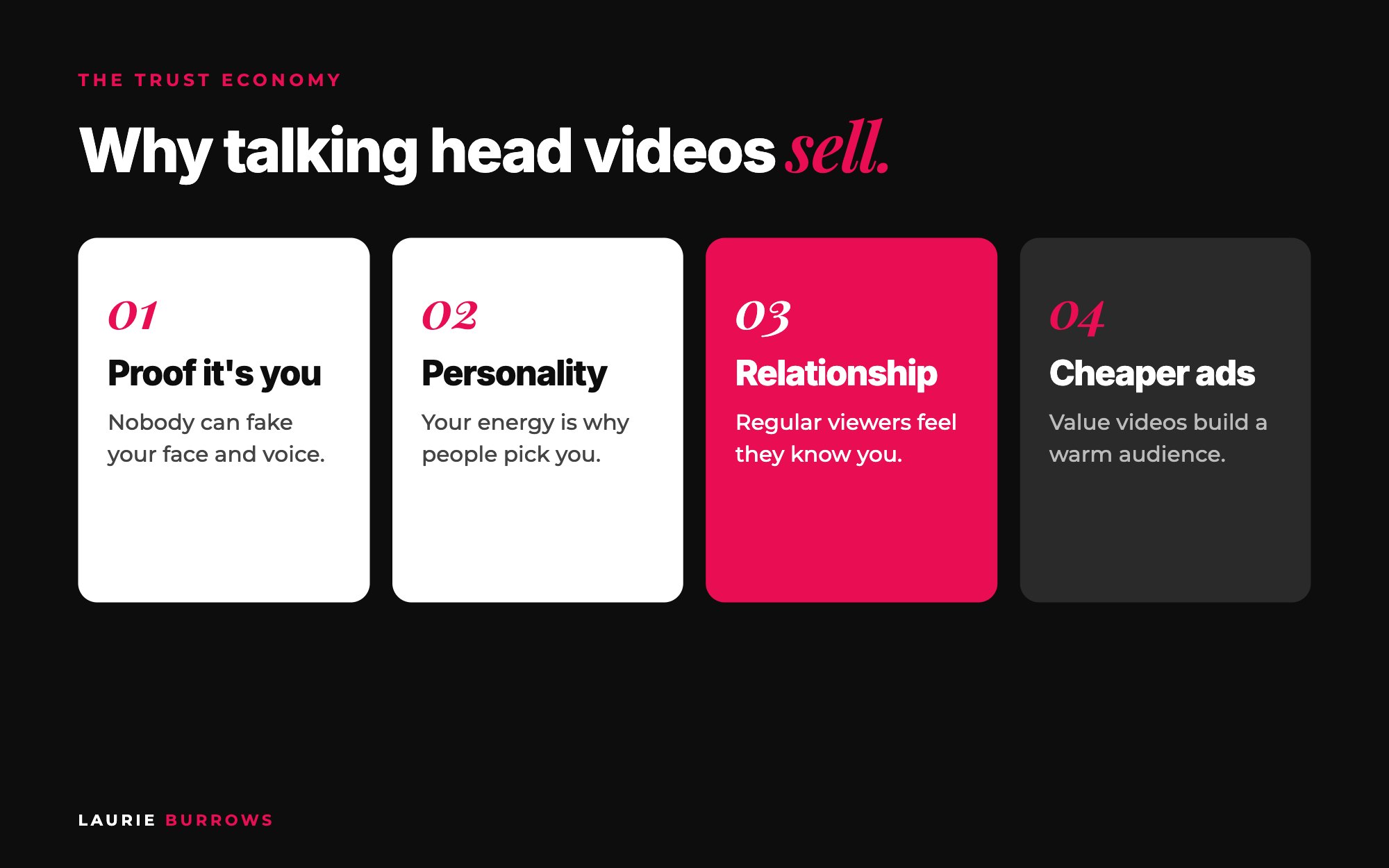
- They prove it's really you. Nobody can fake your face, your voice and the way you explain things.
- They show your personality and energy, which is often why someone chooses you over someone who does the same thing.
- They build a relationship, even one way. Watch someone regularly and you feel like you know them.
- They let you tell stories. People decide emotionally first and justify with logic afterwards.
- They make your ads cheaper. Short value videos are what I use for my $5 a day engagement ads, and advertising back to people who've watched you costs far less than targeting strangers. More in why sending ads straight to your offer wastes money.
How to start talking head videos, step by step
Step 1: Build your topic bank
Write down the top 20 questions your clients and followers ask you. Each one is a video. Then sort them into the four things people want to see, so you can mix it up:
- How-tos: "How to get a sale in the next 24 hours."
- Stories: where you were compared to where you are now.
- Proof: results, numbers and evidence that you walk the walk.
- Beliefs and your why: what you stand for, so the right people feel at home with you.
One that always does well for me: what I'd do if I was starting my business from zero again. For the full content mix, see the 6 types of content every coach needs.
Time: 30 minutes. Done when: 20 questions, each tagged how-to, story, proof or belief.
Step 2: Write a hook and three bullets for each
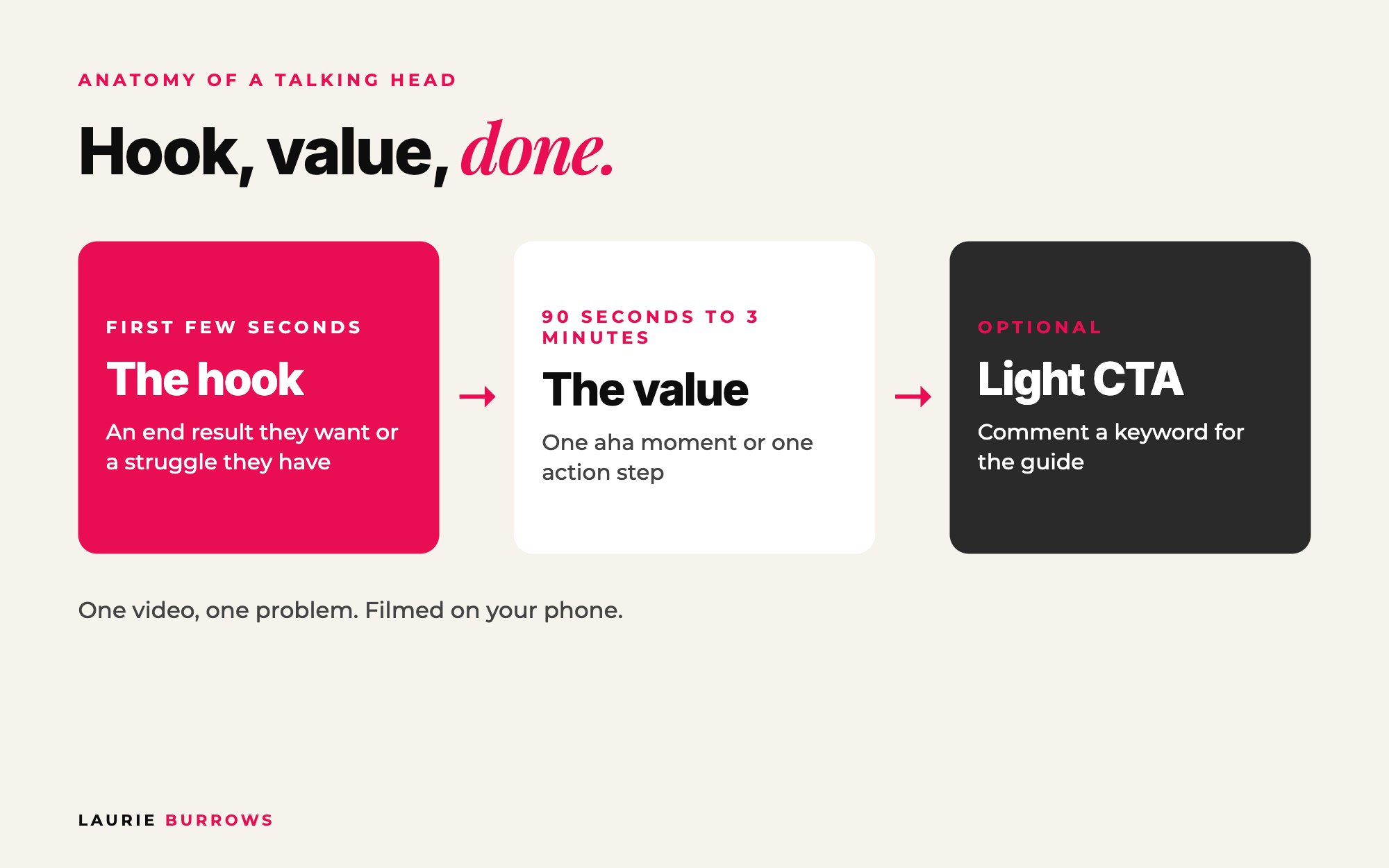
Speak to an end result they want or a struggle they have in the first few seconds. "If your launches keep flopping, steal this strategy." "No one's showing up to your webinars? Do this." Then three bullet points, not a script. A full script makes you sound like you're reading.
Time: 5 minutes per video. Done when: each video has a one line hook and three bullets.
Step 3: Set up your phone
You don't need a camera, lights or a studio to build a business that makes six or seven figures. Find a room with good natural light. If you'll record in takes from different spots, a small clip-on mic keeps the sound consistent.
Time: 15 minutes. Done when: phone at eye level, light on your face, sound tested.
Step 4: Record in takes
I'm brilliant live, but I find pre-recorded video hard. I get in my own head and mess up. So I record in ten second chunks, then stitch them together in a simple editing app and cut out the mistakes. Nobody sees the bloopers. Keep each video to one problem, around 90 seconds to three minutes.
Time: About 10 minutes per video. Done when: five raw videos recorded in one sitting.
Step 5: Try the whiteboard trick
If you don't love talking to camera for minutes at a time, record a ten second hook to camera, then film yourself walking through the strategy on a whiteboard. These have become some of my best performing videos. Bonus: film three or four different hooks for one whiteboard walkthrough. Each hook makes it feel like a different video.
Time: 30 minutes. Done when: one walkthrough and three or four hooks recorded.
Step 6: Edit and caption
Lots of people watch with the sound off. Add captions in the app you post from, or use a captions app.
Time: 10 minutes per video. Done when: mistakes cut, captions on.
Step 7: Use every video four ways
- Post it organically on Instagram and Facebook.
- Run it as a $5 a day engagement ad. Here's the $5 a day ads strategy.
- Pull the audio and put it over B-roll for a different version.
- Transcribe it into a caption, a carousel or an email.
Time: 20 minutes per video. Done when: each video lives in at least three places. This is where AI earns its keep. The Content Creator inside Ascendia OS plans your month, writes the captions in your voice and schedules your posts straight to Instagram, Facebook, LinkedIn and more, so your time goes on the bit only you can do: showing up on camera.
Step 8: Review your top 20% monthly
Once a month, look at which videos performed best (I look at my top 20%) and make more like them. Your audience will tell you exactly what they want if you watch the numbers.
Time: 30 minutes a month. Done when: your next five topics come from your best performers.
Copy-and-paste: talking head video templates
Copy and paste: value video structure
HOOK (first 3 seconds): If you [struggle], [do this / steal this / here's why].
VALUE: Most people [mistake]. Instead, [action step 1], [action step 2], [action step 3].
STORY OR PROOF: When I [did this], [result].
LIGHT CALL TO ACTION (optional): I've broken the full strategy down in a guide. Comment GUIDE and I'll send it to you.
Copy and paste: story video structure
HOOK: In [year], I was [relatable low point].
TURNING POINT: Then I realised [the shift].
WHAT I DID: I [action 1], [action 2], [action 3].
NOW: Today, [where you are now].
LESSON: If you're where I was, start with [one action].
Worked example: a week of video from one hour
Example (illustrative): a consultant who hates being on camera blocks one hour on a Monday.
- 10 minutes: picks five questions from her topic bank (two how-tos, one story, one proof, one belief) and writes a hook and three bullets for each.
- 35 minutes: records them in ten second takes on her phone by the window.
- 15 minutes: stitches, trims and captions in a simple editing app.
- Result: five talking head videos. One posted each weekday, all five tested as $5 a day engagement ads, and the best one transcribed into an email to her list. One hour of filming, a week of content and a growing warm audience.
Your first five videos (steal these)
If you're staring at a blank page, start with these five. Swap in your own topic and story.
- The starting again video (story): "If I was starting my business from zero today, here's exactly what I'd do." Three steps, in order.
- The quick win video (how-to): "Want [small result] in the next 24 hours? Do this." One action they can take today.
- The myth video (belief): "Everyone tells you [common advice]. Here's why I disagree." Then what you'd do instead.
- The proof video (proof): "Here's what happened when I [did the thing you teach]." Show the numbers or a screenshot.
- The mistake video (how-to): "The biggest mistake I see [your ideal client] make with [topic]." Name it, then give the fix.
Record all five in one sitting. Post one a day, run all five as ads, and watch which one your audience loves. That's the kind of video you make more of next week.
Benchmarks
| What | Aim for |
|---|---|
| Video length | About 90 seconds to 3 minutes |
| Hook | Inside the first few seconds |
| Topics per video | One problem |
| Batch size | Five videos per sitting |
| Review | Monthly, make more like your top 20% |
| Ad testing | Around $5 a day, rotated weekly |
Common mistakes (and the fix)
- Reading a script. Fix: three bullets and record in takes.
- Waiting for perfect. Fix: phone and window light. People want the real you.
- A slow start. Fix: hook in the first few seconds, no long intros.
- Only ever how-tos. Fix: rotate how-tos, stories, proof and beliefs.
- Using a video once. Fix: post, ad, audio version, transcript.
- Going fully faceless with AI. Fix: use AI to save time, but make sure your audience regularly sees and hears you.
Your action plan
Today
- Write your top 20 questions and tag each one.
- Pick five and write a hook and three bullets for each.
This week
- Record all five in one sitting on your phone.
- Edit, caption and post one a day.
- Launch them as $5 a day engagement ads.
Next 30 days
- Batch five videos every week.
- Try the whiteboard trick at least once.
- Review your top 20% at the end of the month and plan the next batch from them.
Talking head video and selling without calls
One of the reasons I've been able to sell four figure offers without sales calls is that people have already spent hours with me through my videos and trainings before they ever buy. Video does a lot of the work a sales call used to do. Read how to sell without sales calls, see how video fits into the bigger picture in the ultimate guide to turning content into clients, and if you want my full system for turning content like this into repeat sales, it's inside Content To Clients®.
Want your videos to turn into clients?
Content To Clients® is my full system for turning content into repeat sales: what to post, how to turn viewers into leads, and the emails and offers that convert them, with every template included. For coaches, consultants and online service providers who want their content to sell.
Rather have it done for you?
You film it, Ascendia OS does the rest
The Content Creator plans your month of topics, writes your captions in your voice and schedules every video, and the Copywriter turns your best hooks into ad copy. You just press record. 14 days free, no tech skills needed.
Frequently asked questions
What is a talking head video?
A video of you speaking directly to camera, usually filmed on your phone. It's one of the simplest and most effective types of content for building trust.
Why do talking head videos convert better than graphics?
People can see and hear you, so they know it's really you and get a sense of your personality. That builds trust faster, and in a trust economy, trust is what drives sales.
How long should a talking head video be?
Around 90 seconds to three minutes works well for value videos and ads, though longer is fine if every part is useful. Open with a strong hook in the first few seconds.
What if I hate being on camera?
Record in short takes with bullet points instead of a script, then stitch them together. Or record a short hook to camera and film a whiteboard walkthrough for the rest.
How often should I post talking head videos?
Consistency matters more than volume. A batch of five a week, posted one a day and tested as ads, is plenty to build trust and a warm audience. Review your top performers monthly and make more like them.
Is AI content bad for my business?
Not at all. AI is brilliant for saving time and repurposing. Just make sure your audience regularly sees and hears the real you, because that's what builds the trust that sells.
Laurie Burrows is a UK-based marketing and sales strategist who has built a business that's generated multi-seven figures in sales through social media and digital marketing. Today, Laurie helps business owners use social media, content and digital marketing to get seen, attract more clients and make more sales. She's also the founder of Ascendia OS.
Do you want to scale your business to 10K months in the next 90 days? I am looking for 10 people for my new case study program. DM me the word CASE STUDY on Instagram (@_laurieburrows) to learn more.