How to Find Your Content Pillars (Worksheet and AI Prompt)

Short answer: your content pillars are the three to five topics you want to be known for, and every post you create should fit under one of them. To find yours, cover four different angles: the result your ideal client wants, the method you use to get them there, the proof that it works, and the person behind it (you). Pull them from your expertise, your stories and your results, test them for 30 days, and avoid choosing pillars that are all basically the same topic.
If you feel like you're posting randomly, throwing out whatever comes to mind that morning just to show up, you don't have a consistency problem. You have a pillars problem.
Content pillars are what make you known for something. When someone in a Facebook group asks "who can help me increase my sales?", I get tagged. That's not luck. It's because the same message shows up in my content again and again. It feels repetitive to me. That's exactly the point. Below is a 60 minute exercise to find yours, with a worksheet, an AI prompt and 20 post ideas from one set of pillars.
This is part of my ultimate guide to turning content into clients. Pillars are the foundation, so start here before you plan a single post.
What are content pillars?
Content pillars are the core topics your content always comes back to. They're the reason someone could describe you to a stranger in one sentence. They keep your content focused, keep your messaging consistent and attract the right people. Post way outside your pillars and you start attracting an audience who were never going to buy.
How many? Three to five. Fewer than three and you'll get bored and drift. More than five and you're back to being known for nothing in particular.
The four angles: result, method, proof, person
The mistake most people make is picking pillars that are all pretty much the same thing: "sales strategy", "sales tips", "how to sell more". Every post sounds the same. Instead, cover four different angles.
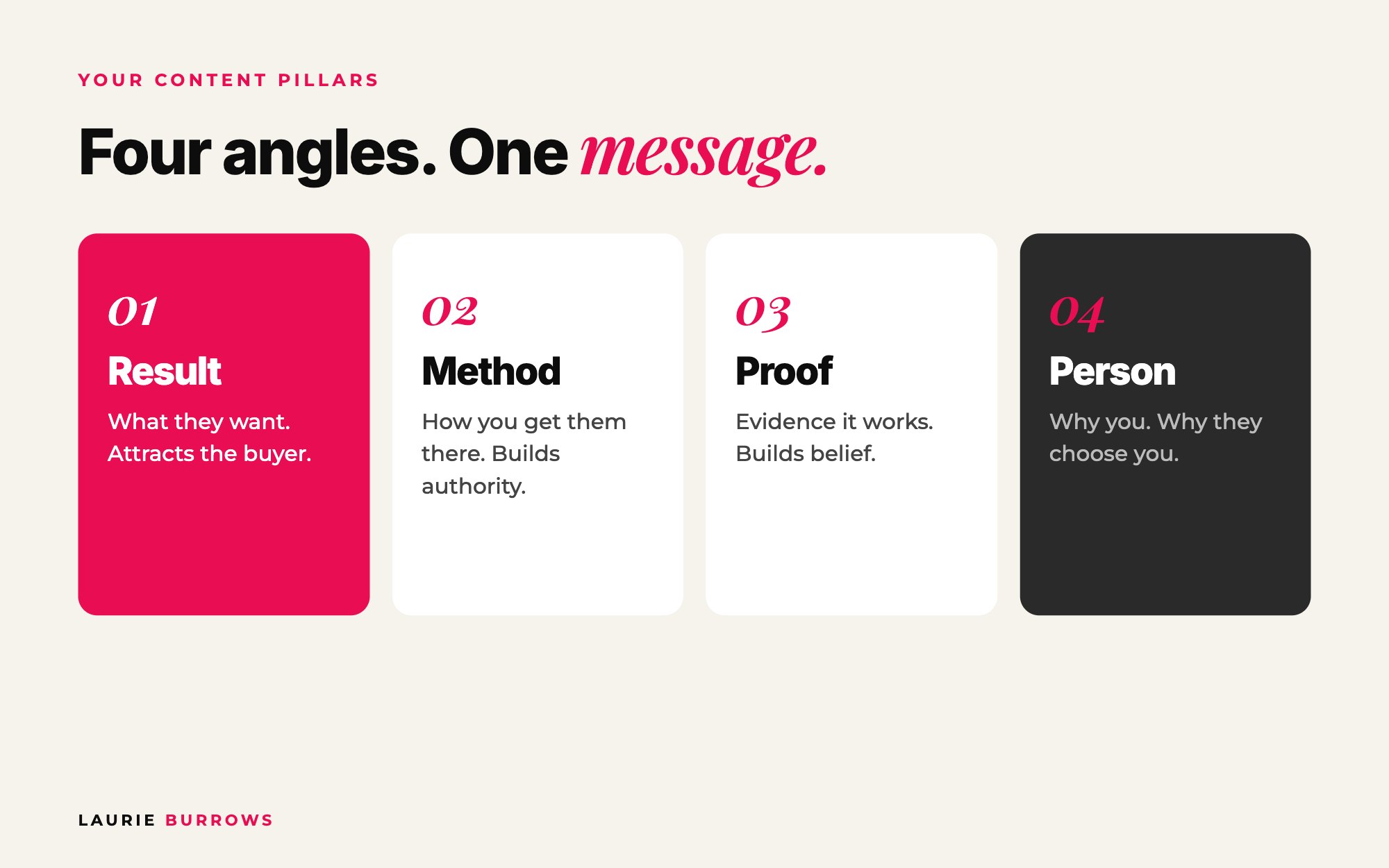
- The result: what your ideal client actually wants, underneath the surface. My clients come for more sales, but what they really want is freedom and flexibility, so one of my pillars is passive revenue. The result attracts the buyer.
- The method: how you get them there. One of my pillars is my evergreen strategy: create something once and sell it on repeat. The method builds your authority.
- The proof: evidence it works. One of my pillars is building in public, documenting the growth of my software business, Ascendia OS. The proof makes them believe you.
- The person: why you. One of my pillars is mum life while growing a business. Anyone can teach a method. Nobody else is you.
How to find your content pillars, step by step
Step 1: Brain dump your four buckets
Write down (or talk through) everything in these buckets:
- Your expertise: the strategies, frameworks and methods you teach.
- Your stories: your origin story and the core stories you're known for. Mine is starting my business in January 2020 and finding out a couple of weeks later I was pregnant, then hitting nearly $200,000 in my first year as a new mum.
- Your results and proof: what you and your clients have achieved.
- Mindset and belief shifts: what your ideal client needs to stop believing, and start believing, to get the result.
Time: 20 minutes. Done when: you have at least 5 bullet points in each bucket.
Step 2: Answer the five questions
Copy and paste: pillar worksheet
1. What does my ideal client need to believe to buy from me? [answer]
2. What's my unique angle or methodology? [answer]
3. What journey have I been on that they're on now? [answer]
4. What results have I or my clients achieved? [answer]
5. What lifestyle or values does my brand represent? [answer]
Result pillar: [ ] | Method pillar: [ ] | Proof pillar: [ ] | Person pillar: [ ] | Optional 5th: [ ]
Time: 15 minutes. Done when: you have one pillar written for each angle.
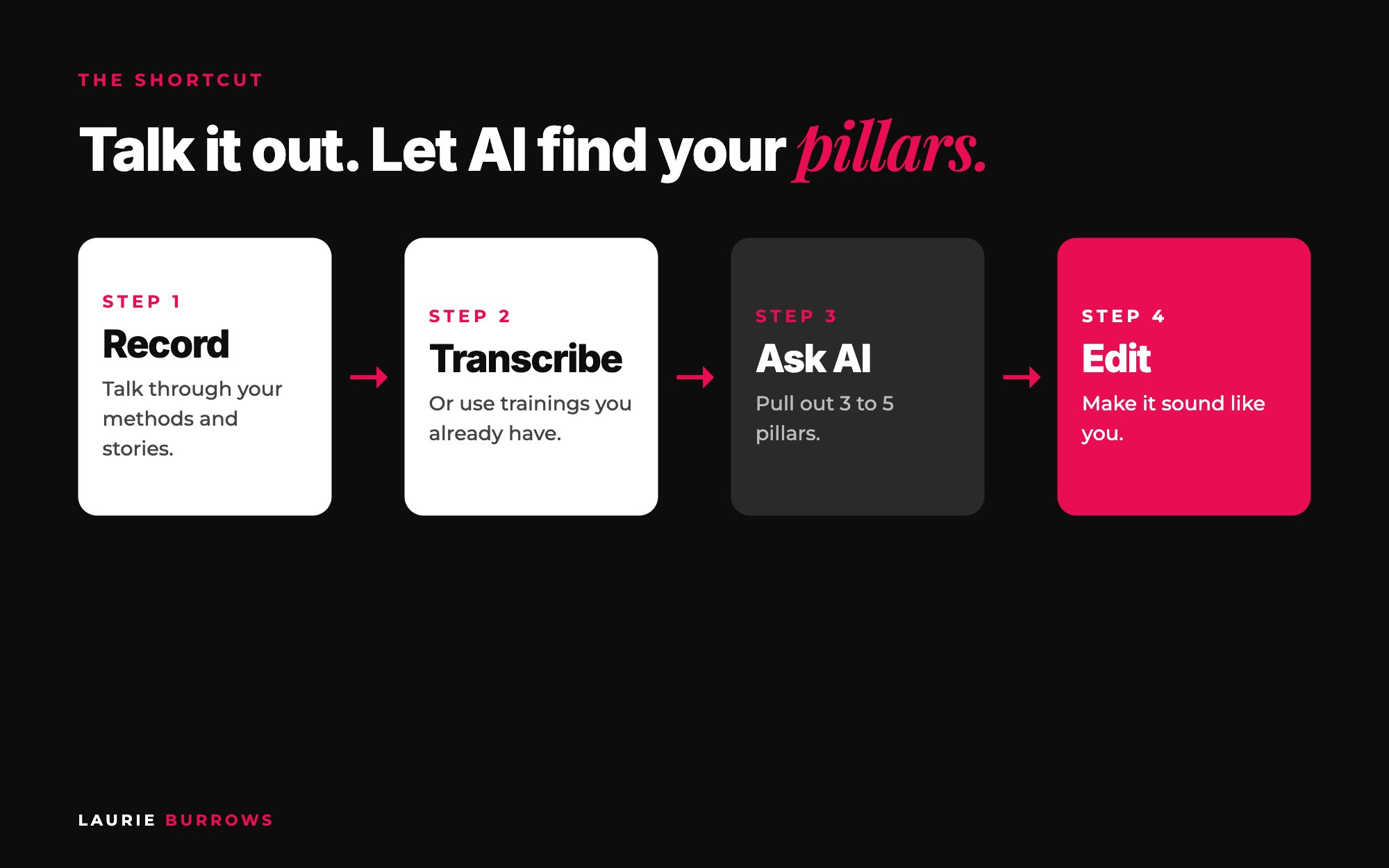
Step 3: Or take the shortcut: talk it out and let AI pull them out
If writing it all down feels like a lot, don't. Record yourself talking through your strategies, your stories and your client results with a transcription tool like Otter. Or gather transcripts you already have: masterclasses, course videos, live sessions. Give them to an AI tool and ask it to pull out your pillars. I record all of my sessions for exactly this reason.
Copy and paste: AI pillar prompt
Here are transcripts of me teaching, telling my stories and talking about results: [paste or attach].
I help [ideal client] get [result]. Pull out 4 content pillars, one for each angle: the result my ideal client wants, my method, my proof and me as a person.
For each pillar give: a short name, one sentence on why it matters to my ideal client, and 5 post ideas (mix educational, story, evidence and lead generation).
Use my words and phrases from the transcripts. Don't give me pillars that overlap.
Time: 20 minutes (plus recording time if you talk it out). Done when: you have a first draft of 4 pillars you can edit until they sound like you.
Step 4: Run the overlap test
Put your pillars side by side. If two of them fall into the same angle, merge them and find the missing one. If you can't think of 10 post ideas for a pillar, it's too narrow. If it could belong to anyone in your industry, add your angle to it.
Time: 5 minutes. Done when: four clearly different pillars, each with 10 or more possible posts.
Step 5: Fill each pillar with the 6 content types
Each pillar can hold educational posts, stories, evidence, lead generation and more. See the 6 types of content every coach needs. A "method" pillar might hold a how-to carousel on Monday, a story about the first time you used the method on Wednesday and a comment below post for your free guide on Friday.
Time: 30 minutes. Done when: each pillar has at least 5 post ideas across different types. Once your pillars are set, the Content Creator inside Ascendia OS can plan your month across them, write the posts in your voice and schedule them for you.
Step 6: Test for 30 days, then review
Plan the month with every post under a pillar (I walk through this in how to plan a month of content in one afternoon). At the end of the month, look at your top 20% of content. Which pillar did it come from? Give that pillar more space next month. Don't change your pillars every week, or you'll never be known for anything.
Worked example: one set of pillars, 20 post ideas
Example: a business coach who helps service providers get their first $10k month.
| Pillar (angle) | Post ideas |
|---|---|
| $10k months without burnout (result) | What a $10k month actually looks like in hours. The 3 numbers behind a $10k month. Why more clients isn't always the answer. Comment PLAN for my $10k planner. "Imagine..." future pacing post. |
| The 3 Step Client Plan (method) | Carousel of the 3 steps. Step 1 deep dive. Common mistakes at step 2. How long each step takes. Free training on step 3. |
| Documenting the journey (proof) | This week's numbers. What worked, what flopped. Behind the scenes of a launch. A milestone post. A lesson from a slow month. |
| Business around family life (person) | Day in the life. How I plan my week. The school run reality. My non negotiables. Why I started. |
Twenty ideas, four pillars, every one pointing back to the offer. That's most of a month planned.
Common mistakes (and the fix)
- Pillars that overlap. Fix: one per angle: result, method, proof, person.
- Pillars nobody is searching for. Fix: name the result in your ideal client's words, not your jargon.
- No person pillar. Fix: if you're a personal brand, the person is often why people choose you.
- Changing pillars every month. Fix: test for 30 days, adjust the mix, keep the pillars.
- Fearing repetition. Fix: say the same thing with different hooks. That's how you become the person people tag.
Your action plan
Day 1
- Brain dump your four buckets, or record yourself talking them through.
Day 2
- Complete the pillar worksheet or run the AI pillar prompt on your transcripts.
Day 3
- Run the overlap test and finalise 3 to 5 pillars.
Day 4
- Write 5 post ideas per pillar across different content types.
Days 5 to 7
- Post one piece from each pillar and note which gets the most comments and saves.
Day 30
- Review your top 20% and rebalance next month's mix.
Next, see how your pillars fit into the full system that turns posts into leads and clients in the ultimate guide to turning content into clients.
Once your pillars are set, The Claude Content Engine can turn each one into a month of carousels, reels and captions in your voice.
Want your pillars turned into a month of content?
The Claude Content Engine sets Claude up to sound like you, with prompts for carousels, reels and captions and a monthly content sprint built around your pillars.
Rather have it done for you?
Turn your pillars into a month of scheduled posts
The Strategist makes sure your pillars point at what you're selling, and the Content Creator plans the month across every pillar, writes the posts in your voice and schedules them. 14 days free, no tech skills needed.
Frequently asked questions
What are examples of content pillars for coaches?
Mine are passive revenue (result), evergreen strategy (method), building in public (proof) and mum life while growing a business (person). A health coach might use gut health without restrictive diets, their signature protocol, transformations and their own story.
Can my content pillars change?
Yes, especially when your offer or audience changes. Review them when you review your top 20% of content each month, but don't change them every week.
Should personal content be a pillar?
If you're a personal brand, yes. The person pillar is often why people choose you over someone with a similar method.
How do content pillars help sales?
They keep everything you post pointing at what you sell, so by the time you make an offer your audience already understands the problem, trusts the method and believes in the result.
Laurie Burrows is a UK-based marketing and sales strategist who has built a business that's generated multi-seven figures in sales through social media and digital marketing. Today, Laurie helps business owners use social media, content and digital marketing to get seen, attract more clients and make more sales. She's also the founder of Ascendia OS.
Do you want to scale your business to 10K months in the next 90 days? I am looking for 10 people for my new case study program. DM me the word CASE STUDY on Instagram (@_laurieburrows) to learn more.